Excavation costs go up when the ground is harder to excavate, the excavation method becomes more complex, the site is difficult to access, or additional work such as hauling, dewatering, shoring, permitting, and backfilling is required. The biggest cost drivers are usually soil and rock conditions, excavation type and equipment, project volume, site accessibility, and material handling.
A useful research-based framework is:
Excavation cost = soil workability + excavation type and technology + excavation volume + site-specific cost drivers
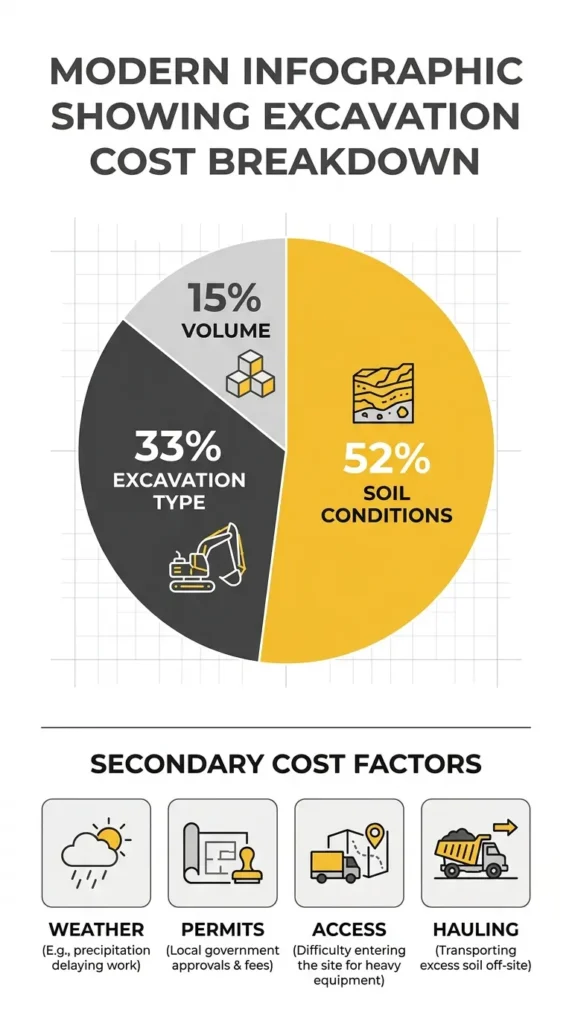
A 2023 study of six sewer-construction projects found that workability class accounted for 52% of the measured influence on earthwork price, excavation type and technology 33%, and excavated volume 15% in one evaluation approach. The researchers also found that the percentages changed under different excavation conditions, so these figures should be treated as a research finding rather than a universal cost formula.
What Makes Excavation Costs Go Up?
1. Difficult Soil and Rock Conditions
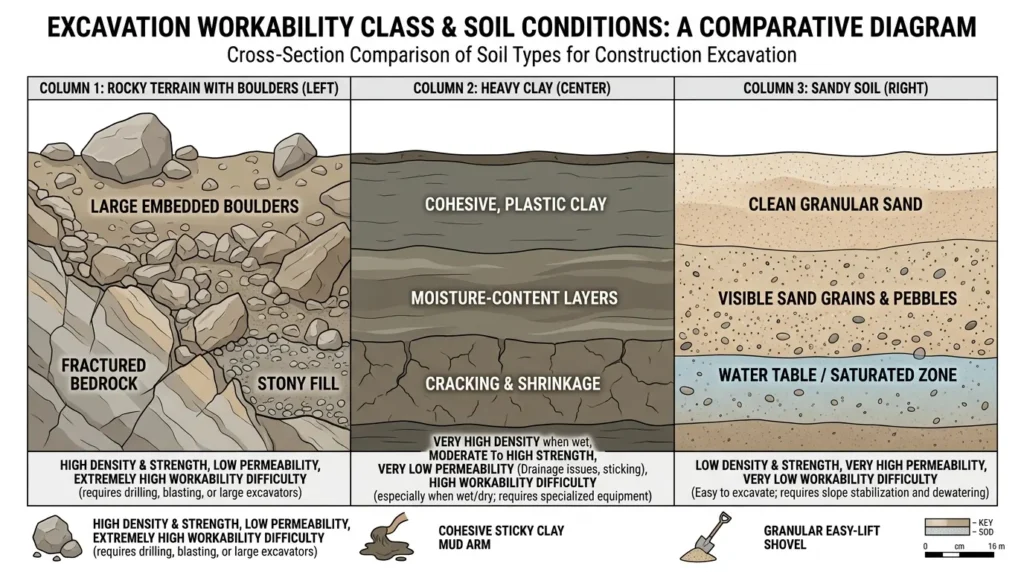
Soil condition is one of the most important factors affecting excavation cost. Loose soil may be relatively easy to remove, while dense clay, compacted fill, gravel, boulders, or bedrock can require slower excavation, heavier equipment, hydraulic breakers, or other specialized methods.
Rock is particularly expensive because ordinary bucket excavation may not be sufficient. Depending on the material, contractors may need hydraulic hammering, ripping, splitting, or controlled blasting.
Current residential cost guides also show a significant difference between ordinary excavation and difficult rock excavation. HomeGuide lists standard excavation at about $2.50–$15 per cubic yard, while rocky material requiring jackhammering can reach $50–$200+ per cubic yard.
Water can create another problem. Saturated or unstable soil may require pumping or dewatering before excavation can continue. It can also affect trench stability and the type of protective system required.
2. The Type of Excavation and Technology
The excavation method can substantially change the price even when the amount of soil is similar.
Open-area mass excavation usually gives equipment more room to work efficiently. A narrow utility trench, deep foundation excavation, or excavation between existing structures can require slower production and additional protection.
Research comparing excavation technologies found that shielded trench excavation was substantially more expensive than unshielded trench excavation in the studied projects. In one comparison, the shielded approach was 3.9 times the cost of the unshielded trench for a particular layer and volume. The study also found that excavation type and technology had a 66% influence in one separate evaluation of unshielded trench work, showing why the cost impact depends heavily on project conditions.
Technology also affects the equipment required. A project may need excavators of different sizes, hydraulic breakers, trench boxes, shoring systems, pumps, compactors, GPS machine control, or additional support equipment.
3. Excavation Volume and Earthwork Quantity
More material generally means more excavation, loading, hauling, and potentially disposal. However, volume alone does not determine the total price.
A large open site may allow an excavator to move substantial quantities efficiently, while a smaller excavation in a confined area can cost more per cubic yard because production is slower.
Another important issue is the difference between bank volume and loose volume. Soil expands after it is excavated, so the material occupying one cubic yard in the ground can require more space once loosened. That affects truck capacity, hauling requirements, and disposal quantities.
For accurate estimates, contractors should calculate the excavation volume first and then account for soil expansion, reuse, hauling, and required backfill.
Site Accessibility Can Increase Excavation Costs
4. Limited Access and Tight Working Space
Equipment needs room to enter, operate, load trucks, and safely move around the excavation. A backyard with a narrow gate may prevent the use of a full-size excavator, forcing the contractor to use a smaller machine with lower production.
Urban sites can be even more difficult because of traffic, pedestrians, neighboring properties, overhead lines, and limited areas for storing excavated material.
More difficult access can increase labor hours, equipment time, mobilization costs, and hauling time.
5. Existing Structures and Underground Utilities
Excavating next to a house, retaining wall, road, foundation, or other structure requires greater control than digging in an open field. The contractor may need to excavate more carefully to avoid undermining nearby foundations.
Underground utilities create another major cost and risk factor. Water, sewer, gas, electric, telecommunications, and other installations must be located before excavation, and some may need to be supported or protected during the work. OSHA specifically identifies underground installations and nearby structures as excavation hazards that must be considered during planning.
6. Slopes and Difficult Terrain
A steep or uneven site can reduce equipment productivity and make access, grading, drainage, and material handling more complicated.
Hillside excavation may require additional grading, retaining measures, temporary access roads, erosion control, or specialized equipment. The contractor may also need to move material greater distances because trucks cannot reach the excavation directly.
Hauling and Disposal Add to Excavation Costs
7. Soil Hauling and Disposal
Excavation does not end when the soil is removed from the ground. Excess material may need to be loaded, transported, and disposed of.
Costs can include:
- Loader or excavator loading time
- Dump truck transportation
- Fuel
- Truck waiting time
- Landfill or disposal fees
- Special handling for unsuitable or contaminated soil
For 2026, Angi reports typical dirt removal or hauling at roughly $8–$25 per cubic yard, although actual charges vary with distance, material, and local disposal facilities.
Keeping suitable excavated soil on-site can reduce hauling and disposal costs when the project design allows it.
8. Contaminated or Unsuitable Soil
Not every excavated material can be reused as backfill. Contaminated soil, organic material, wet material, debris-filled fill, or other unsuitable material may require special handling or disposal.
This can turn a simple excavation into a material-management project, especially when environmental testing or regulated disposal is required.
Backfill and Compaction Requirements
Excavation costs can also rise after digging is complete.
If excavated soil cannot be reused, approved fill may need to be purchased and delivered. The contractor then has to place and compact the material in controlled lifts.
Backfill may therefore include:
Imported material + transportation + placement + moisture conditioning + compaction + testing
Projects involving foundations, utilities, roads, and structural slabs often have specific compaction requirements. These requirements can add equipment, labor, and testing costs to the excavation scope.
Permits, Inspections, and Regulatory Requirements
9. Permits and Site Compliance
Some excavation projects require grading permits, right-of-way permits, erosion-control measures, utility coordination, inspections, or environmental approvals.
These costs depend heavily on location and project type. Current 2026 cost guidance from Angi places land surveys and permits at roughly $50–$550 in typical residential projects, while soil testing and cleanup can add considerably more.
Large commercial or environmentally sensitive projects can have substantially higher compliance costs.
10. Shoring, Sloping, and Trench Protection
Deep excavation is not simply a matter of digging deeper. Worker protection can require sloping, benching, shoring, or shielding based on the excavation and soil conditions.
OSHA requires employees in qualifying excavations to be protected from cave-ins, with exceptions including excavations entirely in stable rock or certain excavations less than 5 feet deep where a competent person finds no indication of a cave-in hazard.
OSHA also requires soil classification and appropriate protective-system decisions under its excavation standard. Protective options include sloping, benching, shoring, and shielding such as trench boxes.
These measures add equipment, engineering, installation, inspection, and labor costs, but they are safety requirements rather than optional upgrades.
Project Schedule and Weather Can Increase Costs
11. Tight Deadlines and Overtime
A compressed construction schedule can increase excavation costs when additional crews, longer shifts, or overtime are required.
Equipment and operators are often paid based on time in use. When excavation takes longer than expected because production is restricted, total equipment and labor costs increase.
For 2026, HomeGuide reports excavator-and-operator rates of approximately $100–$300 per hour, while Angi reports labor around $120–$150 per hour in its current cost data. These published figures vary because pricing depends on location, equipment, scope, and whether the rate includes the operator and other costs.
12. Rain, Water, and Seasonal Conditions
Heavy rain can slow production, create standing water, soften access roads, and increase the risk of unstable excavation walls.
OSHA specifically requires excavation inspections after rainstorms and calls for precautions when water accumulates in an excavation.
Weather-related delays can therefore increase costs through additional pumping, regrading, equipment time, labor, and schedule extensions.
How Much Does Excavation Cost?
There is no single excavation price because the scope varies significantly from one project to another.
Current 2026 published residential cost guides show different ranges. HomeGuide reports approximately $1,100–$5,600 as an average total excavation cost, with standard excavation around $2.50–$15 per cubic yard and excavator-and-operator rates around $100–$300 per hour.
Angi’s September 2026 data places typical residential excavation at approximately $1,658–$6,712, with labor, accessibility, soil, hauling, permits, and grading affecting the final price.
Some published local and residential guides still cite about $3,200 as an average project cost, with very broad totals depending on project type and site conditions.
The important point is that a published average should be used only as a starting benchmark. A contractor’s site-specific estimate is more useful because it accounts for actual soil, depth, access, equipment, hauling distance, and project requirements.
How to Keep Excavation Costs Under Control?
The easiest way to control excavation costs is to identify expensive conditions before equipment arrives.
A soil or geotechnical investigation can reveal soil composition, groundwater, rock, and other subsurface conditions. Proper site planning can then determine excavation dimensions, equipment requirements, access routes, material reuse, and disposal needs before work begins.
Keeping suitable soil on-site can reduce hauling. Providing good equipment access can improve production. Accurate quantity calculations can prevent underestimating spoil volume. Early utility locating can reduce the risk of delays and damage.
The objective is not simply to find the lowest excavation rate. It is to minimize the number of unexpected cost drivers that appear after digging starts.
FAQ
Why does rocky soil cost more to excavate?
Rock is harder to break and remove than ordinary soil and may require hydraulic hammering, ripping, splitting, or blasting. Current cost guidance shows that rock excavation can cost substantially more per cubic yard than standard soil excavation.
Is excavation volume the biggest factor in cost?
Not necessarily. A research study found workability class had the greatest measured influence in one evaluation, followed by excavation type and technology, with volume having the smallest influence of those three factors. However, the study’s percentages changed under different project conditions and should not be treated as a universal pricing formula.
Does difficult access increase excavation costs?
Yes. Limited access can require smaller equipment, slower excavation, additional labor, longer loading times, or more equipment movements. Current cost data also identifies accessibility as a major factor in residential excavation pricing.
Why does water increase excavation costs?
Groundwater and accumulated water can slow digging, destabilize soil, and require pumping or other water-control measures. Excavation safety requirements also call for appropriate precautions when water accumulation creates hazards.
How can I reduce excavation costs?
Get subsurface information early, plan equipment access, calculate excavation and spoil volumes accurately, determine whether excavated soil can be reused, and identify utility and regulatory requirements before excavation begins. These steps reduce the likelihood of expensive changes once work is underway.
Final Takeaway
Excavation costs go up when the job becomes harder to dig, harder to access, harder to protect, or harder to dispose of. Soil and rock conditions, excavation technology, volume, site constraints, underground utilities, hauling, backfill, water, shoring, permits, and weather can all increase the final price.
The most reliable estimate comes from evaluating these conditions before excavation begins rather than relying on a single per-cubic-yard or hourly rate.

Ahmed Ijaz runs this construction rental directory with over 5 years of experience in SEO, content, and web optimization. Every page is built using real research, hands-on expertise, and carefully reviewed information to meet strong EEAT standards.