Excavation cost per day typically ranges from $400 to $1,200+ in the U.S., depending on excavator size, soil conditions, site access, operator costs, fuel, transportation, and project requirements.
Small mini excavators usually cost less per day, while larger hydraulic excavators have higher rental rates but can move more material and complete large projects faster.
As a general benchmark, U.S. equipment rental and minimum charges can commonly fall around $400–$1,200+ per day, depending on machine size, location, and whether an operator is included.
Average Excavation Cost Per Day
| Excavator Type | Typical Daily Cost |
|---|---|
| Mini excavator | $300–$700 |
| Small excavator | $400–$800 |
| Medium excavator | $500–$1,000 |
| Large excavator | $800–$1,500+ |
These are general U.S. rental ranges. The final price may be higher when operator labor, fuel, delivery, attachments, mobilization, taxes, or other charges are added.
Factors That Affect Excavation Cost Per Day
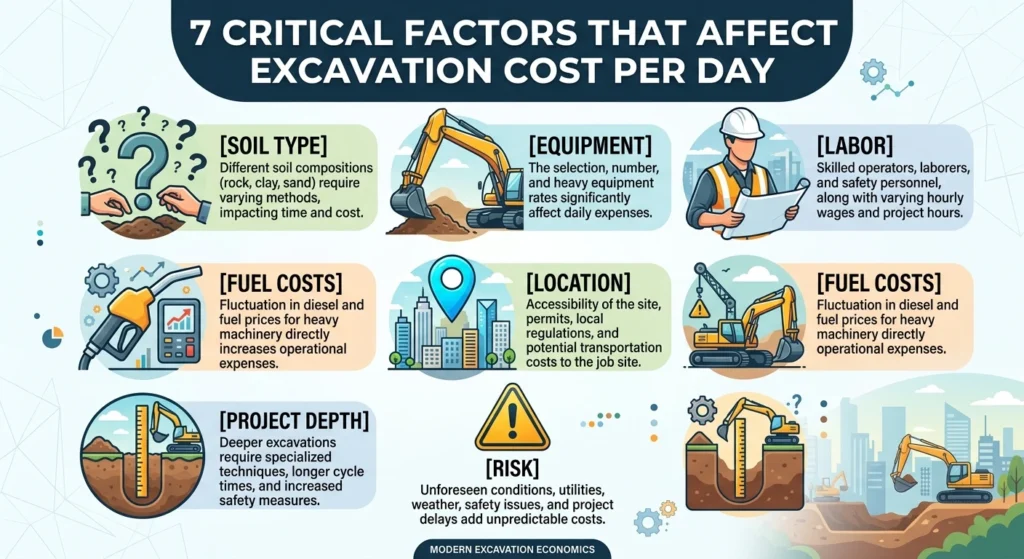
There is no single excavation cost per day that applies to every project. The following factors have the biggest impact on daily pricing.
1. Soil Type and Ground Conditions
Soft or common soil is generally easier and faster to excavate than compacted clay, gravel, boulders, or solid rock. Rock excavation may require hydraulic breakers, specialized attachments, drilling, or blasting, substantially increasing the cost.
2. Excavator Size and Equipment Selection
The equipment used directly affects your daily excavation cost.
A small mini excavator may be economical for residential landscaping, utility trenches, and restricted sites. A medium or large hydraulic excavator is better suited to foundations, large earthmoving projects, and high-volume excavation.
Important equipment factors include:
- Excavator operating weight
- Bucket capacity
- Digging depth
- Hydraulic power
- Attachment type
- Fuel consumption
- Loading and hauling requirements
The cheapest machine per day is not always the cheapest option overall.
3. Operator and Labor Costs
Labor is another major component of the excavation budget.
If the rental price does not include an operator, you may need to pay separately for a qualified excavator operator. Additional laborers may also be needed for signaling, measuring, utility work, site cleanup, or manual excavation.
Your total daily labor cost can therefore include:
- Excavator operator
- General laborers
- Site supervisor
- Equipment support
Always confirm whether operator and labor costs are included in the quoted excavator daily rate.
4. Project Depth and Site Accessibility
Excavating a shallow open area is usually easier than digging a deep or restricted excavation.
Deep excavation may require additional safety measures, shoring, sloping, trench protection, or dewatering when groundwater is present.
Site accessibility also affects productivity. Tight spaces, overhead obstructions, narrow entrances, poor ground conditions, and obstacles can prevent an excavator from working efficiently.
5. Fuel and Operating Costs
Fuel can represent a significant portion of the daily operating cost.
The amount of fuel consumed depends on:
- Machine size
- Engine efficiency
- Work intensity
- Idle time
- Soil conditions
- Operator efficiency
- Number of working hours
Some rental agreements include fuel or operating expenses, while others do not. Before accepting a quote, ask specifically whether fuel, delivery, pickup, and operator costs are included.
6. Location and Local Market Rates
Excavation prices vary considerably by location.
Urban areas may have higher labor, transportation, equipment, and disposal costs. Remote projects can also become expensive because machinery must travel farther to reach the site.
For an accurate estimate, always compare quotes from contractors operating in your specific area rather than relying entirely on national averages.
7. Risk, Delays, and Unexpected Conditions
Excavation involves several risks that can increase the daily cost.
Unexpected rock, groundwater, buried utilities, mechanical breakdowns, extreme weather, unstable soil, or difficult access can reduce productivity and extend the project schedule.
For this reason, professional estimates often include a contingency allowance rather than assuming ideal working conditions every day.
How to Calculate Excavation Cost Per Day?
There are two practical approaches to estimating excavation cost per day.
Method 1: Machine Rental Basis
The simplest calculation is:
Excavation Cost Per Day = Daily Equipment Rental + Operator + Fuel + Other Daily Costs
Example of Daily Excavation Cost
Suppose a medium excavator costs $800 per day, the operator costs $400 per day, fuel costs $150 per day, and transportation costs $250.
The estimated daily cost would be:
$800 + $400 + $150 + $250 = $1,600
So the estimated excavation cost is $1,600 for the day.
Actual costs will vary depending on the rental agreement, project location, machine size, working hours, and site conditions.
Method 2: Productivity and Rate Analysis
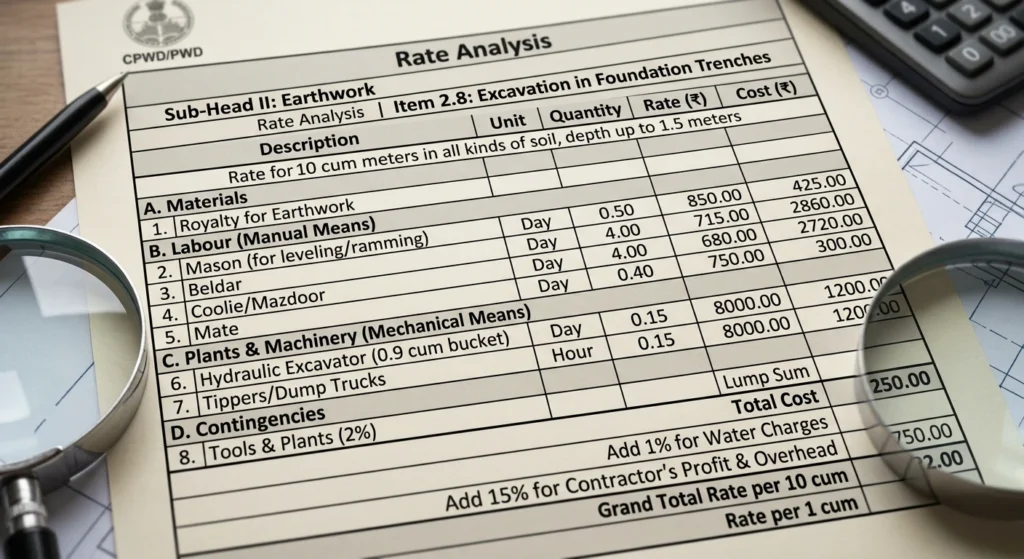
A more accurate approach is to calculate the machine’s daily production.
Daily Output = Hourly Production × Productive Working Hours
For example, if an excavator produces 50 cubic yards per hour and operates for 8 productive hours:
50 × 8 = 400 cubic yards/day
You can then calculate the excavation cost per cubic yard:
Excavation Cost Per Cubic Yard = Total Daily Cost ÷ Cubic Yards Excavated Per Day
For example, if the total daily excavation cost is $1,600 and the excavator removes 400 cubic yards per day:
$1,600 ÷ 400 = $4 per cubic yard
Example Excavation Estimate
Suppose a project requires 1,500 cubic yards of excavation and the excavator can remove approximately 250 cubic yards per day under the site’s actual conditions.
1,500 ÷ 250 = 6 working days
If the excavation-related cost is $1,000 per day:
6 × $1,000 = $6,000
Additional expenses such as hauling, disposal, mobilization, grading, or dewatering may increase the final project cost.
Excavation Cost Per Day: Machine vs. Manual Labor
Choosing between machine excavation and manual excavation depends primarily on project size and accessibility.
Machine Excavation
Machine excavation is generally the better choice for large volumes of soil.
Advantages:
- High productivity
- Faster project completion
- Suitable for large excavation areas
- Consistent digging performance
- Lower unit cost for high-volume work
Disadvantages:
- Higher daily fixed cost
- Requires site access
- Transportation or mobilization costs
- May require a qualified operator
Manual Excavation
Manual excavation can make sense for small areas where machinery cannot safely or economically operate.
Advantages:
- Useful in confined spaces
- No large machinery required
- Suitable for delicate work around existing structures
- Can be practical for very small quantities
Disadvantages:
- Much lower productivity
- Higher cost per cubic meter for larger projects
- More labor-intensive
- Project completion can take considerably longer
For large-volume excavation, machinery generally provides much better productivity. For small or inaccessible areas, manual labor may be more practical.
Excavation Cost Per Hour
You can estimate the hourly excavation cost by dividing the total daily cost by the number of productive working hours.
Hourly Excavation Cost = Total Daily Cost ÷ Productive Hours
For example, if the total daily cost is $1,600 and the excavator completes 8 productive hours:
$1,600 ÷ 8 = $200 per hour
This is only a basic estimate. Actual hourly costs can change based on equipment size, operator costs, fuel, site conditions, and productivity.
For a more detailed breakdown, see our guide to excavation cost per hour.
Excavation Cost Per Cubic Yard
Cost per cubic yard is often more useful than the daily equipment rate when comparing excavation contractors.
Use this formula:
Excavation Cost Per Cubic Yard = Total Excavation Cost ÷ Cubic Yards Excavated
For example, if excavation costs $6,000 and the contractor removes 1,500 cubic yards:
$6,000 ÷ 1,500 = $4 per cubic yard
However, the final project price may also include hauling, disposal, grading, mobilization, labor, and other costs.
How to Reduce Your Excavation Cost Per Day?
A lower daily rate does not necessarily mean a lower total project cost. The goal should be to maximize productive output per day.
Choose the Right Excavator
Avoid using a machine that is significantly larger than necessary. At the same time, an undersized excavator can increase the number of rental days.
Select equipment based on:
- Required digging depth
- Bucket capacity
- Soil conditions
- Site access
- Required production
- Hauling requirements
Reduce Machine Idle Time
An excavator costs money even when it is sitting idle.
Coordinate trucks, laborers, surveying, fuel delivery, and site preparation so the machine can work continuously during scheduled hours.
Improve Site Layout
Efficient positioning can reduce unnecessary machine movement and swing time.
Keeping trucks in a convenient loading position and maintaining clear access can increase daily productivity.
Compare Daily and Project-Based Pricing
For a one-day job, a standard daily rental may be appropriate. For projects lasting several days or weeks, ask contractors about discounted multi-day or project-based rates.
For example, a contractor might charge a higher one-day rate but offer a lower daily rate for a week-long project.
Confirm What’s Included
Before comparing quotes, check whether each price includes:
- Operator
- Fuel
- Delivery
- Pickup
- Attachments
- Mobilization
- Insurance
- Taxes
- Minimum rental hours
- Overtime
A quote that appears cheaper may become more expensive after these charges are added.
Excavation Cost Per Day vs. Excavation Cost Per Cubic Meter
Daily pricing is useful for equipment rental, but cost per cubic meter is often more useful for comparing project efficiency.
For example:
Contractor A: $800/day and excavates 200 cubic yards/day
Cost: $4/cubic yard
Contractor B: $1,000/day and excavates 400 cubic yards/day
Cost: $2.50/cubic yard
Although Contractor B has the higher daily rate, the higher productivity makes the excavation cheaper per cubic meter.
This is why you should evaluate both daily equipment cost and daily production when comparing excavation bids.
What Is Included in an Excavation Quote?
An excavation quote may include some or all of the following:
- Equipment rental
- Excavator operator
- Fuel
- Labor
- Mobilization
- Demobilization
- Excavation
- Loading
- Soil transportation
- Disposal
- Grading
- Dewatering
- Site cleanup
Always request an itemized quote so you can identify additional charges before the project begins.
Quick Excavation Cost Formula
Then show only:
Daily Cost = Equipment + Operator + Fuel + Labor + Transportation
Project Cost = Daily Cost × Working Days
Cost Per Cubic Yard = Total Cost ÷ Cubic Yards Excavated
Frequently Asked Questions
What is the average cost of excavation per day?
Excavation cost per day commonly ranges from about $400 to $1,200+ in the U.S., depending on excavator size, location, operator, fuel, transportation, and rental terms.
How is excavation cost calculated?
Excavation cost can be calculated using the daily equipment rate or by performing a detailed rate analysis. A basic formula is:
Daily Cost = Equipment + Operator + Fuel + Labor + Transportation + Other Costs
What is the daily output of an excavator?
Daily output depends on excavator size, bucket capacity, soil type, digging depth, operator skill, truck availability, and site layout. A medium excavator may potentially produce several hundred cubic meters per day in favorable common-soil conditions, but actual production can be considerably lower on difficult sites.
Why is rock excavation more expensive?
Rock requires more time and specialized equipment than ordinary soil. Hydraulic breakers, drilling, blasting, additional labor, slower production, and hauling can all increase the excavation cost.
Is it cheaper to rent an excavator by the day or by the project?
For short jobs, daily rental can be convenient. For larger projects, a contractor may offer a better project-based or multi-day rate. Always compare the total project cost and expected productivity, not just the advertised daily rate.
Does excavator rental include an operator?
It depends on the rental agreement. Some suppliers provide equipment only, while others offer operated excavation services. Always confirm whether the operator, fuel, delivery, and other charges are included.
How can I get an accurate excavation cost per day?
Provide the contractor with the project location, estimated excavation volume, soil type, required depth, site access conditions, expected duration, and whether excavated material must be hauled away. Request an itemized quote showing equipment, labor, fuel, transportation, and disposal costs.
Final Thoughts
Excavation cost per day depends on much more than the excavator’s rental price. Soil conditions, machine size, labor, fuel, project depth, accessibility, location, and productivity all influence the final cost.
For a quick estimate, start with the daily equipment and operator rate. For a more accurate construction budget, calculate expected daily production and convert the cost into a per-cubic-yard rate.
The most economical excavation solution is usually not the machine with the lowest daily rental price—it is the equipment and crew combination that can complete the required work efficiently with minimal idle time, delays, and unexpected costs.

Ahmed Ijaz runs this construction rental directory with over 5 years of experience in SEO, content, and web optimization. Every page is built using real research, hands-on expertise, and carefully reviewed information to meet strong EEAT standards.