Excavation on a sloped lot can cost more than excavation on a flat lot because the project often involves cut-and-fill work, difficult equipment access, retaining structures, specialized foundations, drainage, and additional soil disposal.
As a planning figure, basic excavation and grading may fall around $3–$15 per cubic yard in relatively accessible soil, but difficult slopes, rocky ground, restricted access, or extensive hauling can push costs considerably higher. Current contractor pricing examples show that sloped-site excavation can reach the upper end of that range or beyond when conditions are difficult.
The important point is that the excavation price alone does not represent the total cost of making a sloped lot buildable. Retaining walls, drainage, foundations, engineering, and disposal can become major additional expenses.
Sloped Lot Excavation Cost at a Glance
| Factor | Typical effect on cost |
|---|---|
| Gentle slope | Minor additional grading and cut-and-fill |
| Moderate slope | More excavation, fill, drainage, and potentially retaining walls |
| Steep slope | Significant earthwork, engineered retaining, specialized foundations, and access challenges |
| Rocky soil | Requires ripping, hammering, or other rock-removal methods |
| Limited access | Smaller equipment and additional hauling/staging |
| Excess excavated soil | Adds loading, transportation, and disposal costs |
There is no reliable single price for every sloped property because the final excavation cost depends on slope percentage, excavation volume, soil and rock conditions, equipment access, finished grades, foundation design, and where excess material can be disposed of.
Why Does Excavation Cost More on a Sloped Lot?
The main relationship is:
Slope → More earthwork → More structural requirements → Higher site-preparation cost
A flat lot may require relatively straightforward excavation for a foundation. A sloped lot often requires the contractor to reshape the existing terrain before construction can begin.
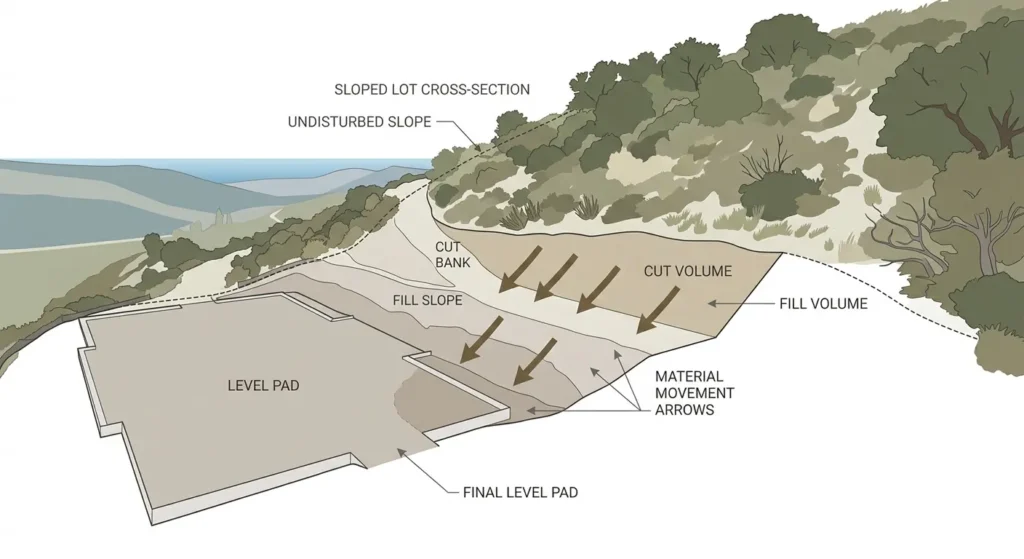
Cut-and-Fill Excavation
The most common approach is to cut soil from the higher part of the property and use it to fill the lower section.
Ideally, the amount of material excavated roughly matches the amount needed for fill. This is called balanced cut-and-fill.
When the quantities do not balance, the project may need:
- Imported fill
- Additional compaction
- Off-site soil disposal
- More truck trips
- Temporary stockpiling
- Additional grading
That means the contractor is potentially being paid not only to dig the material but also to move it, process it, place it, compact it, or haul it away.
Slope Steepness
The steeper the lot, the greater the engineering and earthwork challenge.
A gentle slope may need only limited grading. A steeper property may require a combination of:
- Benched excavation
- Stepped foundations
- Retaining walls
- Soil reinforcement
- Drainage systems
- Specialized equipment
- Engineered access roads
For very steep sites, the project can shift from simple bulk excavation to carefully controlled structural earthwork.
How Soil and Rock Affect Sloped Lot Excavation Cost?
Soil conditions can change both the excavation method and the equipment required.
Loose or relatively easy-to-excavate soil can generally be removed with conventional excavation equipment. Dense soil, clay, cemented material, boulders, or bedrock can require additional passes, hydraulic breakers, ripping, or specialized equipment.
The USDA notes that soil information can reveal characteristics such as slope, depth to bedrock, water table, soil texture, structure, and other conditions relevant to land use.
Typical Planning Ranges
For accessible soil, some current contractor pricing examples place excavation around $2.50–$15 per cubic yard, depending heavily on site conditions. These figures should be treated as planning ranges rather than universal rates.
Rock excavation is substantially different from ordinary soil excavation because the contractor may need to rip or break the material before it can be loaded and removed.
Unexpected rock is one of the conditions most likely to change an excavation quote.
For that reason, soil and geotechnical information should be obtained before finalizing a major excavation budget.
How Site Access Changes the Cost?
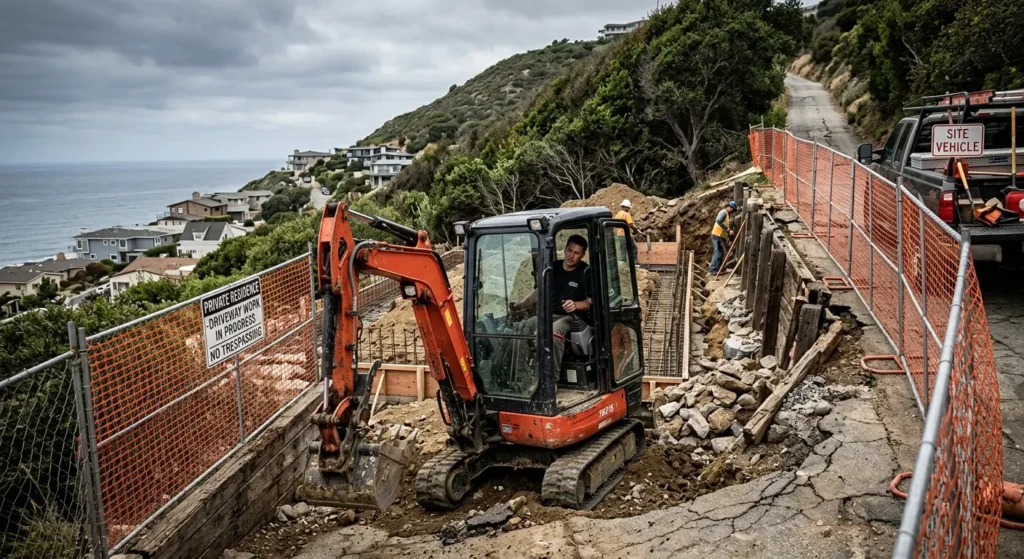
Equipment access is particularly important on sloped properties.
A large excavator and dump truck may work efficiently on an open, relatively level site. A steep property with a narrow driveway or restricted working area may not provide enough room for conventional equipment.
The contractor may then need to:
- Use smaller machinery
- Make additional passes
- Create temporary access
- Stage excavated material
- Use smaller trucks
- Move soil multiple times
These additional handling steps increase labor and equipment time.
Current mountain-lot excavation guidance also identifies tight access and smaller equipment as important reasons that excavation can cost more per cubic yard.
Additional Costs After Excavation
Excavation is often only the first part of the sitework on a sloped lot.
The major cost relationship is:
Excavation → Retaining → Foundation → Drainage
Retaining Walls
A retaining wall may be necessary when excavation creates a vertical or near-vertical change in elevation that cannot safely remain as an unsupported slope.
Retaining structures are commonly used to stabilize steep slopes and prevent soil movement.
The final price depends on:
- Wall height
- Wall length
- Soil pressure
- Foundation requirements
- Reinforcement
- Drainage
- Material
- Site access
- Engineering requirements
Current residential contractor examples show retaining-wall projects ranging from several thousand dollars to tens of thousands of dollars, with substantially larger projects possible on long or tall engineered walls.
Stepped Foundations
A conventional slab or foundation designed for flat ground may not work efficiently on a steep property.
Depending on the site and structural design, the foundation may use:
- Stepped footings
- Piers
- Deep foundations
- Retaining foundation walls
- Walkout basement construction
Stepped foundations allow different portions of the foundation to follow changing elevations rather than excavating the entire building area to one depth.
This can reduce unnecessary excavation, but it increases foundation layout and construction complexity.
Drainage and Erosion Control
Water is another major concern on sloped properties.
Excavation changes the natural surface of the site, potentially changing how water flows toward the building or across exposed soil.
Possible drainage measures include:
- Surface swales
- French drains
- Underdrains
- Toe drains
- Collection systems
- Downspout drainage
- Retaining-wall drainage
- Erosion-control measures
USDA guidance for slope protection identifies drainage measures such as cutoff trenches, underdrains, toe drains, drainage blankets, and horizontal drains as methods used to manage water and improve slope stability.
This is why drainage should be considered during excavation planning rather than added after the grading plan is complete.
Disposal and Hauling Costs
Excess soil can become one of the largest hidden costs on a sloped excavation project.
Suppose excavation produces more material than can be reused on the property. That excess material must be:
- Loaded.
- Transported.
- Taken to an appropriate disposal or fill site.
- Unloaded.
Limited-access properties can make this even more expensive because trucks may not be able to reach the excavation directly.
Conversely, if the project needs more suitable fill than the excavation produces, the contractor may have to purchase, deliver, place, and compact imported material.
So the cheapest excavation plan is often the one that minimizes unnecessary soil movement.
How Much Does a Sloped Lot Add to the Project?
There is no universal percentage because the additional cost comes from several independent factors.
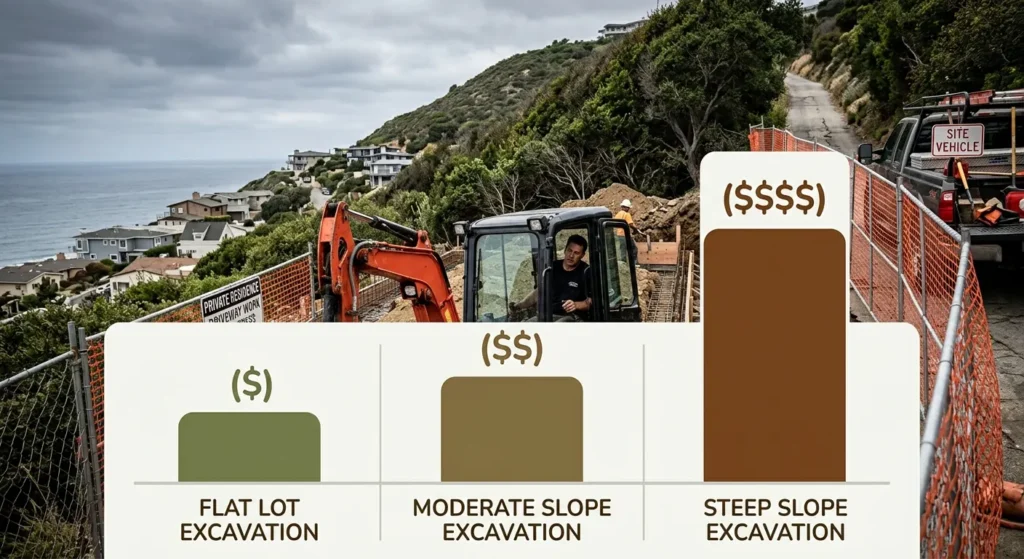
A gentle slope may require only modest additional grading.
A moderate slope can require significant cut-and-fill work, drainage improvements, and possibly retaining walls.
A steep slope may require engineered retaining structures, specialized foundations, difficult excavation, and extensive site drainage.
For this reason, saying that every sloped lot costs exactly “15%–40% more” would be misleading. Two properties with the same slope percentage can have very different costs because of soil, access, building footprint, and design.
Sloped Lot Excavation Cost Scenarios
Scenario 1: Gentle Slope
Typical conditions:
- Relatively easy equipment access
- Stable soil
- Small elevation difference
- Limited cut-and-fill
- No major retaining wall
The excavation premium may be relatively small because most of the work remains conventional grading and foundation excavation.
Scenario 2: Moderate Slope
Typical conditions:
- Significant elevation change
- Cut-and-fill required
- Some imported or exported soil
- Drainage improvements
- Possible retaining wall
- More complicated foundation excavation
This type of property can produce a substantial increase in total sitework costs compared with a similar flat lot.
Scenario 3: Steep Slope
Typical conditions:
- Benched or terraced excavation
- Restricted equipment access
- Engineered retaining walls
- Stepped, pier, or other specialized foundation
- Extensive drainage
- Potential rock excavation
At this point, the project should be priced as a complete slope-development project, rather than simply multiplying a normal excavation rate by the number of cubic yards.
How to Reduce Excavation Costs on a Sloped Lot?
1. Get a Topographic or Contour Survey
Before designing the house, establish the actual elevations across the property.
A contour survey can show where the natural grade rises and falls and help the designer position the building to reduce unnecessary earthwork.
2. Perform Geotechnical Testing Early
Soil information can identify potential issues involving bedrock, groundwater, soil characteristics, and slope conditions. USDA soil-survey resources can provide useful preliminary information, although project-specific engineering may still be required.
3. Design Around the Existing Terrain
Instead of forcing a steep lot into one large flat pad, consider whether a:
- Split-level design
- Stepped foundation
- Terraced layout
- Walkout basement
can better follow the natural grade.
The right design can reduce unnecessary cutting, filling, and soil disposal.
4. Balance Cut and Fill
If suitable excavated material can be reused on-site, you may reduce both disposal and imported-fill costs.
However, material should only be reused when it meets the project’s engineering and compaction requirements.
5. Plan Drainage Before Excavation
Do not wait until excavation is finished to determine where water will go.
Drainage should be coordinated with the grading, foundation, retaining walls, and final site elevations.
Frequently Asked Questions
Does excavation cost more on a sloped lot?
Usually, yes, but the amount varies significantly. Slopes can increase excavation costs through additional cut-and-fill, restricted equipment access, soil handling, retaining structures, foundations, and drainage.
How much does it cost to excavate a hill for a house?
The answer depends primarily on the volume of material, slope, soil or rock, equipment access, foundation design, and disposal requirements. A simple excavation rate alone cannot accurately price a hillside house site.
Is a retaining wall always required on a sloped lot?
No. Some slopes can be graded to a stable angle without a retaining wall. Retaining structures become more relevant when the design requires a significant elevation change or when available space does not allow the slope to be laid back sufficiently.
Is it cheaper to build on a sloped lot?
The land itself may be less expensive, but that does not necessarily make the completed project cheaper. Additional excavation, foundation work, retaining walls, drainage, access, and engineering can offset or exceed the land-price difference.
What is the biggest hidden cost of sloped excavation?
There is no single hidden cost for every property. Excess soil disposal, retaining walls, drainage, difficult access, and unexpected rock are among the most important potential cost increases.
Can you excavate a sloped lot yourself?
Minor landscaping work may be possible for an experienced property owner, but excavation associated with a house foundation, retaining wall, or slope stabilization is a different matter. Structural excavation should follow the project’s engineering, safety, grading, and local permitting requirements.
Bottom Line
Excavation on a sloped lot is priced by more than the amount of dirt removed. The slope affects the entire site-development sequence:
Slope → Cut-and-fill volume → Equipment access → Retaining/foundation requirements → Drainage → Disposal
For an accurate estimate, measure the existing elevations, investigate the soil and groundwater conditions, calculate cut-and-fill quantities, evaluate equipment access, and determine whether retaining walls or specialized foundations are required.
The most useful quote is therefore not simply “$X per cubic yard.” Ask the contractor to break the estimate into excavation, grading, imported fill, disposal, hauling, retaining, drainage, and foundation-related work so you can see exactly where the sloped-lot premium comes from.

Ahmed Ijaz runs this construction rental directory with over 5 years of experience in SEO, content, and web optimization. Every page is built using real research, hands-on expertise, and carefully reviewed information to meet strong EEAT standards.