The number of dump truck loads you need depends on the volume of material, its weight, and the truck’s actual carrying capacity. To calculate dump truck loads, divide the total loose material volume by the truck’s capacity and round up to the next whole load. Most small residential projects need one to five loads, while large excavation projects may require dozens or hundreds of trips.
How to Calculate Dump Truck Loads?
Use this formula to estimate the number of dump truck loads required for soil, gravel, sand, crushed stone, or other construction materials:
Dump Truck Loads = Total Loose Cubic Yards ÷ Truck Capacity in Cubic Yards
Always round up the result because a partial load still requires a truck trip.
For example, if your project requires 30 cubic yards of material and your dump truck holds 12 cubic yards:
30 ÷ 12 = 2.5 loads
You need 3 dump truck loads to deliver the full quantity.
However, if your project volume is measured before excavation or compaction, you may need to adjust it before using this formula.
Step 1: Calculate the Project Volume in Cubic Yards
Measure the length, width, and depth of the area you need to fill or excavate. Convert all measurements to feet and use this formula:
Cubic Yards = Length × Width × Depth ÷ 27
One cubic yard equals 27 cubic feet.
For example, suppose you need a driveway base measuring 20 feet long, 10 feet wide, and 6 inches deep.
- Length: 20 feet
- Width: 10 feet
- Depth: 0.5 feet
Calculation:
20 × 10 × 0.5 ÷ 27 = 3.70 cubic yards
The driveway requires approximately 3.70 cubic yards of material in the measured state. If you are calculating excavated soil, account for soil expansion before determining the number of dump truck loads.
Step 2: Adjust for Soil Swell
Excavated soil usually occupies more space than it did in the ground. This increase in volume is called the swell factor.
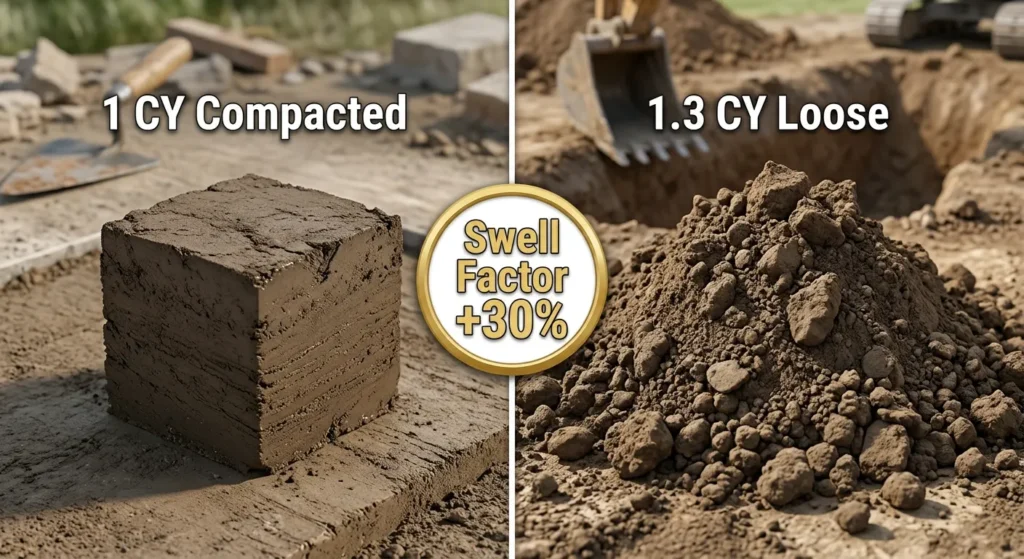
Typical planning estimates are:
| Material | Approximate swell factor |
|---|---|
| Sand and gravel | 10%–15% |
| Clay | 30%–40% |
| Mixed soil | Depends on composition |
These percentages are estimates. Actual swell depends on soil type, moisture, and ground conditions.
Use the following formula to calculate loose volume:
Loose Cubic Yards = In-Place Cubic Yards × (1 + Swell Factor)
For example, if you excavate 3.70 cubic yards of clay with a 30% swell factor:
3.70 × 1.30 = 4.81 loose cubic yards
You need to haul approximately 4.81 loose cubic yards of soil.
If your supplier has already calculated the loose volume, skip this step to avoid counting the expansion twice.
Step 3: Check the Dump Truck Capacity
The number of dump truck loads also depends on the size of the truck. Different trucks carry different amounts of material, and heavy loads may be limited by weight rather than the size of the truck bed.
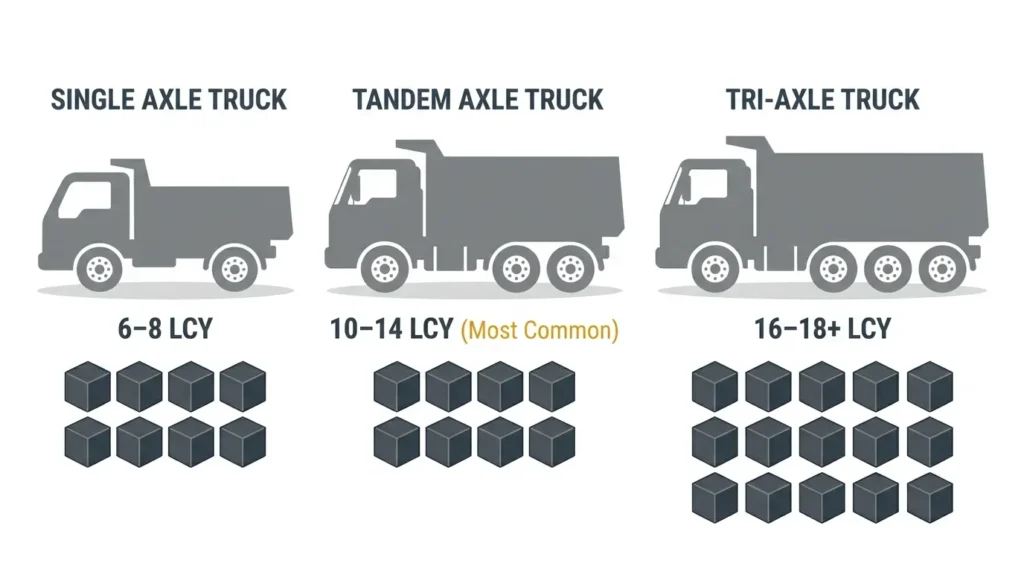
| Dump truck type | Approximate capacity |
|---|---|
| Single-axle dump truck | 6–8 cubic yards |
| Tandem-axle dump truck | 10–14 cubic yards |
| Tri-axle or larger dump truck | 16–18+ cubic yards |
These are general volume estimates, not guaranteed legal payloads. Actual capacity varies by truck configuration, body size, material density, and local weight restrictions.
For a quick estimate, you can use 12 cubic yards for a tandem-axle dump truck if your hauling company confirms that usable capacity.
Step 4: Divide the Volume by Truck Capacity
Once you know the loose volume and the truck capacity, divide the total cubic yards by the amount the truck can carry.
For example, assume your project requires 4.81 loose cubic yards and the truck holds 12 cubic yards.
4.81 ÷ 12 = 0.40 loads
Round up to 1 dump truck load.
For a larger project requiring 100 loose cubic yards, using the same truck:
100 ÷ 12 = 8.33 loads
You need 9 dump truck loads.
Step 5: Add Extra Material When Necessary
A small allowance can help cover measurement errors, spillage, uneven excavation, and variations in material requirements. A 5%–10% contingency may be suitable for preliminary estimates, depending on the project.
For example, if you need 100 loose cubic yards and add a 10% allowance:
100 × 1.10 = 110 cubic yards
With a 12-cubic-yard truck:
110 ÷ 12 = 9.17 loads
Round up to 10 dump truck loads.
Do not use a contingency allowance as a substitute for a proper swell or compaction calculation. The amount of material needed for a compacted driveway base or backfill may differ from the loose volume delivered by the truck.
How Many Dump Truck Loads Do I Need for Common Projects?
The following examples provide a starting point for estimating dump truck loads. Actual quantities depend on project dimensions, material type, and truck capacity.
| Project | Estimated initial volume | Example truck capacity | Estimated loads |
|---|---|---|---|
| Small garden bed, 10 × 10 ft × 6 in | 1.85 cubic yards | 8 cubic yards | 1 |
| Driveway base, 20 × 10 ft × 6 in | 3.70 cubic yards | 12 cubic yards | 1 |
| Pool excavation, 15 × 20 ft × 4 ft | 44.44 cubic yards | 12 cubic yards | 5* |
| Backfill area, 1,000 sq ft × 6 in | 18.52 cubic yards | 12 cubic yards | 2* |
The pool estimate assumes a 20% swell factor and 10% contingency. The backfill estimate assumes the stated volume is the required loose material volume and includes a 10% contingency. The garden bed and driveway estimates use the initial measured volume without additional swell or contingency. Real projects may require different quantities depending on the shape, soil conditions, and compaction requirements.
For more accurate planning, calculate the actual material volume first and then adjust for any expansion, compaction, or weight restrictions that apply.
Tons vs. Cubic Yards: What You Need to Know
Tons measure weight, while cubic yards measure volume. You cannot reliably calculate dump truck loads from tonnage alone without knowing the material’s approximate density.
Typical planning weights include:
| Material | Approximate weight per cubic yard |
|---|---|
| Topsoil | 1,800–2,100 pounds |
| Gravel | 2,800–3,000 pounds |
Actual weights vary with moisture, composition, and compaction.
To convert tons into cubic yards, use:
Cubic Yards = Tons × 2,000 ÷ Pounds per Cubic Yard
For example, 10 tons of gravel weighing 2,900 pounds per cubic yard equals:
10 × 2,000 ÷ 2,900 = 6.90 cubic yards
If the truck can legally carry that quantity, one trip may be sufficient.
Important: Dense materials such as gravel, crushed stone, and wet clay may reach the truck’s legal payload limit before filling its body. Confirm the permitted load with your hauling company.
Common Mistakes When Calculating Dump Truck Loads
Using the Wrong Volume
Dividing the original in-place soil volume by truck capacity can underestimate the amount of loose material produced during excavation.
Solution: Apply the appropriate swell factor when starting with compacted or in-place measurements.
Assuming Every Dump Truck Holds 12 Cubic Yards
A smaller truck may carry only 6–8 cubic yards, while larger trucks may carry more. Using an incorrect capacity can lead to an insufficient number of trips.
Solution: Confirm the actual usable capacity of the truck assigned to your project.
Rounding Down the Number of Loads
A calculation of 5.2 loads means six trips are needed to deliver the entire quantity when each trip is counted as a whole load.
Solution: Always round up to the next whole load.
Ignoring Material Weight
A truck may have enough space for the material but exceed its permitted payload.
Solution: Check both volume capacity and weight restrictions, particularly when hauling heavy aggregates or wet soil.
Frequently Asked Questions
How many cubic yards does a standard dump truck hold?
A tandem-axle dump truck commonly carries approximately 10–14 cubic yards by volume. Single-axle trucks may carry 6–8 cubic yards, while larger tri-axle trucks may carry 16–18 or more. Actual usable capacity depends on the truck and material weight.
How do I calculate dump truck loads from tons?
Convert the total tons into cubic yards using the material’s weight per cubic yard. Divide the resulting volume by the truck’s usable capacity and round up. Confirm that the load also meets the truck’s legal weight limit.
Does the type of material affect the number of dump truck loads?
Yes. Soil expands after excavation, and different materials have different densities. Clay may require a larger swell adjustment than sand, while heavy gravel can reach the truck’s payload limit before the truck bed is full.
How many dump truck loads do I need for 1,000 cubic yards?
If 1,000 cubic yards is the loose volume and each truck carries 12 cubic yards, you need 84 loads because 1,000 ÷ 12 equals 83.33. If the 1,000 cubic yards is measured in place and the soil has a 30% swell factor, the loose volume becomes 1,300 cubic yards, requiring 109 loads before any additional contingency.
Should I calculate dump truck loads using loose or compacted cubic yards?
Use loose cubic yards when dividing by a dump truck’s carrying capacity. If the project volume is measured in place, adjust it for soil swell before calculating hauling requirements. For delivered fill that must be compacted, account for the material needed to achieve the specified finished volume.
Conclusion
To determine how many dump truck loads you need, calculate the project volume, convert it to loose cubic yards when necessary, and divide by the truck’s actual usable capacity. Round up to the next whole trip and account for material density, soil swell, and any required contingency. Confirming the truck’s volume and weight limits before ordering helps you estimate delivery requirements more accurately and avoid unnecessary hauling costs.

Ahmed Ijaz runs this construction rental directory with over 5 years of experience in SEO, content, and web optimization. Every page is built using real research, hands-on expertise, and carefully reviewed information to meet strong EEAT standards.