A typical dump truck holds about 10 to 16 cubic yards of dirt, or roughly 12 to 22 tons, depending on the truck size, dirt density, moisture content, and legal weight limit. A truck may have enough bed space for more dirt, but its payload capacity can limit how much it can legally haul.
Dump Truck Dirt Capacity by Type
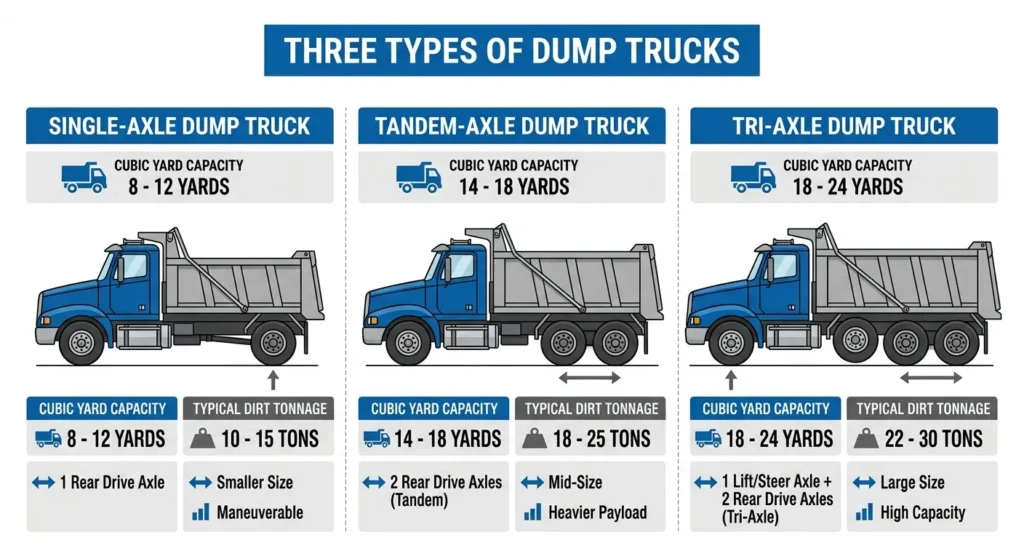
Dump truck capacity varies by truck configuration. The following ranges are common estimates for dirt hauling:
| Dump Truck Type | Typical Dirt Volume | Approx. Dirt Payload | Common Use |
|---|---|---|---|
| Single-axle dump truck | 10–14 cu yd | 10–15 tons | Small residential projects |
| Tandem-axle dump truck | 12–16 cu yd | 15–22 tons | Construction and landscaping |
| Tri-axle dump truck | 16–18 cu yd | 20–30+ tons* | Large earthmoving projects |
| End dump trailer | 20–26 cu yd | 20–30+ tons* | Large commercial projects |
*Actual payload depends on the truck’s GVWR, axle configuration, road restrictions, and the weight of the material.
For most residential and construction jobs, a tandem-axle dump truck carrying around 12–16 cubic yards is a practical reference point.
How Much Does a Cubic Yard of Dirt Weigh?
Dirt does not have one fixed weight. A cubic yard can weigh approximately 2,000 to 3,000 pounds, depending on its composition and moisture content.
Typical estimates include:
- Loose dry dirt: about 2,050 lb per cubic yard
- Loose moist dirt: about 2,100 lb per cubic yard
- Loam: about 2,160 lb per cubic yard
- Topsoil: about 2,000–2,400 lb per cubic yard
- Dry clay: about 2,700 lb per cubic yard
- Wet clay: about 2,970 lb per cubic yard
That means 10 cubic yards of dirt can weigh anywhere from roughly 10 to 15 tons, depending on the material.
How to Convert Cubic Yards of Dirt to Tons?
Use this formula:
Tons = Cubic Yards × Weight per Cubic Yard ÷ 2,000
For example, if dirt weighs 2,600 pounds per cubic yard:
10 × 2,600 ÷ 2,000 = 13 tons
For quick estimates, 1 cubic yard of average fill dirt is often approximated at about 1.2 tons, but using the actual material density gives a more accurate result.
Why a Dump Truck Cannot Always Carry a Full Bed of Dirt?
A dump truck’s capacity is limited by both volume and weight—whichever limit is reached first.
For example, a truck might physically have enough space for 16 cubic yards, but 16 cubic yards of wet clay could exceed its legal payload. In that situation, the driver must haul fewer cubic yards even though there is unused space in the bed.
This is why two truckloads with the same volume can have very different weights.
Moisture Makes a Big Difference
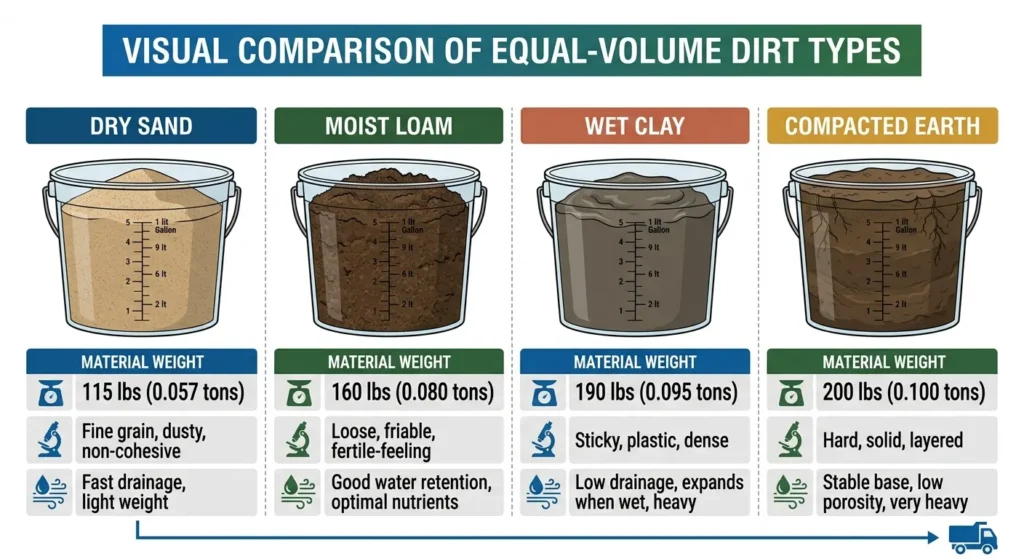
Wet soil weighs considerably more than loose, dry soil. Clay can also be much heavier than sandy or loamy material.
For this reason, ask the supplier whether the quoted capacity is based on cubic yards, tons, or a specific material weight.
Struck vs. Heaped Dump Truck Capacity
Dump truck capacity can also be described as struck or heaped.
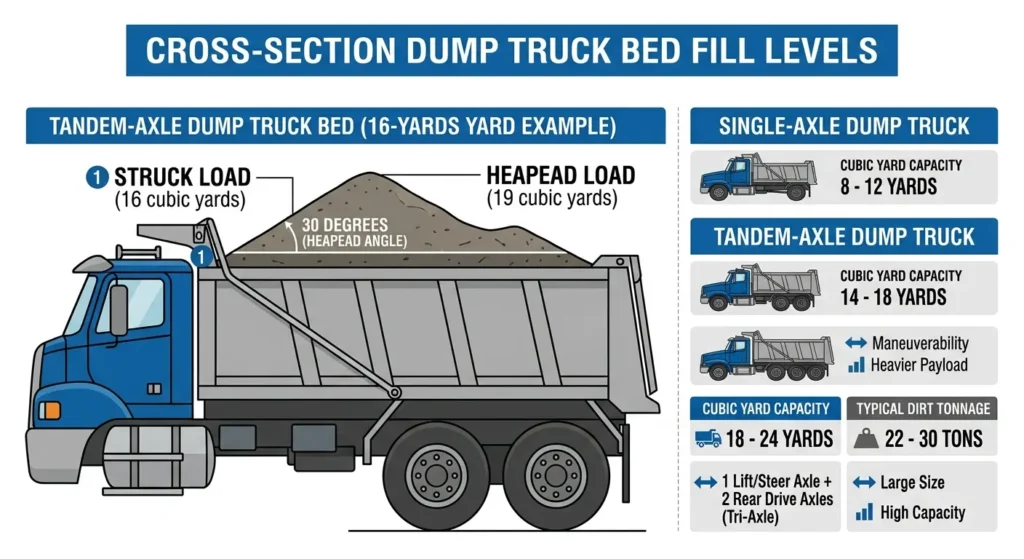
Struck capacity is the amount of material contained when the load is level with the top of the truck bed.
Heaped capacity includes material piled above the sides of the bed. A heaped load can contain significantly more material than a level load, but the additional weight may make it unsuitable for heavy dirt.
For heavy materials such as wet clay, the truck may need to run below its maximum volume to stay within its legal payload.
How Many Dump Truck Loads of Dirt Do You Need?
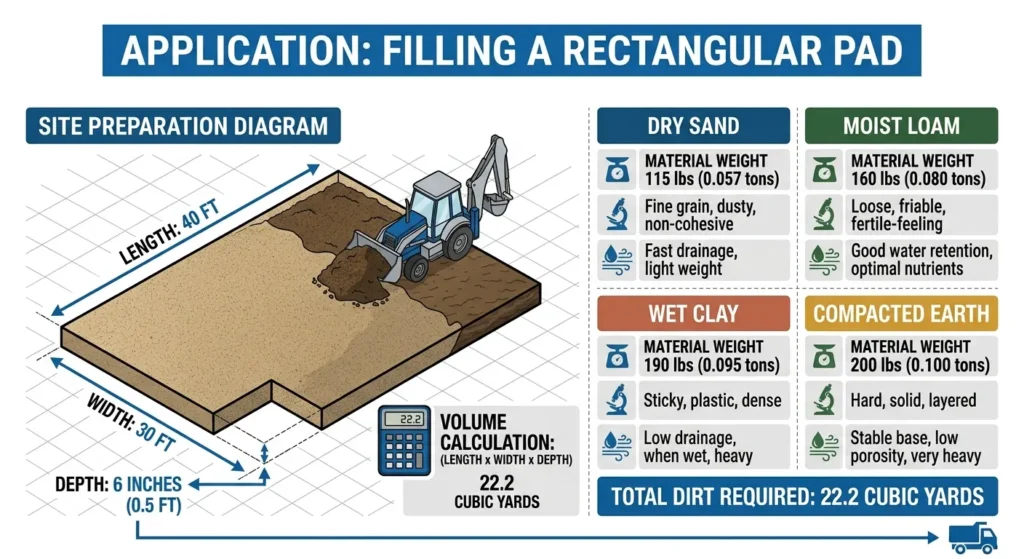
First, calculate how much dirt your project requires.
Step 1: Calculate Cubic Yards
Use:
Length × Width × Depth ÷ 27 = Cubic Yards
For example, a 40-foot × 30-foot area filled to a depth of 6 inches:
40 × 30 × 0.5 ÷ 27 = 22.2 cubic yards
Step 2: Allow for Settling or Compaction
Depending on the project, you may need additional material for settling, compaction, grading, and waste. A 10–15% allowance is a reasonable planning buffer for many projects, while structural fill may require a different engineering-based calculation.
With a 15% allowance:
22.2 × 1.15 = 25.5 cubic yards
Step 3: Calculate Truckloads
If your supplier delivers approximately 12 cubic yards per truck:
25.5 ÷ 12 = 2.1 loads
You would therefore need to round up to 3 truckloads.
Keep in mind that the supplier may reduce the actual volume if the dirt is heavy enough to reach the truck’s legal payload first.
Factors That Affect How Much Dirt a Dump Truck Can Carry
Several factors determine the actual load:
Truck Size and Configuration
Single-, tandem-, and tri-axle trucks have different bed sizes, GVWRs, and payload capacities.
Dirt Type
Clay, loam, sand, topsoil, and fill dirt have different densities.
Moisture Content
Wet soil weighs more than dry soil, reducing the number of cubic yards a truck can legally carry.
Legal Weight Limits
Axle limits, bridge formulas, GVWR, and local road regulations can restrict payload even when there is room in the truck bed.
Loading Method
How the dirt is loaded and distributed can affect safe transport. Loads must remain within the truck’s operating limits and should not create excessive spillage.
5 Questions to Ask Before Ordering Dirt
Before ordering a dump truck load, ask the supplier:
- How many cubic yards does your truck normally deliver?
- Is that capacity struck or heaped?
- How much does the dirt weigh per cubic yard?
- Is the quoted amount limited by volume or legal payload?
- Will the material be wet, dry, screened, or mixed with clay?
These questions can prevent surprises when estimating both the amount of dirt and delivery cost.
Frequently Asked Questions
How many cubic yards does a dump truck hold?
A typical dump truck carries about 10–16 cubic yards of dirt, although smaller trucks may carry less and larger end-dump trailers can carry 20–26 cubic yards or more. The legal payload may reduce the amount of heavy dirt that can actually be hauled.
How many tons is a dump truck load of dirt?
A typical load can weigh around 12–22 tons, but the actual weight depends on truck size and dirt density. Wet clay can weigh substantially more than dry or loose fill dirt.
How much does a cubic yard of dirt weigh?
A cubic yard of dirt commonly weighs about 2,000–3,000 pounds, or approximately 1–1.5 tons. Soil type and moisture content are the biggest variables.
How many yards of dirt fit in a pickup truck?
A pickup truck generally carries far less dirt than a dump truck. Depending on the truck and its payload rating, a pickup may carry roughly 1–2 cubic yards of loose dirt, but the weight can become the limiting factor before the bed is full.
Can a dump truck carry 20 tons of dirt?
Yes, some larger dump trucks can legally carry around 20 tons or more. However, the truck’s GVWR, axle configuration, local weight limits, and the density of the dirt determine the actual legal payload.
How do I convert cubic yards of dirt to tons?
Multiply the number of cubic yards by the dirt’s weight per cubic yard and divide by 2,000:
Cubic yards × pounds per cubic yard ÷ 2,000 = tons
For example, 10 cubic yards weighing 2,600 pounds per cubic yard equals 13 tons.
Conclusion
Most dump trucks carry approximately 10–16 cubic yards of dirt, with a typical load weighing around 12–22 tons. However, there is no single capacity that applies to every truck or every type of dirt.
The actual amount depends on truck configuration, bed size, dirt density, moisture content, and legal weight limits. For accurate project planning, calculate your required cubic yards first, allow for settling or compaction where appropriate, and confirm the supplier’s actual truck capacity before ordering.

Ahmed Ijaz runs this construction rental directory with over 5 years of experience in SEO, content, and web optimization. Every page is built using real research, hands-on expertise, and carefully reviewed information to meet strong EEAT standards.