Dirt removal costs $300 to $500 per standard dump truck load for clean soil. Heavy clay, long haul distances, difficult access, and contaminated material can raise the price to $800–$1,500 or more per load. Volume, soil type, and site conditions are the main cost factors.
Quick Answer — Average Cost Per Dump Truck Load
A standard dump truck carrying about 10–14 cubic yards of loose dirt typically costs $300–$500 per load to remove. Contractors may instead charge $50–$150 per cubic yard or $140–$180 per ton, depending on the material and disposal requirements.
For a 10-cubic-yard project, total removal costs can reach approximately $1,400–$2,300 when hauling, disposal, and related services are included.
The basic relationship is:
Cost per load = Volume × Soil Type × Site Access × Haul Distance
What Fits in a Dump Truck Load? Capacity & Volume
Dump truck capacity varies by truck size and operating conditions.
| Truck Type | Capacity | Typical Use Case |
|---|---|---|
| Small/Mini Dump | 8–10 cu yd | Tight-access residential sites |
| Standard Dump | 12–14 cu yd | Most excavation projects |
| Tri-Axle Dump | 18–20 cu yd | Large commercial projects |
| Super Dump | 22–26 cu yd | Heavy loads and long hauls |
Excavated soil usually occupies more space than it did in the ground. This is known as the swell factor.
Typical expansion factors include:
- Sand or loam: 1.12×
- Mixed soil: 1.20×
- Clay: 1.30×
- Rock: 1.40×
The calculation is:
Bank volume × swell factor = loose volume
The resulting loose volume determines how many truckloads are required.
The 6 Factors That Drive Your Dirt Removal Quote
1. Volume
The amount of soil is the starting point for the estimate.
For a rectangular excavation:
Length × Width × Depth ÷ 27 = Bank cubic yards
The calculated bank volume must then be adjusted for soil expansion before determining the number of loads.
2. Soil Type & Weight
Material affects both handling and disposal costs.
| Soil Type | Approx. Cost Per Cubic Yard |
|---|---|
| Topsoil | $40–$70 |
| Sand/Loam | $50–$80 |
| Mixed Soil | $65–$100 |
| Clay | $80–$120 |
| Rocky Soil | $100–$150 |
Clean fill is generally less expensive to dispose of and may have reuse options. Heavy clay and rock can increase costs by 15%–25%. Contaminated soil can cost substantially more because it may require testing and disposal at a permitted facility, with some disposal charges reaching $450 per ton.
3. Site Access
Access can significantly affect labor and equipment requirements.
A loader or skid steer can quickly load a loose dirt pile when there is sufficient access. Narrow gates, steep slopes, confined backyards, or other obstacles may require additional labor or smaller equipment.
Manual loading can add roughly 30%, while particularly difficult access can increase the total by 50% or more.
4. Already Excavated vs. Still in Ground
A loose pile is generally cheaper to remove because the contractor only needs to load and haul it.
If the dirt is still in the ground, excavation must be completed before hauling. This can add approximately $25 per cubic yard.
5. Haul Distance to the Disposal Site
Longer travel distances increase fuel consumption, driver time, and truck cycle time.
A local disposal site generally provides the baseline hauling cost. Remote disposal locations may add around $12 per cubic yard. Disposal or tipping fees can add approximately $15 per cubic yard, although actual charges vary by facility and material.
6. Extras & Site Finishing
Additional services can increase the final invoice.
Typical examples include:
- Site grading: about $10 per cubic yard
- Clean topsoil backfill: about $30 per cubic yard
- Mixed debris or roots: about $150
- Permits or expedited service: about $75–$100
Cost Breakdown by Dump Truck Load Size
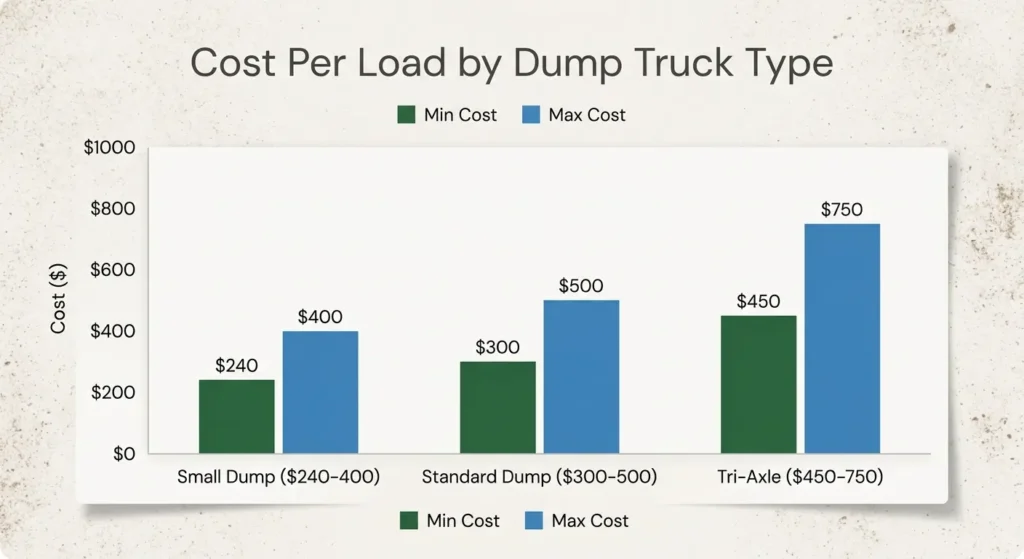
| Truck Type | Capacity | Clean Soil | Heavy Clay/Difficult Conditions |
|---|---|---|---|
| Small/Mini | 8–10 cu yd | $240–$400 | $400–$600 |
| Standard | 12–14 cu yd | $300–$500 | $500–$800 |
| Tri-Axle | 18–20 cu yd | $450–$750 | $750–$1,200+ |
| Super Dump | 22–26 cu yd | $550–$900 | $900–$1,500+ |
These figures are estimates for normal hauling conditions. Contaminated material, extended hauling distances, and restricted access can increase the price considerably.
Per-Load vs. Per-Ton vs. Per-Yard: Which Pricing Method Do Contractors Use?
Contractors may quote dirt removal using different units:
- Per cubic yard: $50–$150 per cubic yard
- Per ton: $140–$180 per ton
- Per load: $300–$500 for a standard truck
Per-ton pricing is more common for dense or heavy materials, while loose soil is often quoted by the cubic yard or truckload.
Regional pricing can vary by approximately 30%, so national estimates should be treated as a starting point rather than a guaranteed local price.
How to Calculate Your Dirt Removal Cost?
Use these steps to estimate the number of loads and the likely removal cost.
Step 1: Calculate Bank Volume
Length × Width × Depth ÷ 27 = Bank cubic yards
Step 2: Apply the Swell Factor
Multiply the bank volume by the appropriate factor for the soil.
Step 3: Determine Truckloads
Loose cubic yards ÷ truck capacity = required loads
Round the result up to the next whole load.
Step 4: Apply the Hauling Rate
Multiply the number of loads by the estimated cost per load.
Step 5: Add Cost Adjustments
Account for soil type, difficult access, haul distance, tipping fees, and other applicable charges.
Step 6: Add Additional Services
Include excavation, grading, backfill, or other work if required.
Example Calculation
Suppose you have 10 cubic yards of clay in the ground.
- Bank volume: 10 cu yd
- Swell factor: 1.3
- Loose volume: 13 cu yd
- Standard truck capacity: 12 cu yd
- Required loads: 2
- Baseline removal: 2 × $350 = $700
- Clay adjustment of 25%: $875
A reasonable estimated range would be approximately $800–$950, depending on access, hauling distance, and disposal charges.
How to Save Money on Dirt Removal?
You can reduce the total cost by making the material easier and cheaper to handle.
- Keep the soil clean: Clean fill may have inexpensive disposal or reuse options.
- Provide equipment access: A clear route allows mechanical loading instead of labor-intensive hand loading.
- Pile excavated soil in advance: Loose material eliminates the excavation charge for soil that is already removed.
- Measure accurately: Include soil expansion when calculating truck requirements.
- Use a nearby disposal site: Shorter hauling distances reduce truck travel time and fuel costs.
- Avoid rush service: Standard scheduling can prevent weekend or expedited-service premiums.
When Dirt Removal Costs More?
Some conditions increase costs because they require additional equipment, labor, transportation, or disposal procedures.
Contaminated soil may require testing and disposal at an approved facility.
Heavy clay or rock can increase the number of trips because trucks have weight limits even when there is unused space in the bed.
Restricted access can prevent the use of standard loaders and require smaller equipment or manual labor.
Rush projects may also cost more because contractors have to schedule additional trucks, labor, or disposal services on short notice.
FAQ
How much does it cost to remove a dump truck load of dirt?
A standard load of clean soil generally costs $300–$500 to remove. Heavy clay, contaminated soil, long hauling distances, or difficult access can increase the cost to $800–$1,500 or more per load.
How many cubic yards are in a dump truck load?
A standard dump truck typically carries 10–14 cubic yards of loose material. Tri-axle trucks can carry approximately 18–20 or more cubic yards, depending on the truck and material.
How much does a dump truck load of dirt weigh?
One cubic yard of dirt weighs approximately 1.0–1.3 tons. A full standard truckload can therefore weigh roughly 12–18 tons, although actual weight depends on moisture and soil composition.
Is it cheaper to rent a dumpster or hire a hauling service?
For large quantities of dirt, a dedicated hauling service is generally more practical because dumpsters have weight restrictions and may not be priced favorably for heavy soil. Dumpsters can be more suitable when dirt is mixed with other construction debris.
Can I remove dirt myself?
Yes. Small quantities can be transported using a pickup or suitable trailer where legally permitted. Once the volume reaches roughly 10 cubic yards or more, professional hauling is generally more efficient because loading, transportation, weight limits, and disposal become more demanding.
Conclusion
Removing a dump truck load of clean dirt typically costs $300–$500 for a standard load, while heavy clay, contaminated soil, difficult access, and long hauling distances can push the price substantially higher. The most important variables are soil volume, material type, site access, and disposal distance.
For an accurate estimate, calculate the bank volume, apply the soil’s swell factor, determine the number of truckloads, and then add excavation, hauling, disposal, and site-specific charges that apply to the project.

Ahmed Ijaz runs this construction rental directory with over 5 years of experience in SEO, content, and web optimization. Every page is built using real research, hands-on expertise, and carefully reviewed information to meet strong EEAT standards.