A dump truck can carry about 5 to 25 tons of dirt, depending on its size, payload rating, bed volume, dirt density, and local weight limits. A typical road-going tandem or tri-axle dump truck commonly carries roughly 10–20 tons of dirt, while larger heavy-duty configurations can carry more.
There is no single tonnage that applies to every dump truck. The practical calculation is:
Tons of dirt = Cubic yards × Dirt density (tons per cubic yard)
For example, if a truck carries 12 cubic yards of soil weighing about 1.1 tons per cubic yard, the load weighs approximately 13.2 tons.
The truck’s legal payload can still be lower than the calculated weight because axle and gross vehicle weight limits may restrict how much material can be hauled on public roads. On U.S. Interstate highways, the federal baseline includes an 80,000-pound gross vehicle weight limit, a 20,000-pound single-axle limit, and a 34,000-pound tandem-axle limit, subject to the Federal Bridge Formula and applicable state rules.
How Many Tons Does a Dump Truck Hold?
For ordinary construction and excavation work, 10 to 20 tons per load is a useful general range for many full-size road dump trucks. Smaller trucks carry less, while tri-axle, quad-axle, super-dump, and off-road mining trucks can carry substantially more.
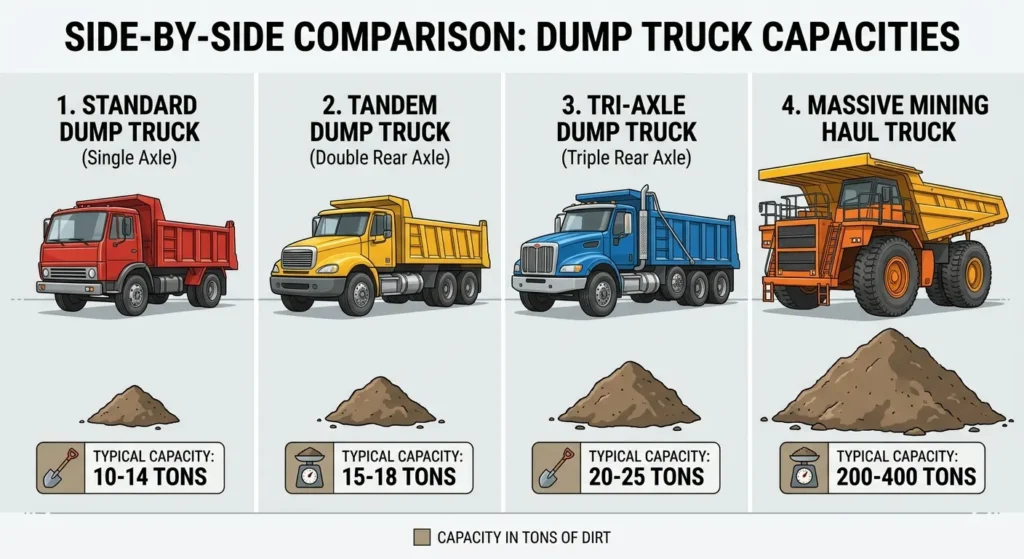
| Dump truck type | Approx. body volume | Typical dirt payload* |
|---|---|---|
| Single-axle dump truck | 5–8 cubic yards | 5–10 tons |
| Tandem-axle dump truck | 10–16 cubic yards | 10–18 tons |
| Tri-axle dump truck | 15–20 cubic yards | 18–25 tons |
| Quad-axle dump truck | 18–24+ cubic yards | 22–30+ tons |
| Super dump | Up to about 25+ cubic yards | Up to about 25–30+ tons |
| Off-road mining truck | 20–100+ cubic yards | 30–150+ tons |
*These are practical planning ranges, not universal legal payload ratings. The actual payload depends on the truck chassis, body, axle configuration, material density, and applicable road restrictions.
A dump body’s cubic-yard capacity also does not automatically equal its legal dirt payload. A truck can have enough physical space for a certain volume but reach its weight limit before the bed is full.
How Do You Calculate Tons of Dirt in a Dump Truck?
The basic calculation is:
Tons = Cubic yards × Density in tons per cubic yard
Suppose a dump truck carries 12 cubic yards of fill dirt and the material weighs approximately 1.1 tons per cubic yard:
12 × 1.1 = 13.2 tons
So the load contains approximately 13.2 tons of dirt.
The same truck carrying wetter or denser material could weigh considerably more even though the volume remains 12 cubic yards.
Why Cubic Yards and Tons Are Different
Cubic yards measure volume.
Tons measure weight.
A truck’s bed determines how much material can physically fit, while the material’s density determines how much that material weighs.
This is why asking only how many cubic yards a dump truck holds does not provide the complete answer to its dirt capacity.
How Much Does a Cubic Yard of Dirt Weigh?
A cubic yard of dirt commonly weighs around 1 to 1.5 U.S. short tons, although the actual figure varies with soil composition and moisture.
For example, dry topsoil is often around 1 ton per cubic yard, while moist or saturated soil can approach 1.5 tons per cubic yard. Published soil estimates also show substantial variation because soil density changes with composition and moisture.
| Material condition | Approx. weight per cubic yard |
|---|---|
| Dry topsoil | 1.0–1.1 tons |
| Moist topsoil | 1.1–1.35 tons |
| Wet/saturated topsoil | 1.3–1.5 tons |
| General fill dirt | About 1.0–1.3 tons |
| Dense clay soil | About 1.3–1.5+ tons |
These figures are estimating ranges, not fixed engineering densities. The supplier’s actual scale weight is more reliable for a particular load.
Does Wet Dirt Weigh More?
Yes. Water adds weight to soil, so wet dirt can be significantly heavier than dry dirt.
For example, if dry soil weighs approximately 2,000 pounds per cubic yard, a wetter load could weigh 2,400–3,000 pounds per cubic yard depending on the soil and moisture level.
This matters for dump trucks because a truck may reach its legal payload limit before its bed is physically full.
Dump Truck Dirt Capacity by Truck Size
Single-Axle Dump Truck
A single-axle dump truck is generally used for smaller construction, landscaping, and residential projects.
A typical body may hold approximately 5–8 cubic yards, although body sizes vary. A practical dirt payload may be around 5–10 tons, depending on the truck’s payload rating and material.
For excavation work on small residential sites, these trucks can be useful when site access is restricted or the required amount of material is relatively small.
Tandem-Axle Dump Truck
A tandem-axle dump truck, often called a 10-wheeler, is one of the common choices for construction and excavation hauling.
Typical body capacity can be around 10–16 cubic yards, depending on the truck and body configuration.
With ordinary soil, a practical payload may fall around 10–18 tons. The actual legal payload depends on axle configuration, truck weight, and local regulations.
Tri-Axle Dump Truck
A tri-axle dump truck generally provides greater carrying capacity than a tandem truck.
Typical body volume can be approximately 15–20 cubic yards, while practical payloads can reach roughly 18–25 tons depending on the truck and jurisdiction.
However, a 20-cubic-yard body does not mean the truck can legally fill the entire body with dense soil. Weight restrictions may become the limiting factor.
Quad-Axle and Larger Road Trucks
Quad-axle and other heavy road configurations can carry more material than ordinary tandem and tri-axle trucks.
Depending on the configuration, body capacity can exceed 20 cubic yards, with payloads potentially reaching the mid-20-ton range or higher. Local axle and gross-weight rules determine how much can actually be hauled legally.
Dirt Type Changes the Number of Tons
Two trucks carrying the same number of cubic yards can have different total weights.
For example, consider a 14-cubic-yard load:
- At 1.0 ton/CY → 14 tons
- At 1.2 tons/CY → 16.8 tons
- At 1.5 tons/CY → 21 tons
That is why dirt density should always be considered when estimating truckloads.
Example: 14 Cubic Yards of Dirt
| Dirt density | 14 cubic yards weighs |
|---|---|
| 1.0 ton/CY | 14 tons |
| 1.1 tons/CY | 15.4 tons |
| 1.2 tons/CY | 16.8 tons |
| 1.3 tons/CY | 18.2 tons |
| 1.5 tons/CY | 21 tons |
The truck may not legally be able to carry the entire calculated weight, so the driver or supplier may reduce the volume.
Why a Dump Truck Cannot Always Be Filled to the Top
A dump truck has two important limits: volume and weight.
The body might physically hold 16 cubic yards, but the truck may reach its allowable payload before 16 cubic yards of dense dirt are loaded.
For U.S. Interstate travel, federal limits include:
- 20,000 pounds maximum single-axle weight
- 34,000 pounds maximum tandem-axle weight
- 80,000 pounds maximum gross vehicle weight for qualifying vehicles
- Federal Bridge Formula requirements for axle groups
State and local rules can differ, and some exceptions or grandfathered provisions apply.
Example
Suppose a truck could physically hold 16 cubic yards.
If the dirt weighs 1.4 tons per cubic yard:
16 × 1.4 = 22.4 tons
That does not automatically mean the truck can legally haul 22.4 tons. Its chassis, axle ratings, empty weight, and applicable road limits determine the permissible payload.
How Many Tons of Dirt Are in a 10-Yard Dump Truck?
A 10-cubic-yard load of typical dirt weighs approximately 10–13 tons if the material weighs 1.0–1.3 tons per cubic yard.
For heavier or wetter soil at 1.5 tons per cubic yard:
10 × 1.5 = 15 tons
So a 10-yard dump truck can contain approximately 10–15 tons of dirt by volume calculation, but the truck’s actual legal payload may be lower.
How Many Tons of Dirt Are in a 12-Yard Dump Truck?
For 12 cubic yards:
- At 1.0 ton/CY = 12 tons
- At 1.1 tons/CY = 13.2 tons
- At 1.2 tons/CY = 14.4 tons
- At 1.3 tons/CY = 15.6 tons
- At 1.5 tons/CY = 18 tons
Therefore, a 12-yard load of ordinary dirt will often weigh around 12–16 tons, depending on moisture and soil type.
How Many Tons of Dirt Are in a 14-Yard Dump Truck?
A 14-cubic-yard load weighs approximately:
14 × 1.0 = 14 tons
to
14 × 1.5 = 21 tons
So a 14-yard truckload can contain roughly 14–21 tons of dirt, depending on density.
A supplier may load fewer than 14 cubic yards if the material is heavy enough to exceed the truck’s payload or axle limits.
How Many Truckloads Are Needed for 100 Tons of Dirt?
The answer depends on the payload of each truck.
For example:
100 tons ÷ 20 tons per load = 5 loads
So a 20-ton dump truck would require approximately 5 loads to transport 100 tons.
If the truck carries only 15 tons:
100 ÷ 15 = 6.67
You would need approximately 7 loads.
| Payload per truck | Loads for 100 tons |
|---|---|
| 10 tons | 10 loads |
| 12 tons | 9 loads |
| 15 tons | 7 loads |
| 18 tons | 6 loads |
| 20 tons | 5 loads |
| 25 tons | 4 loads |
Always round up because you cannot transport a fraction of a truckload.
How to Calculate Dump Truck Loads for an Excavation Project?
If you are estimating dirt removal from an excavation, start with the volume of material, then convert that volume to weight.
Step 1: Calculate excavation volume
Use:
Length × Width × Depth ÷ 27 = cubic yards
For example, an excavation measuring 30 feet × 20 feet × 2 feet:
30 × 20 × 2 ÷ 27 = 44.4 cubic yards
Step 2: Estimate the soil’s weight
If the excavated soil averages 1.2 tons per cubic yard:
44.4 × 1.2 = 53.3 tons
Step 3: Divide by truck payload
If the truck can legally haul 15 tons:
53.3 ÷ 15 = 3.55 loads
You would therefore plan for approximately 4 truckloads.
Step 4: Account for excavated soil expansion
Excavated soil can occupy more volume after it is removed from the ground because digging breaks up and loosens the material. This is commonly called swell.
Therefore, an excavation estimate based only on the original in-place volume can underestimate the amount of loose material that must be hauled away.
The exact swell factor depends on soil type and project conditions, so it should not be treated as a universal 10% number.
Dump Truck Tons vs. Cubic Yards
When ordering dirt, clarify whether the supplier sells it by cubic yard or ton.
If a supplier quotes by cubic yard, you are paying for volume.
If the supplier quotes by ton, you are paying according to weight.
For example, 10 cubic yards of relatively dry soil and 10 cubic yards of wet soil occupy approximately the same volume but can have significantly different weights.
This distinction is especially important for excavation, grading, site preparation, landscaping, and dirt removal, where transportation costs may depend on the number of truckloads or the weight hauled.
What About Mining Dump Trucks?
Mining dump trucks are a completely different category from road-going construction dump trucks.
They are designed for controlled off-highway haul roads and can carry dozens or even hundreds of tons.
For example:
- Komatsu HD325-8: nominal payload of 40.3 U.S. short tons with a 31.4-cubic-yard heaped body.
- Komatsu HD605-10: nominal payload of 70.7 U.S. short tons (64.1 metric tons), depending on configuration.
- Komatsu HD1500-8: rated payload of approximately 157 U.S. short tons (142 metric tons).
These figures should not be compared directly with a normal road dump truck. Mining trucks are specialized off-highway machines with much larger bodies, payload ratings, and operating weights.
Frequently Asked Questions
How many tons of dirt are in a dump truck?
A typical road-going dump truck carries roughly 10–20 tons of dirt, although smaller trucks may carry less and larger configurations can carry 20–30 tons or more.
How many tons of dirt are in a 10-yard dump truck?
A 10-yard load weighs approximately 10–15 tons, depending primarily on soil density and moisture.
How many cubic yards are in one ton of dirt?
If dirt weighs 1.0 ton per cubic yard, one ton equals about 1 cubic yard. If it weighs 1.25 tons per cubic yard, one ton equals about 0.8 cubic yards.
The formula is:
Cubic yards = Tons ÷ Tons per cubic yard
Does wet dirt weigh more than dry dirt?
Yes. Water adds weight, so wet or saturated soil can weigh substantially more than dry soil. The exact increase depends on the soil’s composition and moisture content.
Can a dump truck be overloaded with dirt?
A dump truck should not be overloaded. The allowable load depends on the truck’s rated payload, axle ratings, gross vehicle weight, and applicable state or local regulations.
How many truckloads are needed for 100 tons of dirt?
It depends on payload. A 20-ton truck requires approximately 5 loads, while a 15-ton truck requires approximately 7 loads.
Conclusion
So, how many tons of dirt are in a dump truck?
For ordinary road-going construction dump trucks, about 10–20 tons per load is a useful general estimate. Smaller single-axle trucks may carry around 5–10 tons, while larger tri-axle and heavy configurations can carry roughly 18–30 tons or more, depending on their specifications and legal limits.
The most accurate calculation is:
Dump truck tons = Cubic yards of dirt × Dirt density
Remember that truck size, bed volume, soil type, moisture, axle configuration, and legal weight limits all affect the final load.
For excavation projects, do not estimate truckloads from bed volume alone. Calculate the excavation volume, account for soil expansion after digging, estimate the material’s density, and then compare the resulting weight with the truck’s actual payload rating.

Ahmed Ijaz runs this construction rental directory with over 5 years of experience in SEO, content, and web optimization. Every page is built using real research, hands-on expertise, and carefully reviewed information to meet strong EEAT standards.