Dirt removal costs $140 to $230 per cubic yard for clean fill, or about $140 to $180 per ton when priced by weight. A standard 10-cubic-yard dump truck load can cost $1,400 to $2,300. Contaminated soil can cost up to $450 per ton because of testing, transportation, permitting, and specialized disposal. Your final price depends on the type and volume of soil, site access, hauling distance, labor, equipment, and local disposal fees.
How Is Dirt Removal Priced?
Pricing by Cubic Yard
Most dirt removal contractors price jobs by cubic yard because volume accounts for the amount of material that must be loaded, transported, and disposed of.
Typical clean fill pricing is $140–$230 per cubic yard. Clean soil is generally easier and less expensive to dispose of because it may be reused as fill material.
Mixed soil containing concrete, asphalt, roots, or other debris can cost more because it may require sorting or disposal at a facility that accepts mixed materials.
Keep in mind that contractors usually calculate disposal using loose cubic yards, not the amount of soil originally measured in the ground. Excavated soil expands after digging, commonly by about 10%–30%. This is known as the fluff factor.
Pricing by Ton
Dirt may also be priced by weight when the material is particularly dense or requires regulated disposal.
Typical pricing is around $140–$180 per ton, while contaminated soil can reach $450 per ton because of additional handling and disposal requirements.
Approximate soil weights include:
| Soil Type | Approximate Weight per Cubic Yard |
|---|---|
| Topsoil | 1.2–1.4 tons |
| Clay | 1.5–1.7 tons |
| Sand | 1.4–1.6 tons |
| Gravel | 1.6–1.8 tons |
Actual weight varies with moisture content, compaction, and material composition.
Factors That Affect Dirt Removal Cost
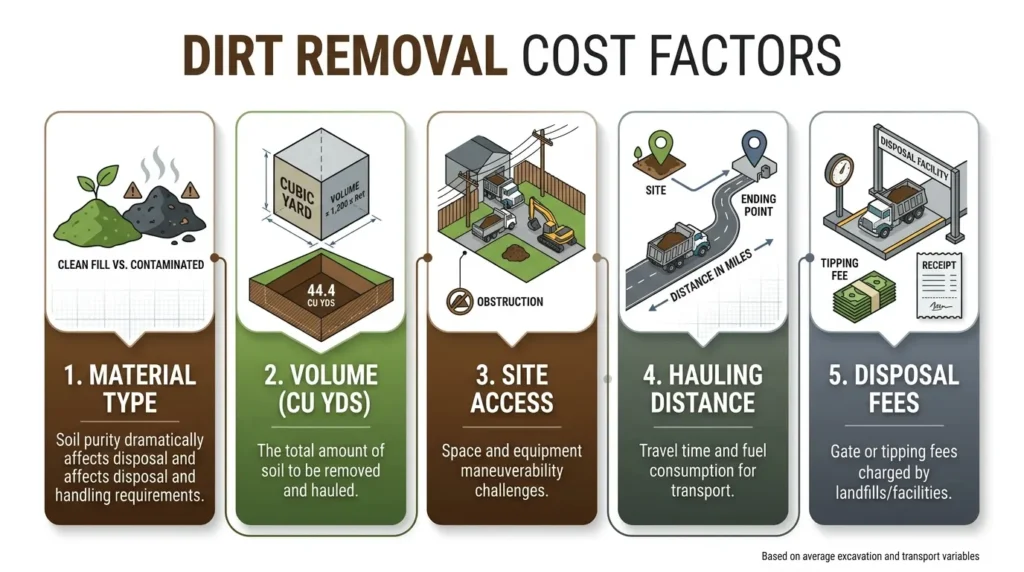
1. Material Type
The type of material is one of the biggest cost factors.
Clean fill dirt containing soil, sand, or clay is generally the easiest to dispose of and may be accepted for reuse.
Mixed debris soil containing concrete, asphalt, roots, or yard waste can require additional sorting or a different disposal facility.
Contaminated soil containing petroleum, chemicals, or other regulated substances requires testing and specialized handling. Disposal must follow applicable environmental and transportation requirements.
2. Volume and Excavation Depth
Larger projects require more truckloads, labor, equipment, and disposal capacity. However, large projects can sometimes receive lower unit rates because equipment and trucks can operate continuously.
Excavation depth also matters. Deep excavation may require additional safety measures, slope protection, shoring, or specialized equipment.
3. Site Accessibility
Limited access can increase labor and equipment time.
If a dump truck cannot reach the excavation area, smaller equipment may need to move soil from the excavation to the truck. Longer equipment travel distances and additional handling can increase the total cost.
A contractor’s site inspection can identify access problems before work begins and help produce a more accurate estimate.
4. Hauling Distance and Disposal Fees
Dirt removal involves both transportation and disposal. The farther the material travels, the more fuel and truck time are required.
Disposal or tipping fees also vary by location and facility. Clean screened soil may have more disposal options than contaminated or mixed material.
On large projects, choosing an appropriate disposal facility can make a substantial difference in the total cost.
5. Soil Expansion
Excavated soil takes up more space than compacted soil in the ground.
For example, 1 bank cubic yard of soil may become approximately 1.25 loose cubic yards after excavation. It can later compact to around 0.90 cubic yard, depending on the material and compaction conditions.
This expansion must be considered when estimating truckloads and disposal costs.
6. Equipment and Labor
Equipment requirements depend on the project’s size, soil conditions, and site access.
Example hourly rates from a public project include:
| Equipment | Example Hourly Rate |
|---|---|
| 40,000-lb excavator | $290/hour |
| 90,000-lb excavator | $365/hour |
| Front-end loader | $265/hour |
| 22,000-lb skid steer | $195/hour |
| Super 10 dump truck | $180/hour |
These figures are reference rates from a public project, not universal residential prices. Local equipment, operator, fuel, and labor rates can differ considerably.
7. Location and Market Conditions
Dirt removal prices vary significantly by region.
For example, some Austin-area estimates for hauling and disposal alone fall around $15–$30 per cubic yard, while national estimates can be substantially higher when excavation, labor, equipment, and other costs are included.
Local landfill fees, labor costs, traffic, fuel prices, and competition all affect the final quote.
Typical Dirt Removal Cost Scenarios
Small Residential Job: Under 2 Cubic Yards
Small jobs may involve removing soil from planting beds, minor landscaping work, small patio excavations, or stump-related soil removal.
A typical project may cost around $295–$425, depending on location and the equipment required.
Costs can include:
- Several hours of labor
- Waste disposal
- Small equipment such as a skid steer
- Loading and hauling
Small projects often have minimum service charges, so their cost per cubic yard can be higher than larger jobs.
Standard Residential Job: 10 Cubic Yards
A 10-cubic-yard project can occur during driveway work, basement additions, landscaping, or other residential excavation.
A national reference range is approximately $1,583–$1,992, although actual prices vary by location and scope.
The quote should clarify whether excavation, loading, hauling, disposal, and site cleanup are included.
Large Site Work: Hundreds or Thousands of Cubic Yards
Commercial developments, park improvements, and large grading projects can involve hundreds or thousands of cubic yards.
One reference project involving 3,820 cubic yards had approximately $85,000 in equipment costs, $85,000 in hauling, and $45,000 in tipping fees, for a total of about $215,000.
Large projects can achieve lower costs per cubic yard when trucks and equipment operate continuously and the material has a suitable disposal or reuse destination.
How to Calculate Dirt Removal Cost?
Step 1: Calculate the Excavated Volume
Use this formula:
Length × Width × Depth = Cubic Feet
Then:
Cubic Feet ÷ 27 = Cubic Yards
For example:
20 ft × 20 ft × 3 ft = 1,200 cubic feet
1,200 ÷ 27 = 44.4 cubic yards
Step 2: Apply the Fluff Factor
Multiply the bank volume by approximately 1.15–1.30 to estimate loose material.
For the 44.4-cubic-yard example:
44.4 × 1.15 = 51.1 loose cubic yards
44.4 × 1.30 = 57.7 loose cubic yards
The appropriate factor depends on the soil type and how compacted it was before excavation.
Step 3: Identify the Soil Type
Soil type affects handling, weight, and disposal options.
| Soil Type | Example Cost Range per Cubic Yard |
|---|---|
| Topsoil / loose fill | $50–$100 |
| Sand | $40–$80 |
| Clay / compacted soil | $75–$150 |
| Rocky soil | $100–$250 |
These figures are material-specific reference ranges and should not be confused with a complete dirt removal quote, which may also include loading, hauling, disposal, labor, and equipment.
Step 4: Add Other Project Costs
Depending on the job, additional costs may include:
| Cost Item | Typical Estimate |
|---|---|
| Hauling | $15–$50 per cubic yard |
| Tipping fees | About $40 per ton for some self-haul situations |
| Permits and inspections | Varies by location |
| General contractor management | About 12%–20% when applicable |
Not every project requires each of these charges.
Step 5: Compare at Least 3 Quotes
Dirt removal quotes can vary substantially. Get at least three estimates and make sure each contractor clearly states:
- Price per cubic yard or ton
- Estimated quantity
- Loading costs
- Hauling costs
- Disposal or tipping fees
- Minimum charges
- Equipment and labor
- Cleanup
- Any required permits
- Whether grading or backfilling is included
Comparing quotes using the same scope makes it easier to identify the actual cost difference.
How to Reduce Dirt Removal Costs?
Reuse Soil On-Site
If your project has areas that need additional fill, reuse suitable excavated soil instead of hauling it away. A grading plan that balances cut and fill can reduce both transportation and disposal costs.
Screen Clean Soil
If clean soil contains roots, rocks, or other debris, screening may make it suitable for reuse or a lower-cost disposal option. The potential savings depend on local equipment and disposal prices.
Self-Haul When Practical
For small quantities, self-hauling may reduce labor and hauling charges. Some facilities charge only a disposal or tipping fee for accepted materials.
Before loading a vehicle, confirm that the disposal facility accepts public drop-offs, determine its material requirements, and check weight limits.
Give Away or Sell Suitable Fill
Clean fill or usable topsoil may be valuable to nearby homeowners, landscapers, or contractors.
Offering clean material locally with “free fill dirt — you haul” can sometimes eliminate disposal costs. Local demand and material quality determine whether someone will take it.
Measure the Volume Accurately
Accurate measurements prevent paying for unnecessary truckloads or discovering that the project requires more disposal than expected.
An excavation calculator can provide a starting estimate, but a contractor’s measurement is more reliable for a final quote.
Frequently Asked Questions
How much does it cost to remove 10 cubic yards of dirt?
A 10-cubic-yard dirt removal project can cost roughly $1,400–$2,300 when using the stated clean-fill rate of $140–$230 per cubic yard. Actual costs depend on loading, hauling distance, disposal fees, labor, and site conditions.
How much does dirt removal cost per ton?
Dirt removal commonly ranges from about $140–$180 per ton when priced by weight. Contaminated soil can cost substantially more, potentially reaching $450 per ton.
Is it cheaper to haul dirt away yourself?
For small quantities, self-hauling can reduce labor and hauling charges. However, you still need to account for vehicle or trailer costs, fuel, your time, and the disposal facility’s tipping fee.
How much does a dump truck of dirt removal cost?
Using a 10-cubic-yard load and a clean-fill removal rate of $140–$230 per cubic yard, the estimated cost is $1,400–$2,300. The actual truckload capacity and final price depend on the truck, material weight, and local disposal requirements.
Why does excavated dirt cost more than the amount in the ground?
Soil expands when excavated. This increases the volume that must be loaded into trucks and transported to a disposal or reuse site. The increase is commonly estimated at 10%–30%, depending on the material.
Can I avoid dirt disposal fees?
Sometimes. If the excavated soil is clean and suitable for reuse, you may be able to use it elsewhere on the property or give it to someone who needs fill. Local disposal rules and soil quality determine whether this is practical.
Conclusion
Dirt removal costs depend on more than the amount of soil being hauled away. Material type, soil expansion, site access, hauling distance, disposal fees, labor, and equipment can all change the final price. For an accurate estimate, calculate the loose soil volume, identify the material, and compare quotes that clearly separate loading, hauling, and disposal costs. When possible, reusing suitable soil on-site or finding a local reuse option can reduce the amount that needs to be hauled away.

Ahmed Ijaz runs this construction rental directory with over 5 years of experience in SEO, content, and web optimization. Every page is built using real research, hands-on expertise, and carefully reviewed information to meet strong EEAT standards.