A dump truck load of dirt typically weighs about 10 to 25 tons, depending on the truck’s payload capacity, the amount of dirt loaded, soil type, moisture content, and local weight limits. A common tandem dump truck carrying roughly 10 to 15 cubic yards of ordinary excavated soil may haul around 15 to 22 tons.
The exact weight cannot be determined from truck size alone because dirt density varies considerably. OSHA notes that soil can weigh 110–140 pounds or more per cubic foot, while one cubic yard can weigh more than 3,000 pounds.
For a quick estimate, use:
Total dirt weight = Cubic yards × Weight per cubic yard
For example, 12 cubic yards × 1.3 tons per cubic yard = about 15.6 tons.
Dump Truck Dirt Weight at a Glance
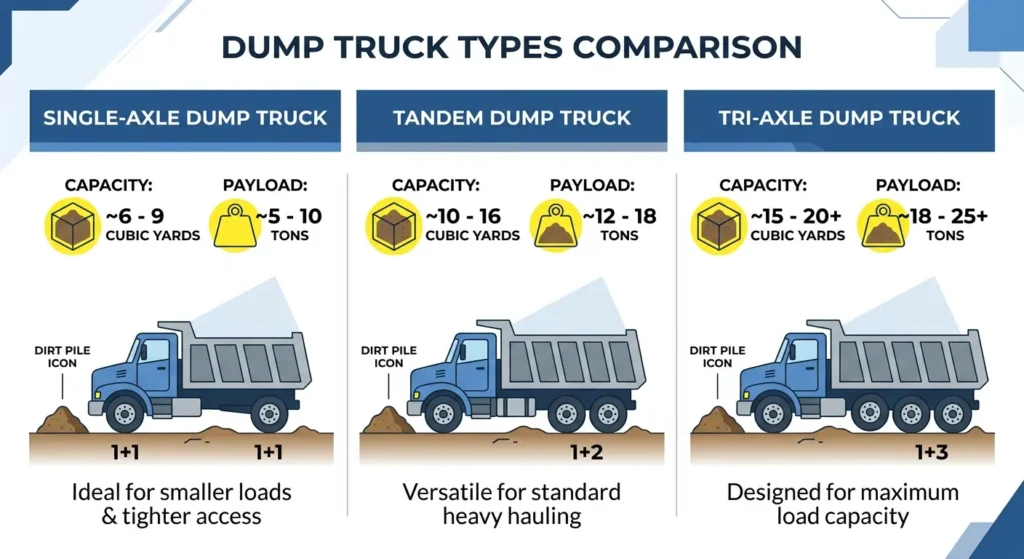
| Dump Truck Type | Approx. Dirt Capacity | Approx. Dirt Weight* |
|---|---|---|
| Single-axle | 5–8 cubic yards | 5–10 tons |
| Tandem-axle | 10–15 cubic yards | 15–22 tons |
| Tri-axle | 15–20 cubic yards | 18–25 tons |
| Super dump | 20–24 cubic yards | 25–30 tons |
*These are planning ranges, not universal payload ratings. The actual legal payload depends on the truck’s empty weight, axle configuration, material density, and applicable road limits.
How Do You Calculate the Weight of a Dump Truck Load of Dirt?
The basic calculation is simple:
Weight = Volume × Density
If the truck contains 12 cubic yards of dirt and the dirt weighs 1.3 tons per cubic yard:
12 × 1.3 = 15.6 tons
So the load weighs approximately 15.6 tons, or 31,200 pounds.
The important point is that the same truck can carry very different weights when the soil changes. Dry, loose dirt may be substantially lighter than saturated clay.
Basic Conversions
- 1 cubic yard = 27 cubic feet
- 1 short ton = 2,000 pounds
- 1 cubic foot = 1/27 of a cubic yard
- 1 cubic yard of soil can weigh roughly 2,700–3,000+ pounds, depending on soil conditions.
How Much Does a Cubic Yard of Dirt Weigh?
A cubic yard of dirt does not have one fixed weight.
OSHA’s excavation guidance gives a general soil range of about 110–140 pounds per cubic foot or more. That corresponds to approximately 2,970–3,780 pounds per cubic yard when converted directly.
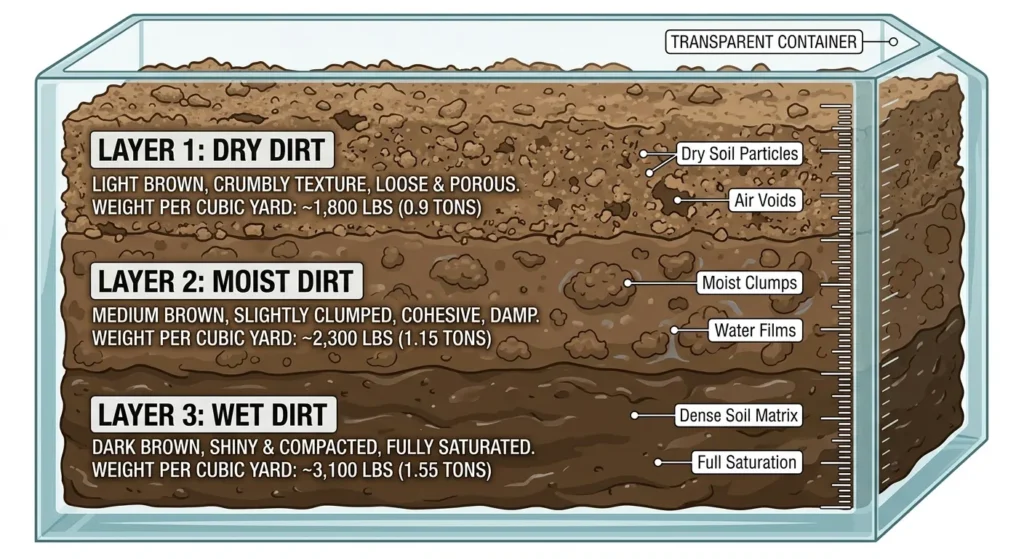
A practical estimating range is:
| Dirt Condition | Approx. Weight per Cubic Yard |
|---|---|
| Loose, dry dirt | ~2,000–2,500 lbs |
| Moist/excavated soil | ~2,400–3,000 lbs |
| Heavy or wet soil | ~2,700–3,300+ lbs |
| Dense clay | Can exceed 3,000 lbs |
These numbers are estimates because soil density depends on composition, moisture, compaction and how the material was excavated.
For excavation and hauling calculations, using an actual soil-density value from the project is better than assuming every cubic yard weighs the same.
Dump Truck Weight by Type
Single-Axle Dump Truck
A single-axle dump truck is generally used for smaller residential and landscaping jobs.
A typical load may contain approximately 5–8 cubic yards of dirt. At roughly 1–1.3 tons per cubic yard, that produces an estimated load of around 5–10 tons.
Common applications include:
- Small excavation projects
- Residential landscaping
- Driveway work
- Small dirt deliveries
- Limited-access properties
Because the truck is smaller, it can be useful where a larger dump truck cannot easily access the property.
Tandem Dump Truck
The tandem dump truck is one of the most common configurations for construction and dirt hauling.
A typical planning range is approximately 10–15 cubic yards of material. Depending on soil density, that can represent roughly 15–22 tons of dirt.
For example:
10 cubic yards × 1.3 tons = 13 tons
15 cubic yards × 1.3 tons = 19.5 tons
This is why a statement such as “a dump truck holds 15 tons” should not be treated as a universal specification. The actual payload depends on the truck and material.
Tri-Axle Dump Truck
A tri-axle dump truck has an additional axle compared with a typical tandem configuration and is commonly used for larger construction and hauling operations.
A planning range of 15–20 cubic yards can translate to approximately 18–25 tons of dirt, depending heavily on material density and the truck’s rated payload.
Heavy wet soil can reach the truck’s legal payload limit before the bed is physically full.
Super Dump Truck
A super dump is designed to provide greater payload capacity than many conventional dump trucks.
Depending on the specific configuration, a load may be capable of carrying roughly 20–24 cubic yards of material, but the truck should never simply be filled to its physical volume without checking its rated payload and applicable weight limits.
For dense dirt, weight can become the limiting factor before volume does.
That distinction is important when ordering dirt or hauling excavated soil.
What Factors Affect the Weight of a Dump Truck Load of Dirt?
1. Moisture Content
Moisture is one of the biggest variables affecting soil weight.
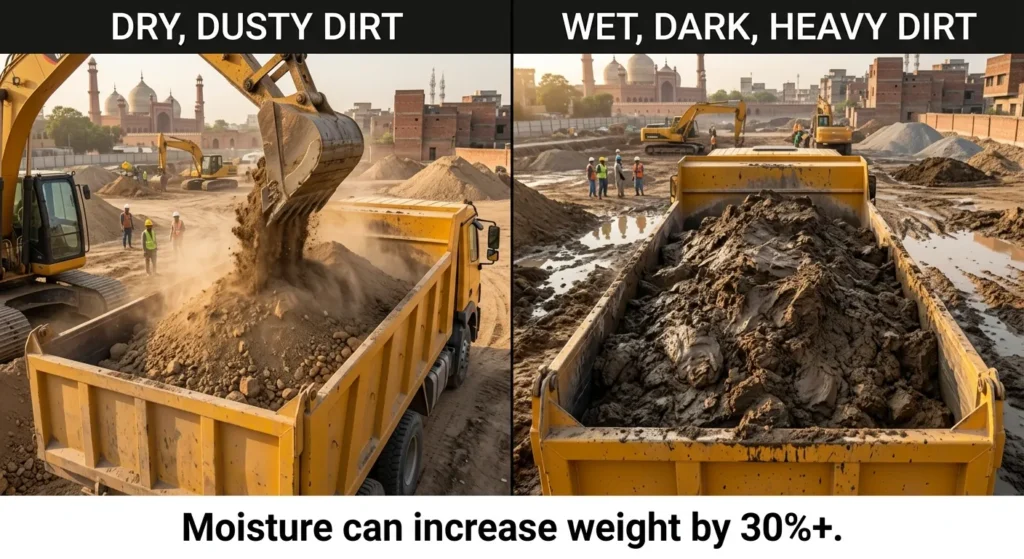
Water adds mass to the material, so a load of wet dirt can weigh considerably more than the same volume of dry dirt.
OSHA specifically notes that soil weight varies with moisture content and that heavy rain can significantly increase soil weight.
For example, consider two 12-cubic-yard loads:
- Dry soil at 1.1 tons/yd³ = 13.2 tons
- Moist soil at 1.3 tons/yd³ = 15.6 tons
- Heavy soil at 1.5 tons/yd³ = 18 tons
The volume hasn’t changed, but the weight has.
2. Soil Type
The composition of the dirt also affects its density.
Sandy Soil
Sand can have a relatively high density, particularly when wet. Engineering reference data shows dry sand around 100 lb/ft³ and wet sand around 120 lb/ft³ in typical examples.
Clay
Clay can become especially heavy when wet or saturated. Typical reference values range from roughly 100 lb/ft³ for dry clay to about 130 lb/ft³ for saturated clay.
Loam and Topsoil
Topsoil and loam can have lower densities than dense clay, but their weight varies substantially depending on organic content and moisture.
Fill Dirt
Fill dirt can contain soil, gravel, rocks and other material. Its density therefore varies according to its composition and compaction.
3. Compaction
Compaction changes the amount of material contained within a given volume.
Loose excavated soil occupies more space than the same soil after compaction. This is one reason excavation estimates, hauling quantities and final backfill quantities don’t always match one-for-one.
If you’re calculating excavated dirt for removal, don’t automatically use the compacted in-place volume as the truck volume. Excavated soil can expand, commonly referred to as soil swell.
How Much Dirt Can a Dump Truck Legally Carry?
The physical capacity of a dump truck and its legal payload are two different things.
For U.S. Interstate travel, the federal limits generally include:
- 20,000 pounds on a single axle
- 34,000 pounds on a tandem axle
- 80,000 pounds maximum gross vehicle weight, subject to the Federal Bridge Formula and applicable exceptions.
Gross vehicle weight includes the truck itself plus its load, so you cannot assume an 80,000-pound truck limit means the truck can carry 40 tons of dirt.
For example, if a particular truck weighs 25,000 pounds empty:
80,000 − 25,000 = 55,000 pounds
That leaves a theoretical 55,000-pound payload before considering axle and bridge-formula restrictions and any applicable state rules.
That’s about:
55,000 ÷ 2,000 = 27.5 short tons
But the actual legal payload may be lower.
FHWA also notes that state-specific regulations can impose different limits, and the applicable limit can depend on axle configuration and bridge-formula requirements.
How to Calculate Your Dump Truck Dirt Weight?
You can estimate your load in four steps.
Step 1: Calculate Cubic Yards
Measure:
Length × Width × Depth = Cubic Feet
Then:
Cubic Feet ÷ 27 = Cubic Yards
For example, a 30-foot × 10-foot × 1-foot excavation gives:
30 × 10 × 1 = 300 cubic feet
300 ÷ 27 = 11.1 cubic yards
Step 2: Determine the Soil Condition
Ask:
- Is the dirt dry or wet?
- Is it loose or compacted?
- Is it clay, sand, loam, topsoil or fill?
- Does it contain rocks or gravel?
Step 3: Choose a Density
For a rough estimate, you might use:
- 1.1 tons/yd³ for relatively light, dry dirt
- 1.3 tons/yd³ for moist excavated dirt
- 1.5 tons/yd³ for heavy or wet dirt
For an important construction or hauling calculation, use a project-specific density rather than relying on a generic factor.
Step 4: Multiply Volume by Density
If your excavation produces 11.1 cubic yards of moist dirt:
11.1 × 1.3 = 14.43 tons
So the load would weigh approximately 14.4 tons.
Example: How Much Does a 12-Cubic-Yard Dump Truck Load Weigh?
Suppose a truck carries 12 cubic yards of moist dirt.
Using an estimated density of 1.3 tons per cubic yard:
12 × 1.3 = 15.6 tons
Convert that to pounds:
15.6 × 2,000 = 31,200 pounds
So:
12 cubic yards of moist dirt ≈ 15.6 tons ≈ 31,200 pounds
If the same 12 cubic yards were considerably wetter and weighed 1.5 tons per cubic yard:
12 × 1.5 = 18 tons
That is a difference of 2.4 tons, or 4,800 pounds, from the same volume.
Can a Dump Truck Carry 20 Tons of Dirt?
Yes, some dump trucks can carry 20 tons of dirt, but the answer depends on the truck’s rated payload, axle configuration, dirt density and local weight regulations.
A tandem dump truck carrying 15 cubic yards of relatively dense soil could approach or exceed 20 tons.
For example:
15 cubic yards × 1.3 tons = 19.5 tons
But a 15-cubic-yard load of heavier material could weigh substantially more.
The correct approach is to check the truck’s payload rating and legal gross/axle limits, rather than assuming that the entire bed can be filled.
How Many Tons Is a Dump Truck Load of Topsoil?
Topsoil can weigh less or more depending on its organic content and moisture.
A rough planning range is approximately 1.0–1.3 tons per cubic yard.
Therefore, a 12-cubic-yard load could weigh approximately:
12 × 1.0 = 12 tons
to
12 × 1.3 = 15.6 tons
A tandem truck carrying topsoil may therefore haul roughly 12–18 tons, depending on its actual capacity and the soil’s density.
Always check the supplier’s stated weight or delivery specification when purchasing topsoil.
Why Does Dirt Weight Matter?
Project Planning
Knowing the approximate weight helps you determine:
- How many truckloads you need
- Which truck size is appropriate
- Whether the truck can legally haul the material
- How much material can be removed per trip
Cost Estimating
Dirt may be priced by:
- Cubic yard
- Ton
- Truckload
- Delivery distance
Understanding the relationship between cubic yards and tons makes it easier to compare quotes.
Transportation
A load that looks acceptable by volume may still be too heavy by weight.
This is particularly important with wet clay, saturated soil, gravelly fill and other dense materials.
Safety
Soil is extremely heavy. OSHA states that one cubic yard of soil can weigh 3,000 pounds or more, which is why soil weight is a major hazard during trenching and excavation.
Dump Truck Dirt Weight: Quick Reference
| Question | Approximate Answer |
|---|---|
| 1 cubic yard of ordinary soil | ~2,700–3,000+ lbs |
| 1 cubic yard in short tons | ~1.35–1.5+ tons |
| Small single-axle load | ~5–10 tons |
| Tandem dump truck | ~15–22 tons |
| Tri-axle dump truck | ~18–25 tons |
| Larger/super dump | ~25+ tons, depending on configuration |
| 12 yd³ at 1.3 tons/yd³ | 15.6 tons |
| 15 yd³ at 1.3 tons/yd³ | 19.5 tons |
| 20 yd³ at 1.3 tons/yd³ | 26 tons |
These are estimates, not manufacturer-specific payload specifications.
Dump Truck Load of Dirt: Tons vs. Cubic Yards
One of the most common mistakes is treating cubic yards and tons as interchangeable.
They aren’t.
Cubic yards measure volume.
Tons measure weight.
The conversion between them depends on density.
For example:
10 cubic yards × 1.1 tons/yd³ = 11 tons
But:
10 cubic yards × 1.5 tons/yd³ = 15 tons
Both loads occupy the same volume, but one weighs 4 tons more.
That’s why contractors should identify both the volume and material condition when estimating dirt hauling.
Frequently Asked Questions
How much does a full dump truck of dirt weigh?
A full dump truck can weigh anywhere from roughly 5 to 30+ tons of dirt, depending on the truck configuration, bed capacity and soil density. A common tandem dump truck carrying about 10–15 cubic yards may haul around 15–22 tons.
How much does 10 cubic yards of dirt weigh?
At 1.1 tons per cubic yard, 10 cubic yards weighs about 11 tons. At 1.5 tons per cubic yard, it weighs about 15 tons.
How much does 15 cubic yards of dirt weigh?
At 1.3 tons per cubic yard:
15 × 1.3 = 19.5 tons
So 15 cubic yards of moderately dense dirt weighs approximately 19.5 tons.
How much does a cubic yard of dirt weigh in pounds?
A practical estimate is around 2,700–3,000 pounds or more, although actual weight varies with soil type, moisture and density. OSHA’s guidance notes that soil can exceed 3,000 pounds per cubic yard.
Does wet dirt weigh more than dry dirt?
Yes. Water adds mass, and moisture can substantially increase the weight of a cubic yard of soil. OSHA specifically warns that heavy rain can increase soil weight.
Can a dump truck be full but overweight?
Yes. A truck can reach its legal payload or axle limit before the bed is physically full, particularly when hauling dense or wet material.
How many cubic yards are in a dump truck?
It depends on the truck. A small single-axle truck may carry around 5–8 cubic yards, while larger configurations can carry considerably more. Always verify the truck’s actual bed capacity and payload rating rather than relying on a generic number.
Regional and Legal Weight Differences
The 80,000-pound federal Interstate gross-weight limit is not a universal dump-truck payload limit.
It is a gross vehicle weight limit, meaning it includes the truck and its load. Federal Interstate rules also include axle limits and the Federal Bridge Formula.
State and local roads can have different requirements, including:
- Lower weight limits
- Different axle limits
- Bridge restrictions
- Seasonal restrictions
- Permits for overweight vehicles
- Special rules for particular truck configurations
Therefore, a load that is legal in one location may not be legal on another road.
Final Answer: How Much Does a Dump Truck Load of Dirt Weigh?
A dump truck load of dirt typically weighs about 10–25 tons, while a common tandem dump truck carrying 10–15 cubic yards may haul approximately 15–22 tons.
The actual weight depends primarily on:
- Truck payload capacity
- Number and configuration of axles
- Cubic yards of dirt loaded
- Soil type
- Moisture content
- Compaction and density
- Local legal weight limits
For an actual hauling job, the safest and most accurate method is to use the truck’s rated payload and the material’s known or measured density, then check the applicable axle and gross-weight limits.

Ahmed Ijaz runs this construction rental directory with over 5 years of experience in SEO, content, and web optimization. Every page is built using real research, hands-on expertise, and carefully reviewed information to meet strong EEAT standards.