Commercial excavation costs vary widely depending on project size, soil conditions, equipment, site access, hauling, and permits.Small-to-midsize commercial excavation projects commonly cost about $5,000–$25,000 or more, while large-scale site development and major earthwork projects can cost substantially more.
Commercial Excavation Cost at a Glance
| Cost Type | Typical Cost |
|---|---|
| Commercial excavation | $5,000–$25,000+ |
| Site development | $20,000–$100,000+ per acre |
| General excavation | $10–$50/CY |
| Excavation hourly rate | $75–$150+/hour |
| Mini excavator | $70–$110/hour |
| Medium excavator | $120–$250/hour |
| Large excavator | $200–$300+/hour |
Equipment rates vary depending on whether the price includes an operator, fuel, delivery, and other job-related expenses. Contractor billing rates are usually higher than equipment-only rental rates.
General commercial excavation may cost roughly $10–$50 per cubic yard for excavation work, with hauling, disposal, rock excavation, grading, and other site work potentially charged separately.
What Affects Commercial Excavation Cost?
1. Project Size
The more material that must be removed, the more you’ll pay for equipment, labor, hauling, and disposal. Commercial excavation may include site clearing, grading, building pads, utility trenches, basements, and drainage work.
2. Soil Type
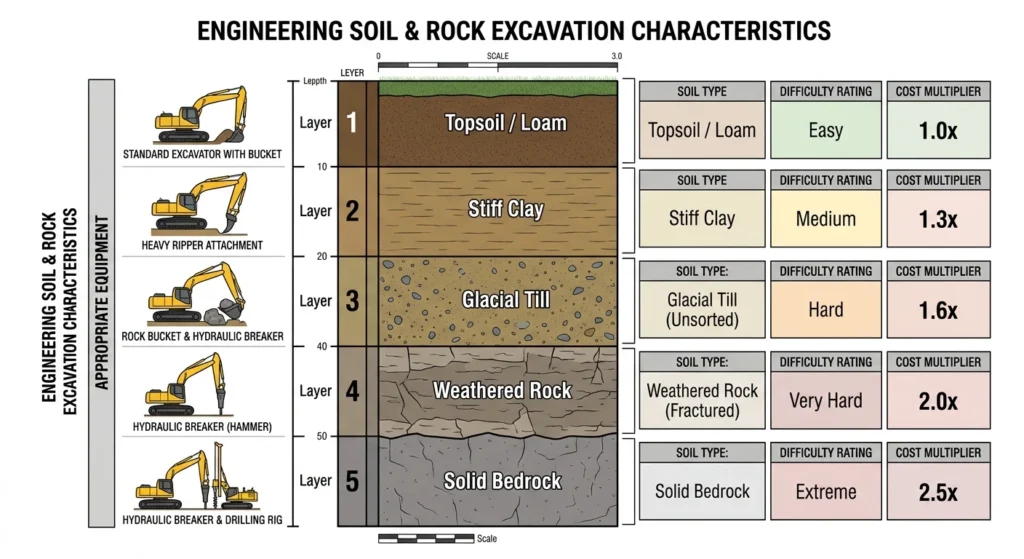
Soil conditions can significantly change excavation costs.
| Material | Cost Per Cubic Yard |
|---|---|
| Common earth | $3.50–$6 |
| Stiff clay | $5–$9 |
| Glacial till | $7–$14 |
| Weathered rock | $12–$22 |
| Solid rock | $18–$35+ |
These are planning-level excavation ranges. Hauling, disposal, dewatering, blasting, specialized equipment, and other site costs can increase the final project price.
3. Site Access
Restricted urban sites, steep terrain, wetlands, and remote locations can increase equipment and transportation costs. Easy equipment access generally keeps costs lower. It also include:
- narrow entrances
- overhead power lines
- nearby buildings
- traffic restrictions
- limited staging area
- underground utilities
- steep slopes
- soft ground
- urban congestion
4. Hauling and Disposal
If excavated soil cannot be reused on-site, hauling can become a major expense.
- On-site: $1.50–$3/CY
- 1–5 miles: $4–$7/CY
- 5–15 miles: $6.50–$11/CY
- 15–30 miles: $10–$16/CY
- 30+ miles: $14–$22+/CY
Reusing suitable soil as fill can significantly reduce these costs. Hauling costs depend on both travel distance and trucking logistics. Disposal or landfill fees may also be charged separately from transportation.
5.Soil Disposal and Hauling Costs
Explain the difference between:
Excavate → load → haul → dispose
versus:
Excavate → stockpile → reuse on-site
The second option can save substantial money when the soil is suitable.
6. Permits and Site Conditions
Grading permits, stormwater requirements, utility coordination, groundwater, unsuitable soil, and environmental restrictions can add both cost and construction time.
Commercial Excavation Cost Per Cubic Yard
Commercial excavation is often estimated by cubic yard when contractors need to calculate the amount of soil or rock that must be removed. A basic excavation project may cost around $10–$50 per cubic yard, although difficult soil, rock, restricted access, hauling, and disposal can increase the final price.
Excavation cost = cubic yards × excavation cost per cubic yard
Example
If a project requires 1,000 cubic yards of excavation and the excavation rate is $20/CY:
1,000 × $20 = $20,000
Commercial Excavation Cost Per Square Foot
Square-foot pricing is less reliable than cubic-yard pricing because excavation depth varies.
For example:
A 10,000-square-foot building pad excavated 1 foot deep is completely different from the same 10,000-square-foot area excavated 6 feet deep.
Real Excavation Calculation
10,000-Square-Foot Commercial Site
Suppose:
- Area = 10,000 sq. ft.
- Average excavation depth = 2 ft.
Volume:
10,000 × 2 = 20,000 cubic feet
Convert to cubic yards:
20,000 ÷ 27 = approximately 741 CY
If excavation costs $20/CY:
741 × $20 = $14,820
While commercial site work involves strict municipal regulations, residential excavation costs typically focus on home foundations, lot prep, and utility connections.
This is an example of excavation-only pricing. Hauling, disposal, grading, rock excavation, permits, and other project costs can increase the final price.
Typical Commercial Site Development Cost Components
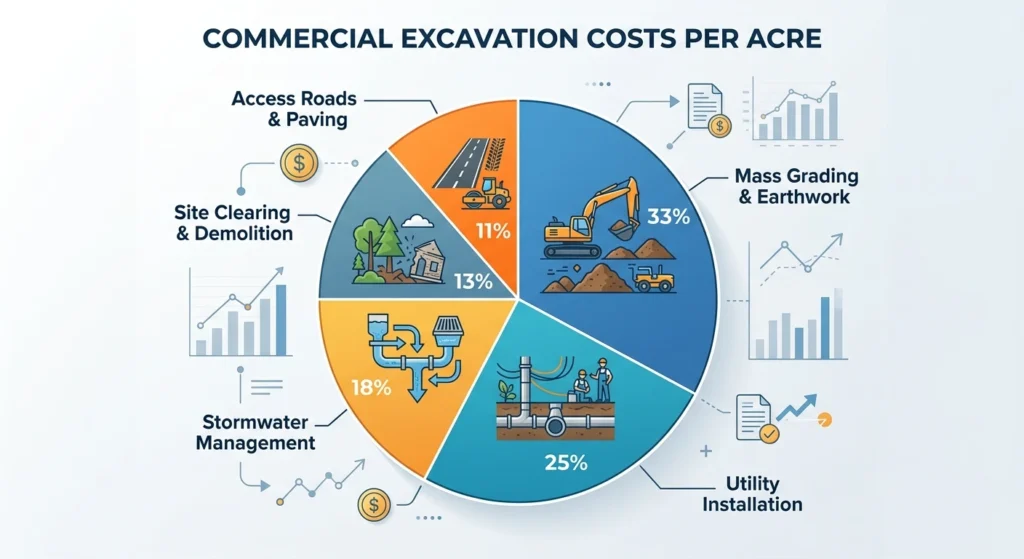
For broader site development, costs may include:
| Component | Typical Cost Per Acre |
|---|---|
| Clearing/demolition | $3,000–$25,000+ |
| Grading/earthwork | $8,000–$45,000 |
| Utilities | $15,000–$50,000+ |
| Stormwater | $15,000–$30,000 |
| Roads/paving/drainage | $10,000–$40,000 |
| Total site development | $20,000–$100,000+ |
These are planning ranges; actual contractor pricing depends on local conditions.
Groundwater and Dewatering
A project with a high water table may require:
- pumps
- drainage
- well points
- temporary piping
- sump systems
- additional excavation stabilization
Underground Utilities
This is another important commercial factor.
Before excavation, contractors may need to locate:
- water lines
- sewer
- gas
- electrical
- telecommunications
- stormwater infrastructure
Unexpected utilities can delay the project and require redesign or hand excavation.
How to Reduce Commercial Excavation Costs?
You can control excavation expenses by:
- Getting a geotechnical report before construction
- Balancing cut and fill on-site
- Reusing suitable excavated material
- Comparing at least three contractor quotes
- Planning hauling routes carefully
- Reducing equipment idle time
- Building a contingency for unexpected site conditions
Frequently Asked Questions
How much does commercial excavation cost per cubic yard?
General excavation can cost approximately $10–$50 per cubic yard, while the actual cut-only cost depends on the soil or rock being excavated.
How much does commercial site development cost per acre?
A broad planning range is $20,000–$100,000+ per acre, depending on the scope of development and site conditions.
What is the biggest factor affecting excavation costs?
Soil conditions are one of the biggest variables. Rock, clay, groundwater, and unsuitable material can substantially increase costs.
Is hauling included in excavation costs?
Not always. Some contractors include hauling and disposal, while others charge separately. Always request an itemized quote.
Final Takeaway
Commercial excavation typically starts around $5,000 and can exceed $25,000, while complete site development can reach $100,000+ per acre. Soil, project size, hauling, access, permits, and utilities have the biggest impact on your final cost.
For an accurate estimate, test the soil, calculate excavation quantities, compare detailed contractor quotes, and account for hauling and site preparation before setting your budget.

Ahmed Ijaz runs this construction rental directory with over 5 years of experience in SEO, content, and web optimization. Every page is built using real research, hands-on expertise, and carefully reviewed information to meet strong EEAT standards.