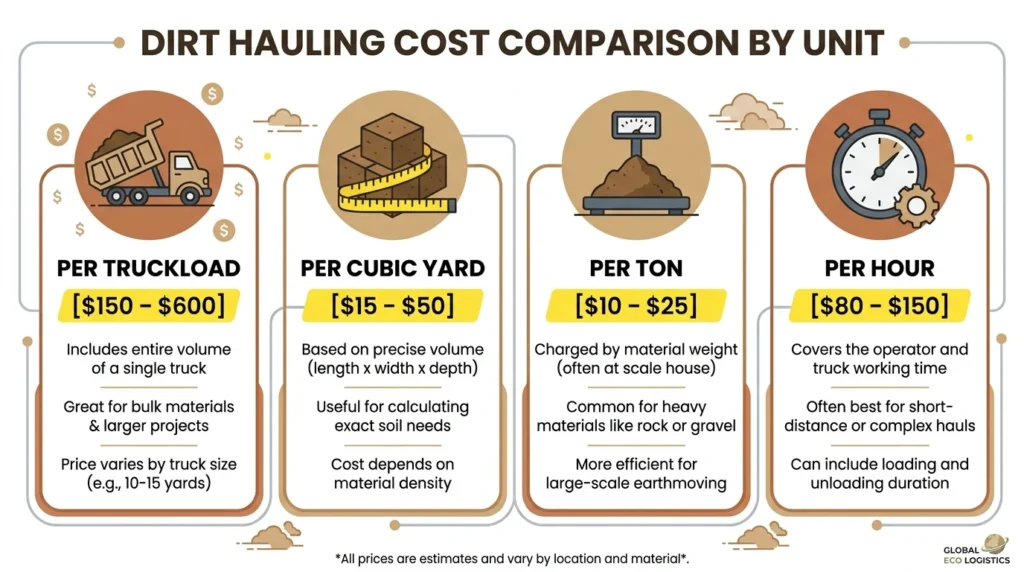
Dirt hauling costs $150 to $600 per truckload or about $15 to $50 per cubic yard, depending on haul distance, material type, truck capacity, labor, fuel, and disposal fees. Larger projects may also use per-ton or hourly pricing.
What Is Dirt Hauling?
Dirt hauling is the transportation of excavated soil, fill dirt, spoil material, or aggregate from a construction site to a disposal site, landfill, fill site, or another project that can use the material.
The process typically involves:
- Excavation: Produces the material that needs to be removed.
- Dump trucks: Transport the material.
- Haul route: Determines travel time and fuel use.
- Disposal or fill site: Receives or reuses the dirt.
- Labor and equipment: Cover loading, trucking, fuel, and operating costs.
How Much Does Dirt Hauling Cost?
| Pricing Method | Typical Cost | Best For |
|---|---|---|
| Per truckload | $150–$600 | Residential and small commercial jobs |
| Per cubic yard | $15–$50 | Estimating and project bidding |
| Per ton | $10–$25 | Large earthwork projects |
| Per hour | $80–$150 | Short hauls or uncertain workloads |
The actual price depends mainly on distance, material weight, truck size, disposal charges, and local market conditions.
Dirt Hauling Cost Per Truckload
A standard dirt-hauling load generally costs $150 to $600.
Typical truck capacities include:
- Tandem axle: 10–12 cubic yards
- Tri-axle: 14–16 cubic yards
- Articulated truck: 20–24 cubic yards
Longer routes increase cycle time and reduce the number of loads a truck can complete in one shift. Heavy materials such as wet clay can also reduce the legal payload, requiring additional trips.
Dirt Hauling Cost Per Cubic Yard
Dirt hauling costs about $15 to $50 per cubic yard when hauling and disposal are included.
When estimating excavated material, distinguish between bank cubic yards (BCY) and loose cubic yards (LCY). Excavated soil expands after it is removed from the ground, increasing the volume that must be transported.
Dirt Hauling Cost Per Ton
Hauling alone typically costs $10 to $25 per ton. Additional charges may include:
- Tipping fees: $3–$8 per ton
- Fuel surcharges: $0.50–$1.50 per ton
Per-ton pricing is commonly used for large earthwork projects, variable-density materials, and contracts that require certified scale tickets.
What Factors Affect Dirt Hauling Cost?
Haul Distance
Distance is one of the largest cost factors. Longer routes increase fuel consumption, driver time, and truck cycle time.
| One-Way Distance | Typical Cycle Time | Loads per Truck/Shift |
|---|---|---|
| 0–3 miles | 15–25 minutes | 16–20 |
| 5–10 miles | 30–45 minutes | 9–12 |
| 15–25 miles | 60–90 minutes | 5–7 |
| 25+ miles | 90+ minutes | 3–4 |
Traffic, road restrictions, queues, and site access can make a short-distance haul take considerably longer.
Material Type and Weight
Soil density affects how much material a truck can legally carry. Wet clay and aggregate are heavier than dry topsoil, so the truck may reach its weight limit before reaching its maximum volume.
Typical densities include:
- Dry loam: 1.1–1.3 tons/BCY
- Moist loam: 1.3–1.5 tons/BCY
- Wet clay: 1.5–1.8 tons/BCY
- Sand/gravel: 1.4–1.6 tons/BCY
- Hardpan/shale: 1.6–2.0 tons/BCY
Truck Size
Truck selection affects both capacity and the number of trips required.
| Truck Type | Loose Capacity | Typical Legal Payload |
|---|---|---|
| Single axle | 8–10 CY | 10–12 tons |
| Tandem axle | 10–12 CY | 13–15 tons |
| Tri-axle | 14–16 CY | 15–18 tons |
| Articulated | 20–24 CY | 20–25 tons |
Larger trucks can reduce trip counts, but payload limits must still be observed.
Disposal and Tipping Fees
The receiving location can add substantially to the total.
Typical disposal conditions include:
- Free fill exchange: $0
- Standard landfill/inert debris: $20–$60 per load
- Construction and demolition debris: $50–$100 per load
- Contaminated soil: $150–$300+ per ton, plus specialized handling
Clean dirt may have little or no disposal cost when another nearby project needs fill.
Local Market Conditions
Labor rates, traffic, and disposal-site availability cause regional differences. Urban areas can have significantly higher hauling costs because trucks spend more time in traffic and permitted receiving locations may be limited.
How to Calculate Dirt Hauling Cost?
Step 1: Calculate Loose Volume
Excavated material expands after removal. Use the fluff factor when converting bank volume to loose volume:
Loose Cubic Yards (LCY) = Bank Cubic Yards (BCY) × (1 + Fluff Factor)
The outline identifies typical expansion as approximately 15–35%, although the supplied methodology also lists higher factors for some soil types. The appropriate factor depends on the material.
Step 2: Calculate Truckloads
Divide the loose volume by the truck’s loose capacity:
Loads = Total LCY ÷ Truck LCY Capacity
Then check that the resulting load weight does not exceed the truck’s legal payload.
Step 3: Calculate Cycle Time
A truck’s cycle time includes:
- Loading: 8–12 minutes
- Loaded travel
- Dumping and spotting: 3–5 minutes
- Empty return
- Waiting or queue time: 0–30+ minutes
Longer cycle times reduce truck production and can increase the total project cost.
Step 4: Add Hauling and Disposal Costs
For example, a project with 3,000 BCY of moist clay, a 40% fluff factor, and a 12-mile haul produces approximately 4,200 LCY of loose material.
Using a 15-CY tri-axle:
- Loose volume: 4,200 LCY
- Truckloads: 280
- Estimated truck shifts: 40
- Driver, fuel, and truck: $34,200
- Tipping fees: $16,800
- Subtotal: $51,000
- Contractor margin: $10,200
- Total: $61,200
- Cost per BCY: $20.40
Actual bids should be based on current local hauling and disposal rates rather than this example.
Step 5: Verify Local Rates
Before finalizing a budget or bid:
- Get quotes from at least three local hauling companies.
- Confirm current tipping fees.
- Check the current fuel-cost basis for applicable surcharges.
- Review the actual haul route for traffic, access, and weight restrictions.
How to Reduce Dirt Hauling Costs?
Find a Nearby Fill Site
A nearby project that needs clean fill can eliminate or reduce disposal-related hauling. Material exchange can be particularly useful when the receiving location is only a few miles away.
Optimize the Haul Route
Check the route before bidding. Consider:
- Peak traffic periods
- Weight-restricted roads
- Low bridges
- School zones
- Site access
- Queue times
Match Trucks to the Project
Use truck sizes that match the excavator’s production, material weight, access conditions, and haul distance. Oversized trucks may not provide an advantage when weight or site access limits the load.
Define Hauling Terms in the Contract
Specify:
- Measurement method
- Fuel surcharge
- Standby rate
- Material specifications
- Disposal requirements
Clear terms reduce disputes over quantities, rejected loads, fuel adjustments, and waiting time.
Urban vs. Rural Dirt Hauling Costs
Urban hauling can cost substantially more than comparable rural work because of congestion, longer cycle times, higher labor costs, and limited disposal capacity.
Lower-cost conditions generally include:
- Haul distances under 5 miles
- Nearby fill sites
- Low traffic
- Multiple competing hauling companies
- Available material exchange opportunities
Frequently Asked Questions
How much does it cost to haul away 10 yards of dirt?
A 10-yard load typically costs $150 to $400, depending on distance and disposal fees. A 15-yard tri-axle load may cost approximately $200 to $500.
Is it cheaper to haul dirt per ton or per load?
Neither pricing method is automatically cheaper. Per-ton pricing can work well for large projects with scale tickets, while per-load pricing is simpler for smaller jobs. Compare both quotes using the same project quantities.
How much does it cost to haul dirt per mile?
The supplied pricing framework gives approximately $3 to $8 per mile when calculated on a round-trip basis.
Can I avoid dirt hauling costs?
Yes. On-site cut-and-fill balancing can eliminate hauling when excavated material can be reused on the property. A nearby fill exchange can also reduce transportation and disposal costs.
What is the fluff factor?
The fluff factor accounts for the increase in soil volume after excavation. Ignoring this expansion can result in too few estimated truckloads and an inaccurate hauling budget.
Conclusion
Planning dirt hauling early can make the entire removal process more predictable and easier to manage. A clear understanding of the material, project requirements, and hauling arrangements helps prevent delays and unexpected complications. For accurate budgeting, use the actual conditions of your project rather than relying solely on general estimates.

Ahmed Ijaz runs this construction rental directory with over 5 years of experience in SEO, content, and web optimization. Every page is built using real research, hands-on expertise, and carefully reviewed information to meet strong EEAT standards.