If you are planning an aerial work project in Colorado, explore available reach heights and machine specs on our Denver boom lift rentals page.
Selecting the right boom lift can significantly impact productivity, safety, and project costs. A lift that’s too small may leave workers unable to reach the work area, while an oversized machine can create maneuverability challenges and increase rental expenses.
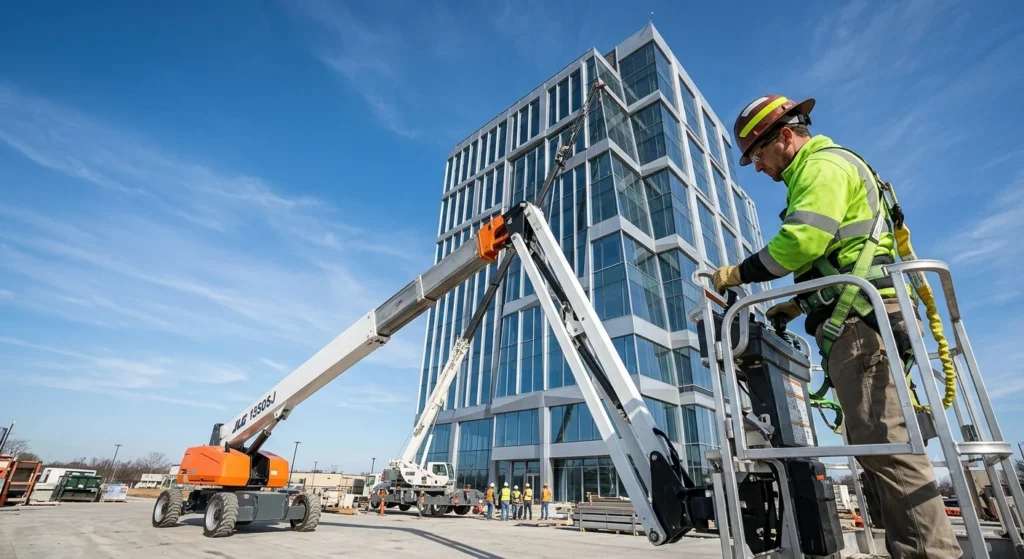
Whether you’re managing a construction project, facility maintenance job, tree trimming operation, or industrial inspection, choosing the correct boom lift size starts with understanding height requirements, horizontal reach, platform capacity, and jobsite conditions.
This guide explains everything you need to know about boom lift sizing in 2026, including detailed size comparisons, project recommendations, and expert selection tips.
Understanding Boom Lift Fundamentals
What Is a Boom Lift?
A boom lift, often called a cherry picker, is a mobile aerial work platform that uses an extendable boom arm to raise workers and materials to elevated work areas.
Unlike scissor lifts that only move vertically, boom lifts can extend both upward and outward, allowing operators to access difficult-to-reach locations.
Common applications include:
- Building construction
- Exterior maintenance
- Tree trimming
- Utility work
- Warehouse maintenance
- Telecommunications installation
- Industrial inspections
Articulating vs. Telescopic Boom Lifts
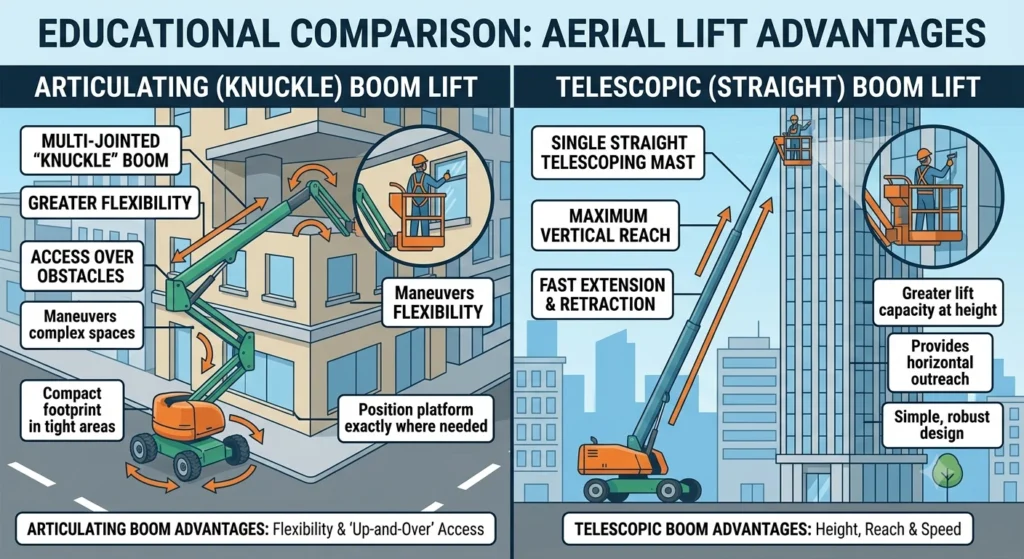
Choosing between articulating and telescopic boom lifts is often the first step in selecting the correct machine.
Articulating Boom Lifts
Articulating boom lifts feature multiple hinged sections or “knuckles” that allow the boom to bend around obstacles.
Advantages
- Excellent obstacle navigation
- Precise positioning
- Better access in confined areas
- Ideal for indoor and outdoor work
Best Applications
- Facility maintenance
- Roofing repairs
- Tree trimming
- Warehouse operations
- Building facade work
Maximum Height
Most articulating lifts reach up to 150 feet of working height.
Telescopic Boom Lifts
Telescopic boom lifts use a straight boom that extends and retracts like a telescope.
Advantages
- Greater horizontal reach
- Higher maximum working heights
- Faster positioning
- Higher lift capacities
Best Applications
- High-rise construction
- Bridge work
- Utility projects
- Large infrastructure jobs
Maximum Height
Some telescopic boom lifts provide working heights exceeding 185 feet.
Quick Decision Rule
Choose an articulating boom lift when obstacles must be navigated.
Choose a telescopic boom lift when maximum height and reach are required.
Understanding Working Height vs. Platform Height
One of the most common mistakes when renting a boom lift is confusing platform height with working height.
Platform Height
The vertical distance from the ground to the floor of the platform.
Working Height
Platform height plus approximately six feet to account for the operator’s reach.
Example
- Platform Height: 40 feet
- Working Height: 46 feet
Always use working height when determining the lift size required for a project.
Complete Boom Lift Size Breakdown
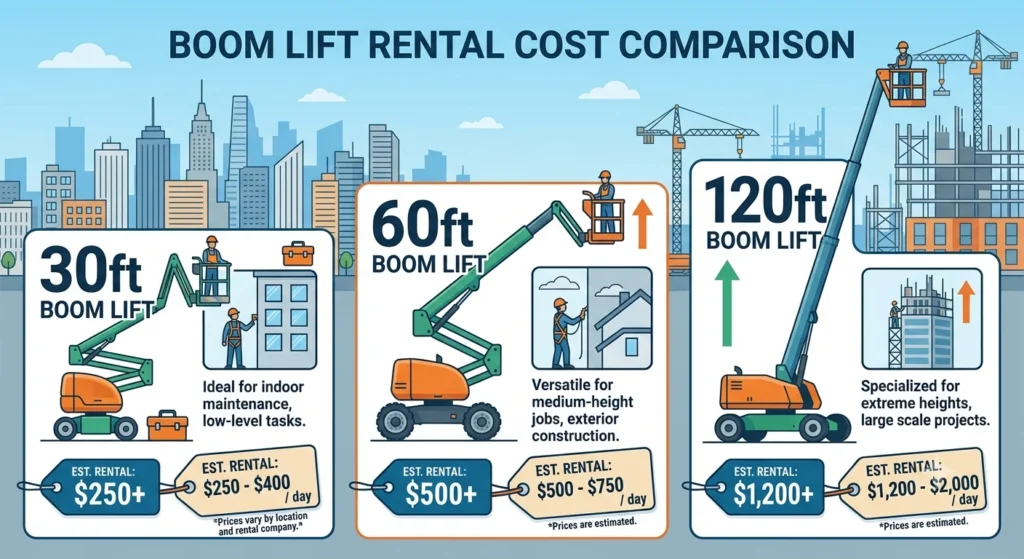
Small Boom Lifts (30–50 Foot Working Height)
Typical Applications
- Indoor maintenance
- Lighting installation
- Warehouse repairs
- Ceiling work
Common Features
- Compact design
- Easy maneuverability
- Lower operating costs
- Available in electric models
Best For
Facilities managers, electricians, and maintenance contractors.
Medium Boom Lifts (60–80 Foot Working Height)
Typical Applications
- Commercial construction
- Building maintenance
- Exterior renovations
- Tree care services
Benefits
- Greater horizontal reach
- Improved jobsite versatility
- Suitable for most commercial projects
Best For
General contractors and commercial maintenance teams.
Large Boom Lifts (100–150 Foot Working Height)
Typical Applications
- High-rise construction
- Industrial facilities
- Infrastructure maintenance
- Telecommunications towers
Benefits
- Extensive reach capabilities
- Higher platform capacities
- Suitable for complex projects
Best For
Large-scale construction and industrial contractors.
Extreme Height Boom Lifts (150–185+ Foot Working Height)
Typical Applications
- Skyscraper construction
- Stadium maintenance
- Bridge inspections
- Utility infrastructure
Benefits
- Maximum elevation
- Industry-leading horizontal reach
- Access to difficult work zones
Best For
Specialized infrastructure and mega-projects.
Key Factors That Determine Boom Lift Size
1. Height Requirements
Start by identifying the highest point where work will occur.
Simple Formula
Required Working Height = Highest Work Point + Safety Clearance
Example:
- Building height: 75 feet
- Additional clearance: 5 feet
Recommended boom lift working height: 80–85 feet.
2. Horizontal Reach
Can the machine park directly beneath the work area?
If not, you’ll need additional horizontal outreach.
Common Examples
- Reaching over landscaping
- Working above roofs
- Accessing utility poles
- Navigating industrial equipment
Telescopic lifts generally provide the greatest horizontal reach.
3. Platform Capacity
Capacity includes:
- Workers
- Tools
- Equipment
- Materials
Typical Capacity Ranges
| Capacity | Best For |
|---|---|
| 500 lbs | One operator + tools |
| 600–750 lbs | Two workers + equipment |
| 1,000 lbs | Heavy materials or multiple workers |
Always leave a safety margin below maximum capacity.
4. Worksite Conditions
Indoor Work
Recommended:
- Electric boom lifts
- Non-marking tires
- Compact articulating models
Outdoor Construction
Recommended:
- Diesel-powered lifts
- Rough-terrain tires
- Telescopic or large articulating models
Uneven Ground
Look for:
- Four-wheel drive
- Oscillating axles
- High gradeability ratings
5. Power Source Selection
Electric Boom Lifts
Best For:
- Warehouses
- Shopping centers
- Hospitals
- Airports
Benefits:
- Zero emissions
- Quiet operation
- Reduced maintenance
Diesel Boom Lifts
Best For:
- Construction sites
- Infrastructure projects
- Rough terrain
Benefits:
- Greater power
- Longer runtime
- Superior outdoor performance
Hybrid Boom Lifts
Best For:
- Mixed-use environments
Benefits:
- Indoor and outdoor versatility
- Improved fuel efficiency
Project-Specific Boom Lift Recommendations
Residential Construction
Recommended Lift:
- Articulating or telescopic
- 45–60 ft working height
Suitable For:
- Roofing
- Exterior siding
- Framing work
Commercial Construction
Recommended Lift:
- Telescopic
- 80–150 ft working height
Suitable For:
- Multi-story buildings
- Structural steel installation
- Curtain wall systems
Warehouse Maintenance
Recommended Lift:
- Electric articulating
- 30–45 ft working height
Suitable For:
- Lighting replacement
- HVAC maintenance
- Inventory systems
Tree Trimming
Recommended Lift:
- Articulating
- 45–60 ft working height
Why?
The articulated boom can maneuver around branches and obstacles.
Telecommunications Work
Recommended Lift:
- Telescopic
- 60–120 ft working height
Suitable For:
- Cell towers
- Communication infrastructure
- Utility poles
Bridge Inspection
Recommended Lift:
- Telescopic
- 80–150 ft working height
Benefits:
- Long outreach
- High platform capacities
- Excellent access to hard-to-reach structures
Should You Rent or Buy a Boom Lift?
Renting Makes Sense When:
- Projects are temporary
- Storage space is limited
- You need specialized equipment occasionally
- Maintenance costs are a concern
Buying Makes Sense When:
- Equipment is used regularly
- Long-term costs justify ownership
- Fleet availability is critical
For many contractors, renting provides access to the latest technology without the burden of maintenance and transportation costs.
Frequently Asked Questions
How do I know what size boom lift I need?
Determine the required working height, horizontal reach, platform capacity, and worksite constraints. Select a machine that exceeds each requirement.
What is the most common boom lift size?
Boom lifts with 45–60 feet of working height are among the most commonly rented models for construction and maintenance projects.
What size boom lift do I need for a two-story building?
A two-story building generally requires a boom lift with approximately 30 feet of working height.
What is the difference between working height and platform height?
Platform height measures the floor of the platform, while working height adds approximately six feet for operator reach.
Can boom lifts be used indoors?
Yes. Electric boom lifts are specifically designed for indoor environments because they produce no emissions and operate quietly.
How much weight can a boom lift platform hold?
Most boom lifts support between 500 and 1,000 pounds depending on the model and operating position. requirements. Proper sizing improves productivity, enhances safety, and helps avoid costly project delays.
When comparing aerial lift options for construction projects, the right equipment depends on the height, workspace, and type of work involved. A boom lift is useful when workers need extended horizontal or vertical reach, while a scissor lift provides a stable platform for jobs that require straight vertical access. If you’re considering the latter for your project, see our guide to scissor lift rental costs to understand typical rental rates and the factors that affect the final price.

Ahmed Ijaz runs this construction rental directory with over 5 years of experience in SEO, content, and web optimization. Every page is built using real research, hands-on expertise, and carefully reviewed information to meet strong EEAT standards.