A skid steer loader also known as a skid loader or compact loader is one of the most versatile pieces of heavy equipment used in construction, landscaping, agriculture, snow removal, and demolition. While these machines are known for their power and maneuverability, one of the most important specifications to understand is how much a skid steer weighs.

Skid steer weight affects jobsite safety, lifting capability, transportation requirements, ground impact, and rental costs. In this guide, we’ll break down skid steer weight in detail, explain what influences it, and help you choose the right machine for your job.
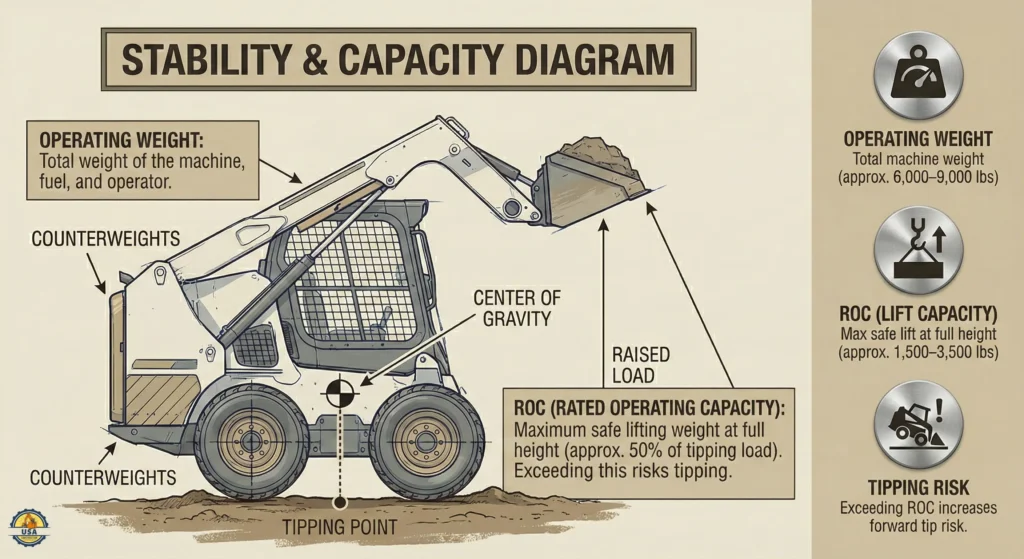
What Is a Skid Steer’s Operating Weight?
The operating weight of a skid steer refers to the total weight of the machine ready for work. This typically includes:
- The base machine
- Fluids (fuel, oil, hydraulic fluid)
- Standard bucket or attachment
- Operator (in some manufacturer specs)
Operating weight is different from how much a skid steer can lift. That lifting ability is defined by a separate metric called Rated Operating Capacity (ROC).
Understanding both numbers is critical for safe operation and proper equipment selection.
How Much Does a Skid Steer Weigh on Average?
Most skid steer loaders fall within the following range:
- Typical operating weight: 3,000 to 12,000 pounds
- Average skid steer weight: ~7,500 pounds
The exact weight depends on the machine size, frame class, engine power, counterweights, and attachments.
Skid Steer Weight by Size Class
Skid steers are commonly grouped into small-frame, medium-frame, and large-frame categories. Larger machines weigh more, lift more, and require more space and transport capacity.
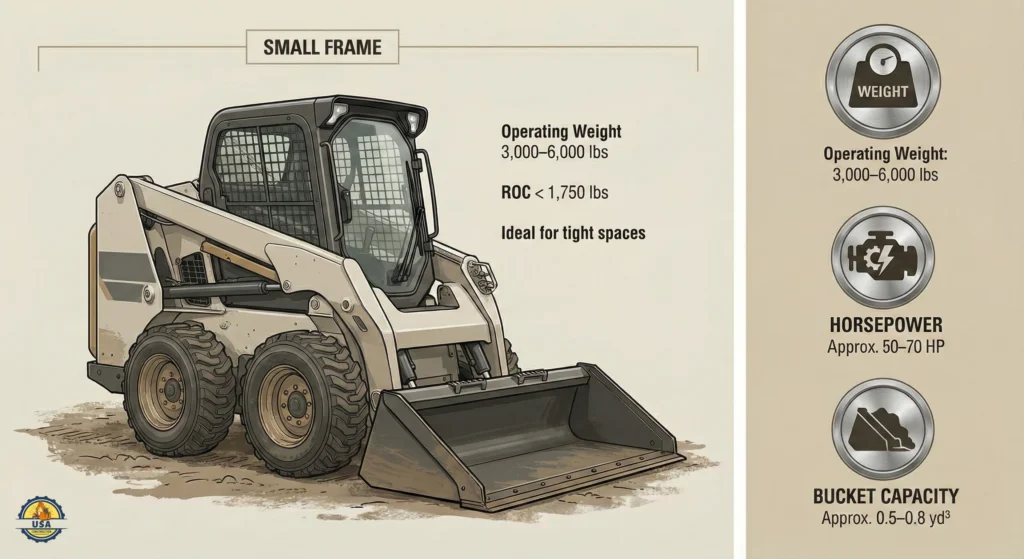
Small-Frame Skid Steers (3,000–6,000 lbs)
Small-frame skid steers are lightweight, compact, and highly maneuverable. They’re ideal for tight spaces, residential projects, interior work, and landscaping.
- Operating weight: 3,000–6,000 lbs
- Rated operating capacity: Under 1,750 lbs
- Horsepower: 20–50 HP
Common use cases
- Landscaping
- Interior demolition
- Residential construction
- Sidewalks and narrow access sites
Popular small-frame models
| Model | Operating Weight (lb) | ROC (lb) | Horsepower |
|---|---|---|---|
| Bobcat S70 | 2,892 | 760 | 24 |
| Bobcat S450 | 5,370 | 1,370 | 49 |
| CASE SR130 | 5,000 | 1,300 | 49 |
Medium-Frame Skid Steers (6,000–7,000 lbs)
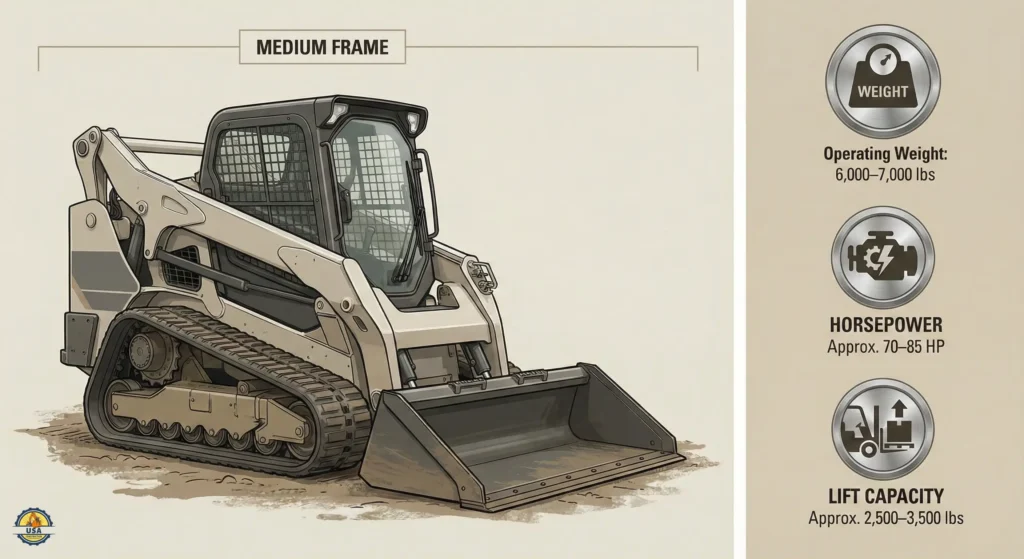
Medium-frame skid steers are the most common machines on jobsites. They balance power, lifting ability, and maneuverability.
- Operating weight: 6,000–7,000 lbs
- Rated operating capacity: 1,750–2,200 lbs
- Horsepower: 55–75 HP
Common use cases
- Site development
- Earthmoving
- Snow removal
- Roadside and municipal work
Popular medium-frame models
| Model | Operating Weight (lb) | ROC (lb) | Horsepower |
|---|---|---|---|
| Bobcat S510 | 6,208 | 1,876 | 55 |
| Bobcat S590 | 6,765 | 2,101 | 68 |
| CASE SR120B | 6,970 | 2,100 | 74 |
Large-Frame Skid Steers (7,000–12,000 lbs)
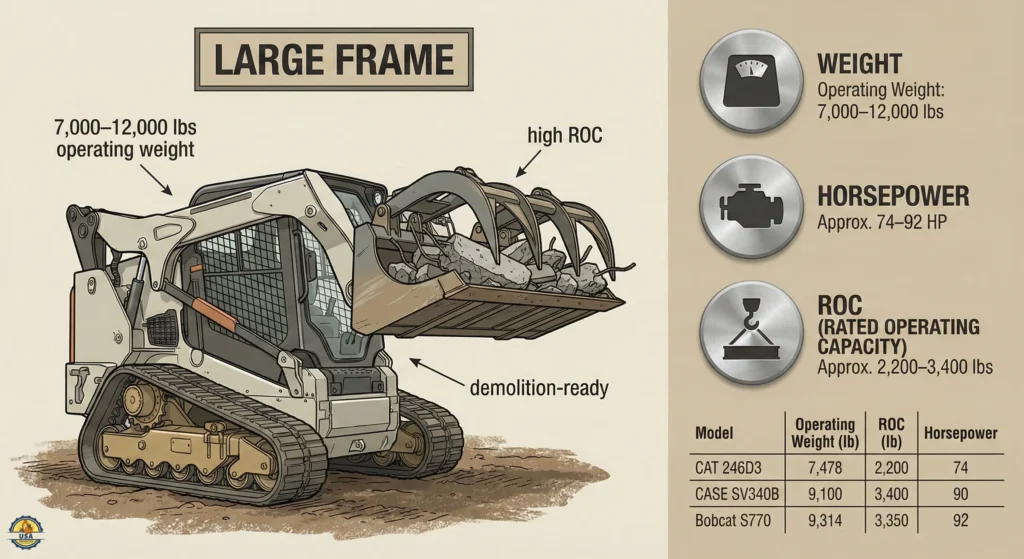
Large-frame skid steers are built for demanding, high-production work. Their heavier weight improves stability when lifting large loads.
- Operating weight: 7,000–12,000 lbs
- Rated operating capacity: 2,200–4,200 lbs
- Horsepower: 75–100+ HP
Common use cases
- Demolition
- Excavation
- Heavy material handling
- Road construction
Popular large-frame models
| Model | Operating Weight (lb) | ROC (lb) | Horsepower |
|---|---|---|---|
| CAT 246D3 | 7,478 | 2,200 | 74 |
| CASE SV340B | 9,100 | 3,400 | 90 |
| Bobcat S770 | 9,314 | 3,350 | 92 |
Operating Weight vs Rated Operating Capacity (ROC)
A common mistake is confusing machine weight with lifting capacity.
- Operating Weight: How much the skid steer itself weighs
- Rated Operating Capacity (ROC): Maximum safe lifting weight at full height
ROC is typically 50% of the tipping load. Exceeding it increases the risk of tipping forward, especially with raised arms or heavy attachments.
What Affects Skid Steer Weight?
Several variables influence how much a skid steer weighs:
1. Counterweights
Heavier counterweights improve stability but increase overall machine weight.
2. Attachments
Attachments are included in operating weight and directly reduce available lift capacity.
3. Frame Size & Engine Power
Larger engines, reinforced frames, and hydraulic systems add significant weight.
4. Wheeled vs Tracked
Compact track loaders typically weigh 1,000–2,000 lbs more than wheeled skid steers of similar size.
How Much Do Skid Steer Attachments Weigh?
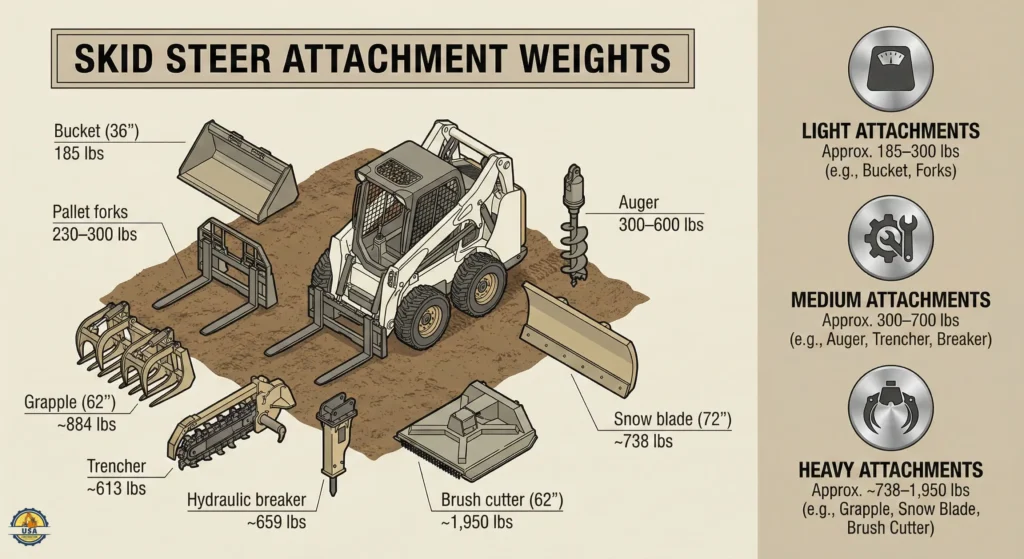
Attachments can dramatically increase total operating weight.
| Attachment | Approximate Weight |
|---|---|
| Bucket (36”) | 185 lbs |
| Pallet forks | 230–300 lbs |
| Auger | 300–600 lbs |
| Trencher | ~613 lbs |
| Hydraulic breaker | ~659 lbs |
| Grapple (62”) | ~884 lbs |
| Snow blade (72”) | ~738 lbs |
| Brush cutter (62”) | ~1,950 lbs |
Transportation & Trailering Considerations (Often Missed)
Skid steer weight directly affects how you transport it.
- Small skid steers may fit on 7,000–10,000 lb GVWR trailers
- Medium to large machines often require 14,000–20,000 lb GVWR trailers
- Add attachment weight to avoid overloading
- DOT and CDL requirements may apply depending on combined weight
This is a major decision factor for contractors hauling equipment daily.
How Much Can a Skid Steer Lift?
- Small-frame: Up to ~1,750 lbs
- Medium-frame: 1,750–2,200 lbs
- Large-frame: Up to 4,200 lbs
Always stay within manufacturer ROC limits to prevent rollovers.
Rental Cost: How Weight Impacts Price
Heavier skid steers generally cost more to rent.
Typical monthly rental ranges
- Wheeled skid steer: $600–$1,000
- Tracked skid steer: $700–$1,500
- Attachments: Additional weekly/monthly fees
Weight influences delivery fees, fuel use, and wear costs, which rental companies factor into pricing.
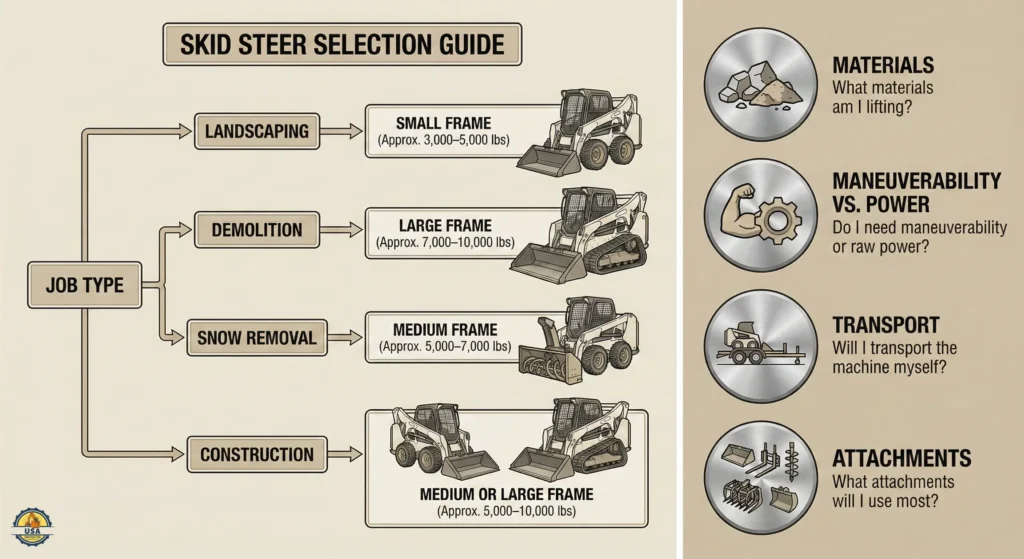
Choosing the Right Skid Steer for Your Job
Ask these questions:
- What materials am I lifting?
- Do I need maneuverability or raw power?
- Will I transport the machine myself?
- What attachments will I use most?
Skid Steer Safety and Weight Awareness
Many skid steer incidents occur not because of mechanical failure, but due to overloading, improper operation, or misunderstanding the machine’s limits. Whether you’re working on a residential lot or a commercial construction site, respecting skid steer weight limits is essential for protecting operators, nearby workers, and property.
Never Exceed the Rated Operating Capacity (ROC)
The rated operating capacity (ROC) defines the maximum load a skid steer can safely lift to full height without tipping. Exceeding this limit dramatically increases the risk of a forward rollover, especially when:
- The load is raised above shoulder height
- The skid steer is operating on uneven ground
- A heavy attachment is installed
ROC is calculated based on 50% of the machine’s tipping load, meaning there is very little margin for error. Even if the machine can lift more momentarily, doing so compromises stability and violates safety guidelines.
Lower Attachments Before Exiting the Machine
Before leaving the operator’s seat:
- Fully lower the bucket or attachment to the ground
- Place the skid steer in neutral
- Engage the parking brake
Lowering attachments reduces stored hydraulic energy and prevents accidental movement. A raised attachment combined with the machine’s weight creates a dangerous tipping hazard if hydraulics fail or controls are accidentally engaged.
Use ROPS and FOPS at All Times
Modern skid steers are equipped with:
- ROPS (Roll-Over Protective Structure) to protect operators during rollovers
- FOPS (Falling Object Protective Structure) to guard against debris and overhead hazards
These safety systems are designed specifically to handle the forces generated by the machine’s weight during an accident. Never modify, remove, or bypass these protections, and always wear the seatbelt so they function correctly.
Train Operators on Weight Limits and Load Dynamics
Proper training is one of the most effective ways to prevent skid steer accidents. Operators should be trained to understand:
- The difference between operating weight and ROC
- How attachment weight reduces usable lift capacity
- How load height and reach affect balance
- How skid steer weight shifts during turns and braking
Even experienced operators can underestimate how quickly weight distribution changes when lifting, dumping, or traveling on slopes.
Adjust Operation for Uneven Terrain and Slopes
Skid steer weight behaves differently on uneven ground. When working on slopes or rough terrain:
- Travel with the load low to the ground
- Avoid turning on inclines
- Drive straight up or down slopes, not across them
- Use tracked machines for soft or unstable surfaces when possible
Heavier skid steers offer increased stability, but they also generate greater momentum. Improper handling on slopes can lead to loss of control or rollovers.
Weight Awareness Improves Jobsite Safety and Efficiency
While heavier skid steers are generally more stable, that stability only holds when the machine is used within its engineered limits. Understanding weight, capacity, attachments, and terrain allows operators to:
- Work more efficiently
- Reduce machine wear with regular maintenance
- Prevent costly accidents
- Maintain compliance with safety regulations
Heavier machines are safer only when operated correctly. Respecting skid steer weight is not optional it’s fundamental to safe and productive operation.
Frequently Asked Questions About Skid Steer Weight & Use
1. How much does a skid steer weigh in kg?
A skid steer typically weighs between 1,360 kg and 5,440 kg, depending on the size and model.
- Small-frame skid steers: ~1,360–2,720 kg
- Medium-frame skid steers: ~2,720–3,175 kg
- Large-frame skid steers: ~3,175–5,440 kg
The average skid steer weight is approximately 3,400 kg (7,500 lbs).
2. How much does a skid steer weigh with a bucket?
With a standard bucket attached, most skid steers weigh 185 to 300 pounds (85–136 kg) more than their base operating weight.
For example:
- A 7,500 lb skid steer + 185 lb bucket = ~7,685 lbs total
- Heavier-duty buckets or attachments will add more weight
Always factor attachment weight into your operating weight and rated operating capacity (ROC) calculations.
3. What is the 70/30 rule for skid steers?
The 70/30 rule refers to how a skid steer’s weight is distributed:
- 70% of the machine’s weight is over the rear
- 30% is over the front
This rear-heavy design improves traction and stability when lifting loads. However, when a load is raised, weight shifts forward, increasing the risk of tipping—especially if ROC limits are exceeded.
4. Can a Ford F-150 tow a skid steer?
In most cases, no.
While some Ford F-150 models can tow up to 13,000–14,000 lbs, a skid steer plus trailer often exceeds safe limits:
- Skid steer: ~6,000–9,000 lbs
- Trailer: ~2,000–4,000 lbs
- Attachments: 300–2,000 lbs
This typically pushes the total beyond what a half-ton truck can safely tow. A ¾-ton or 1-ton truck is usually recommended.
5. What should you not do with a skid steer?
You should never:
- Exceed the rated operating capacity (ROC)
- Travel with a raised load
- Turn sharply on slopes
- Operate without a seatbelt
- Bypass ROPS or FOPS safety systems
- Use improper or unsecured attachments
These actions significantly increase the risk of rollovers, equipment damage, and serious injury.
6. Do I need a CDL to tow a skid steer?
You may need a CDL depending on combined vehicle weight ratings (GVWR).
- If the truck + trailer + skid steer exceed 26,001 lbs combined GVWR, a CDL is required
- Many medium and large skid steer setups cross this threshold
Always check federal, state, and local regulations before transporting heavy equipment.
7. Can you get struck by lightning in a skid steer?
Yes, it is possible.
Skid steers are not fully enclosed Faraday cages. While the metal frame offers some protection, operators should:
- Stop work during lightning storms
- Lower attachments to the ground
- Remain inside the cab if shelter is unavailable
- Avoid touching metal components
Lightning safety procedures should always be followed on jobsites.
8. Do I need a license to drive a skid steer?
In most areas, no driver’s license is required to operate a skid steer on private property or jobsites.
However:
- Employer training is usually mandatory
- OSHA requires proper operator training
- A driver’s license may be required if operating on public roads
Certification or documented training is strongly recommended.
9. Can you use a skid steer in the rain?
Yes, skid steers can be used in the rain, but caution is required.
Wet conditions reduce traction and increase stopping distance. Operators should:
- Avoid steep slopes
- Reduce speed
- Ensure attachments are secure
- Watch for soft or muddy ground
Tracked skid steers generally perform better than wheeled models in wet conditions.
10. Skid steer weight with trailer
A skid steer with a trailer typically weighs 8,000 to 16,000+ pounds combined, depending on equipment size.
Typical breakdown:
- Skid steer: 6,000–9,500 lbs
- Trailer: 2,000–4,000 lbs
- Attachments: 300–2,000 lbs
Always verify trailer GVWR and towing capacity before transport.

Usman Zahid runs this construction rental directory with over 5 years of experience in SEO, content, and web optimization. Every page is built using real research, hands-on expertise, and carefully reviewed information to meet strong EEAT standards.