If you’re considering buying, renting, or transporting a mini excavator, one of the first questions you’ll ask is: How much does a mini excavator weigh?
The answer affects more than transportation. Weight determines:
- Whether your pickup truck can tow it
- What size trailer you need
- Whether it will damage lawns, driveways, or soft ground
- Loading and unloading safety
- Licensing and regulatory requirements
- Machine stability and lifting performance
Most mini excavators weigh between 1,000 lbs (0.5 tons) and 12,000 lbs (6 tons). The most commonly rented and purchased models fall in the 3,000–8,000 lb range, making them suitable for residential construction, landscaping, utility work, and light commercial excavation.
What Is a Mini Excavator?
A mini excavator is a compact hydraulic excavator typically weighing less than 12,000 lbs and designed for work in confined spaces.
Compared with larger excavators:
| Machine Type | Typical Weight |
|---|---|
| Mini Excavator | 1,000–12,000 lbs |
| Compact Excavator | 8,000–20,000 lbs |
| Standard Excavator | 20,000–200,000+ lbs |
When evaluating machines, the most important specification is operating weight, not shipping weight.
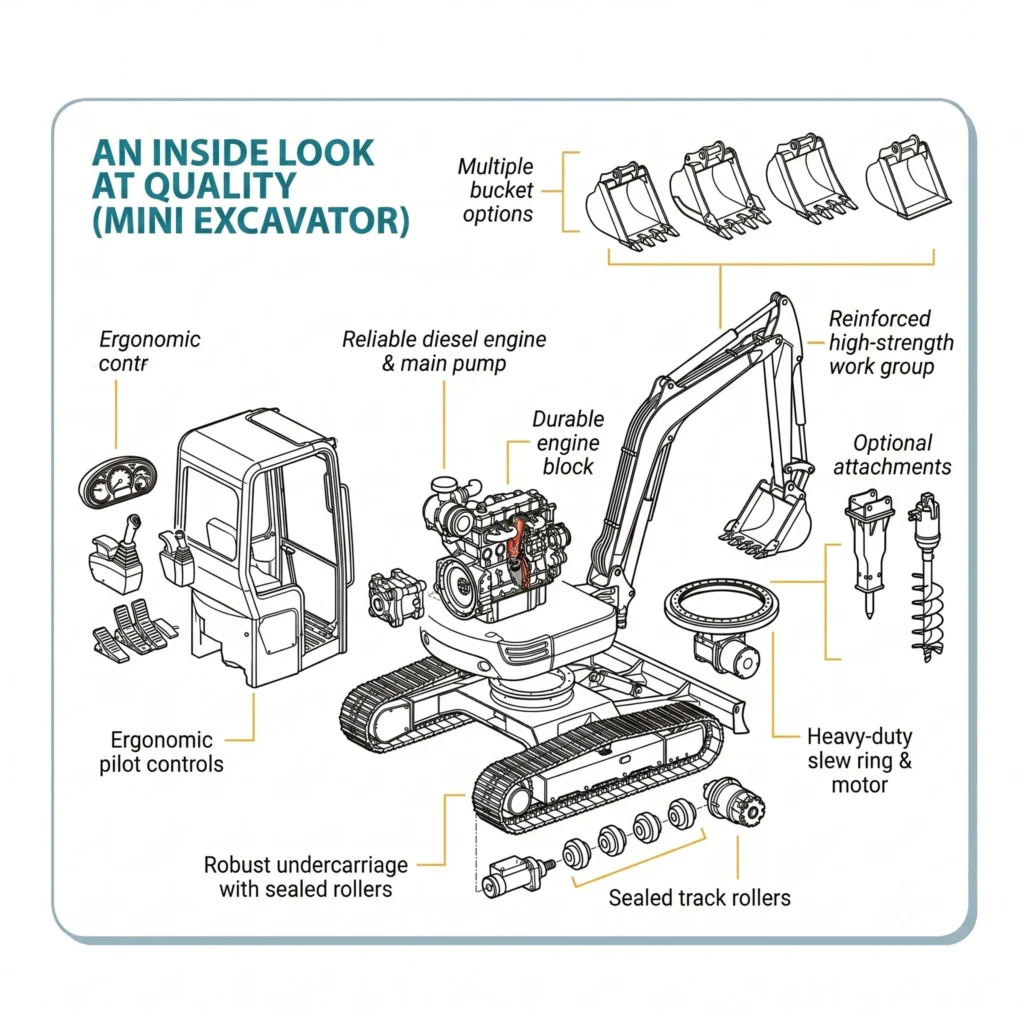
Operating weight is influenced by:
- Track width
- Boom and stick length
- Cab configuration
- Counterweight size
- Fuel and hydraulic fluids
- Standard bucket configuration
6 Key Factors That Influence Mini Excavator Weight
1. Chassis & Track Material
Track construction has a significant impact on operating weight.
- Rubber tracks are lighter
- Steel tracks improve durability but add weight
- Typical difference: 200–500 lbs
Impact: Lower transport weight versus greater durability.
2. Engine Size
Larger engines require heavier cooling systems, frames, and hydraulic components.
- Typical mini excavator engines: 10–60 HP
- Rough guideline: approximately 1.5 lbs of machine weight per additional HP
Impact: More power generally means a heavier machine.
3. Counterweight Design
Counterweights improve lifting capacity and stability.
- Integrated counterweights
- Bolt-on counterweights
- Can represent up to 15% of total operating weight
Impact: Better lifting performance but reduced transportability.
4. Cab Enclosure
An enclosed cab adds substantial mass.
- ROPS/FOPS structures
- Glass panels
- HVAC systems
- Additional insulation
Typical increase: 300–600 lbs
Impact: Greater comfort and safety at the cost of higher weight.
5. Long Arm / Extended Stick
Extended digging reach requires additional steel structure.
Typical increase: 200–800 lbs
Impact: More reach but higher transport and operating weight.
6. Quick Couplers & Attachments
Attachment systems add weight before any work tool is installed.
- Quick coupler: 150–400 lbs
- Hydraulic thumb: 250–600 lbs
- Specialized attachments vary widely
Impact: Operating weight can increase significantly after installation.
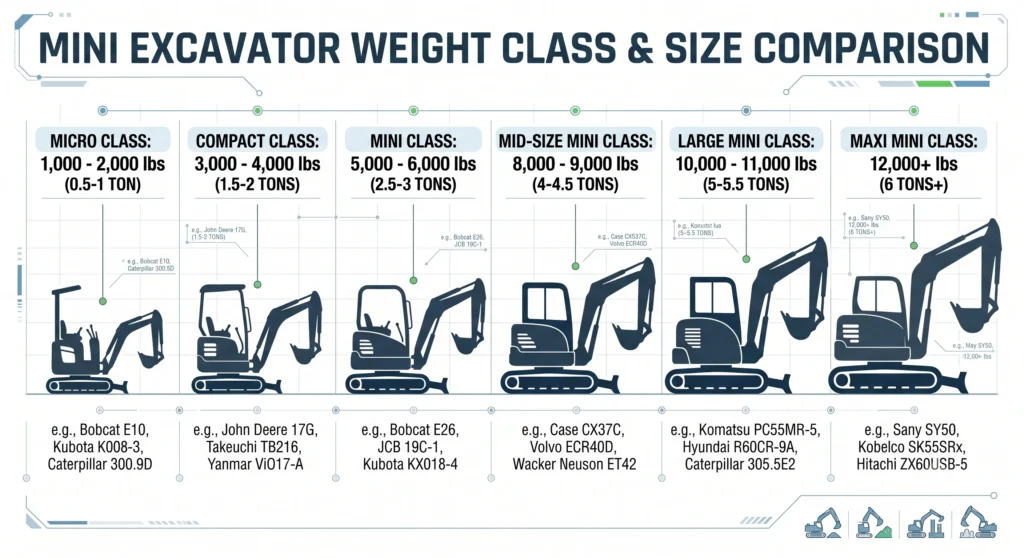
Mini Excavator Weight Classes
| Weight Class (Tons) | Typical Operating Weight (lbs) | Common Model Examples | Trailer Requirement |
|---|---|---|---|
| 0.5–1.0 ton | 1,000–2,200 lbs | Kubota U10, Yanmar ViO12 | Light-duty trailer |
| 1.5–2.0 tons | 3,000–4,500 lbs | Bobcat E35, Deere 26G | Tandem axle (5k lbs) |
| 2.5–3.5 tons | 5,500–7,500 lbs | Cat 303.5, Takeuchi TB260 | 7k–10k GVWR trailer |
| 4.0–6.0 tons | 8,000–12,000 lbs | Kubota KX080, Hitachi ZX85USB | Class IV hitch + 12k+ trailer |
Most rental units fall into the 3,000–5,000 lb range.
Weight vs. Transportability (Trailer & Towing)
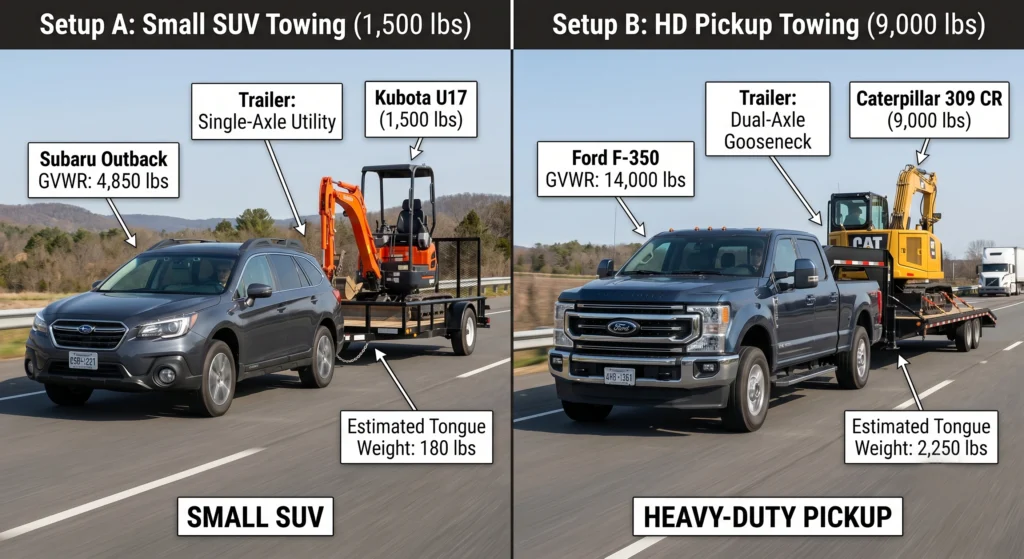
Mini excavator weight directly affects transportation requirements.
Trailer GVWR
The trailer must support:
Machine Weight + Bucket + Attachments + Fuel + Tie-Down Equipment
Example:
- Excavator: 7,000 lbs
- Hydraulic thumb: 400 lbs
- Fuel and accessories: 200 lbs
Minimum trailer capacity needed: 7,600+ lbs
Vehicle Towing Capacity
| Vehicle Type | Practical Excavator Range |
|---|---|
| Small SUV | Up to 2,000 lbs |
| Half-ton pickup (F-150 class) | Up to ~5,000 lbs machine/trailer combination |
| Three-quarter-ton truck (F-250 class) | 5,000–8,000 lbs |
| One-ton truck (F-350 class) | 8,000–12,000+ lbs |
Always verify the manufacturer’s tow rating.
CDL Considerations
In many U.S. jurisdictions, licensing requirements may be triggered by combined vehicle and trailer weight ratings.
Common threshold:
- 10,001 lbs+ combined weight
- Some situations may require higher-class licenses or commercial registration
Always verify local regulations.
Trailer Brakes
General industry practice:
- Under 3,000 lbs: often lighter brake requirements
- Over 3,000 lbs: trailer brakes are commonly required
- Electric brakes are typically preferred for heavier excavator loads
Weight vs. Ground Pressure & Jobsite Access
Many operators assume heavier machines always create more ground damage.
That’s not necessarily true.
Ground Pressure Formula
Ground Pressure (psi) = Operating Weight ÷ Track Contact Area
More specifically:
Ground Pressure = Operating Weight ÷ (Track Length × Track Width Contact Area)
Example
Consider:
- Machine A: 4,000 lbs with narrow steel tracks
- Machine B: 8,000 lbs with very wide rubber tracks
Machine B may actually exert lower ground pressure because its weight is spread across a much larger footprint.
This is why larger mini excavators can sometimes perform surprisingly well on lawns, soft soils, and landscaped areas.
Mini Excavator vs. Other Compact Equipment Weights
| Equipment Type | Typical Weight Range |
|---|---|
| Mini Excavator | 1,000–12,000 lbs |
| Skid Steer Loader | 5,000–9,000 lbs |
| Compact Track Loader | 7,000–12,000 lbs |
| Mini Dump Truck | 3,000–8,000 lbs |
| Full-Size Backhoe | 14,000–17,000 lbs |
Mini excavators occupy a unique position between ultra-light compact equipment and heavier construction machinery.
Operating Weight vs. Shipping Weight vs. Dry Weight
These terms are frequently confused.
Operating Weight
Includes:
- Full fluids
- Standard bucket
- ROPS/FOPS structure
- Often a 165-lb operator equivalent
This is the specification most buyers should use.
Shipping Weight
Typically excludes:
- Full fuel load
- Some attachments
- Sometimes certain counterweight configurations
Used primarily for freight calculations.
Dry Weight
Excludes:
- Fuel
- Hydraulic oil
- Coolant
- Other fluids
Rarely used in purchasing decisions.
Important Warning
Some manufacturers prominently advertise shipping weight because it appears lighter.
Always ask for operating weight when comparing machines.
How to Find the Exact Weight of Any Mini Excavator
Step 1: Check the Manufacturer Spec Sheet
Look for:
- Operating Weight
- Operating Mass
- Machine Weight
Step 2: Add Attachment Weight
Examples:
- Hydraulic thumb: +250–600 lbs
- Quick coupler: +150–400 lbs
- Breaker attachment: varies significantly
Step 3: Account for Cab Options
If optional:
- Enclosed cab: +300–600 lbs
Step 4: Verify Operator Inclusion
Some international specifications include a 150–165 lb operator equivalent.
Others do not.
Compare like-for-like specifications before making decisions.
Common Questions
How much does a 1-ton mini excavator weigh?
Typically 2,000–2,600 lbs, even though it’s called a “1-ton” machine. Nominal tonnage classifications rarely match actual operating weight exactly.
What’s the lightest mini excavator I can tow with a car?
Ultra-compact machines can weigh around 1,000–2,000 lbs, making them potentially towable with appropriately rated passenger vehicles and trailers.
Does bucket size change weight?
Yes.
A larger bucket can add substantial mass.
- 12-inch bucket
- 36-inch bucket
The difference can approach 300 lbs depending on design and material thickness.
How much weight does a hydraulic thumb add?
Most hydraulic thumbs add:
250–600 lbs
depending on machine size and configuration.
Real-World Examples (Manufacturer Data)
| Model | Operating Weight (lbs) | Notable Feature |
|---|---|---|
| Kubota U17-3a | ~3,700–3,900 | Zero-tail swing |
| John Deere 50G | ~10,700 | Long-arm option available |
| Yanmar ViO35-6 | ~7,900–8,200 | True zero-tail swing |
| Bobcat E10 | ~2,600 | 28-inch retractable undercarriage |
| Caterpillar 301.5 | ~3,900 | Expandable undercarriage |
Manufacturer specifications show the following operating weights: the Kubota U17-3a is approximately 3,700–3,900 lbs depending on configuration, the Yanmar ViO35-6 ranges around 7,900–8,200 lbs depending on cab, tracks, and coupler options, the Bobcat E10 is approximately 2,593 lbs, and the Caterpillar 301.5 is approximately 3,913 lbs.
How to Use Weight Data for Smarter Buying or Renting?
When choosing a mini excavator, use these simple rules:
Under 3,000 lbs
- Light-duty trailer
- Easier transport
- Suitable for residential work
- Often towable with many pickups
3,000–7,500 lbs
- Most common rental category
- Tandem-axle trailer recommended
- Brake controller strongly advised
- Mid-size to heavy-duty truck preferred
Over 7,500 lbs
- Heavy-duty truck recommended
- Higher-capacity trailer required
- Load-leveling hitch often beneficial
- Review licensing, registration, and towing regulations before transport
The most important takeaway is that operating weight not advertised size class should drive transportation, jobsite access, and purchasing decisions. A difference of only a few hundred pounds can change trailer requirements, towing capacity, ground pressure, and overall operating costs.

Ahmed Ijaz runs this construction rental directory with over 5 years of experience in SEO, content, and web optimization. Every page is built using real research, hands-on expertise, and carefully reviewed information to meet strong EEAT standards.