If you are budgeting an excavation, landscaping, utility, farming, or construction project, knowing how much a backhoe costs per hour can make a major difference to your final project price
As a general planning range, backhoe costs can run from roughly $40 to $150+ per hour, depending on the equipment, service model, and market.
Backhoe Cost Per Hour at a Glance
| Cost Type | Typical Planning Range |
|---|---|
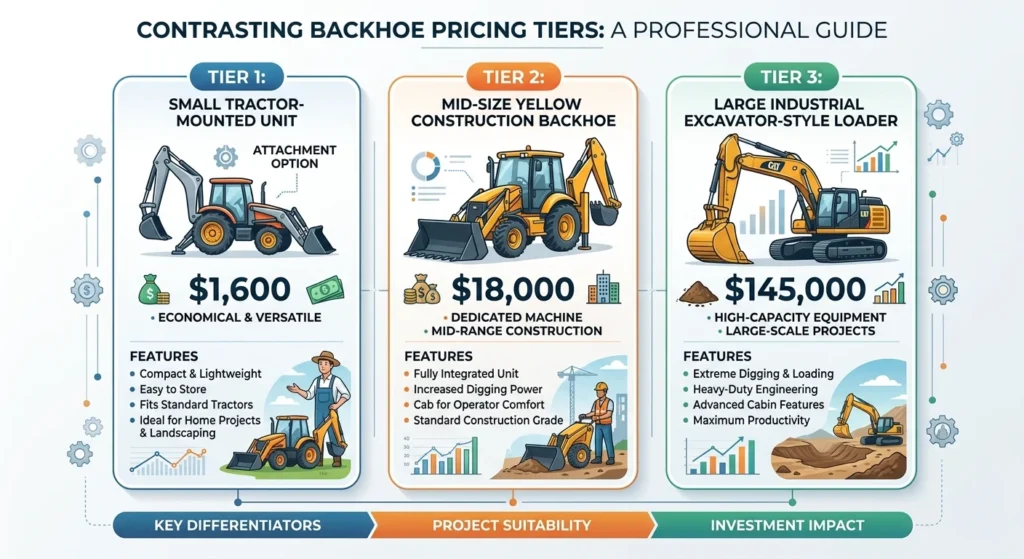
| Small/mini backhoe | $30–$70/hour |
| Standard backhoe loader | $60–$120/hour |
| Heavy-duty backhoe | $90–$150+/hour |
| Backhoe with operator | $80–$150+/hour |
| Fuel and operating expenses | $10–$30+/hour |
| Specialized attachments | Additional hourly/daily charge |
| Transportation/mobilization | Often charged separately |
These are budgeting ranges rather than fixed market prices. Local rental companies, contractors, machine age, availability, and project conditions can change the final rate.
How Much Does a Backhoe Cost Per Hour?
For most commercial projects, a reasonable starting point is $60 to $120 per hour for a standard backhoe, before unusual transportation, attachments, or difficult site conditions.
A machine with an operator can cost more because the hourly price includes labor. A basic rental may advertise only the machine rate, while a contractor’s hourly service rate can include the equipment, operator, fuel, insurance, and business overhead.
Small or Mini Backhoe Cost
Small backhoes are commonly used for residential construction, landscaping, farms, and light excavation.
A typical planning range is:
$30–$70 per hour
Their lower fuel consumption and smaller size can make them economical for projects that do not require the digging power of a full-size machine.
However, an attachment should not be compared directly with a commercial backhoe loader because their capabilities, productivity, durability, and operating requirements are different.
Standard Backhoe Loader Cost
Standard backhoe loaders are the workhorses of many construction projects.
Budget approximately:
$60–$120 per hour
Models in this category can handle excavation, trenching, loading, grading, and general construction work.
Heavy-Duty Backhoe Cost
Large or specialized machines used for infrastructure, road construction, and demanding excavation can cost:
$90–$150+ per hour
The higher rate reflects greater machine capacity, fuel consumption, transportation requirements, and operating costs.
Backhoe Rental Cost vs. Backhoe Service Cost
One of the most important distinctions when comparing hourly prices is whether the advertised rate is for the machine only or for a complete service.
Equipment-only rental: You pay for the machine and may have additional charges for fuel, delivery, insurance, attachments, and other fees.
With operator: The hourly service rate may include the machine, operator, fuel, insurance, maintenance, and overhead.
What Determines the Hourly Cost of a Backhoe?
Several factors influence the amount you will actually pay.
1. Machine Size
Larger backhoes generally cost more to rent and operate.
A mini backhoe may use substantially less fuel than a full-size machine, while heavy equipment requires greater transportation capacity.
2. Operating Weight
Operating weight affects transportation, fuel consumption, ground pressure, and overall machine capacity.
A heavier machine may be more productive in difficult soil but can cost more to mobilize.
3. Engine and Fuel Consumption
A compact machine working at light load can consume much less fuel than a large backhoe continuously performing heavy excavation and loading.
For accurate project estimating, calculate fuel separately instead of assuming the rental rate represents the machine’s entire cost.
4. Operator Skill
An experienced operator can often complete excavation more quickly and accurately.
A lower hourly labor rate does not necessarily mean a lower project cost if an inexperienced operator takes significantly longer to complete the work.
5. Project Conditions
Hard clay, compacted soil, rocks, slopes, wet ground, restricted access, and underground utilities can all increase the time required.
6. Location
Backhoe rental prices vary between regions because of:
- Local demand
- Equipment availability
- Labor costs
- Fuel prices
- Transportation costs
- Construction activity
- Seasonal demand
Backhoe Operating Cost Per Hour
Hourly Operating Cost = Fuel + Maintenance + Repairs + Wear Items + Other Operating Expenses
For example, if a backhoe consumes $15 of fuel per hour and averages $10 per hour in maintenance and repairs, its direct operating expense would be approximately:
$15 + $10 = $25/hour
Backhoe Fuel Cost Per Hour
Suppose:
- Fuel consumption = 3 gallons/hour
- Diesel price = $4/gallon
Then:
3 × $4 = $12/hour in fuel
If the machine is working under heavy load, actual consumption could be higher.
Backhoe Maintenance Cost Per Hour
Common maintenance expenses include:
- Engine oil and filters
- Hydraulic fluid and filters
- Greasing
- Tires
- Hydraulic hoses
- Bucket teeth
- Pins and bushings
- Belts
- Batteries
- Repairs
Transportation and Mobilization Costs
Your effective project cost can include:
Backhoe Hourly Rate + Delivery + Pickup + Fuel + Operator + Attachments
For short jobs, transportation can represent a significant percentage of the total bill.
Backhoe Ownership Cost Per Hour
A simplified ownership calculation is:
Ownership Cost Per Hour = Depreciation + Financing + Insurance + Storage + Maintenance + Repairs + Fuel
Financing Costs
The actual hourly financing cost depends on:
- Purchase price
- Down payment
- Interest rate
- Loan term
- Annual utilization
- Remaining balance
Backhoe vs. Excavator: Which Has the Lower Hourly Cost?
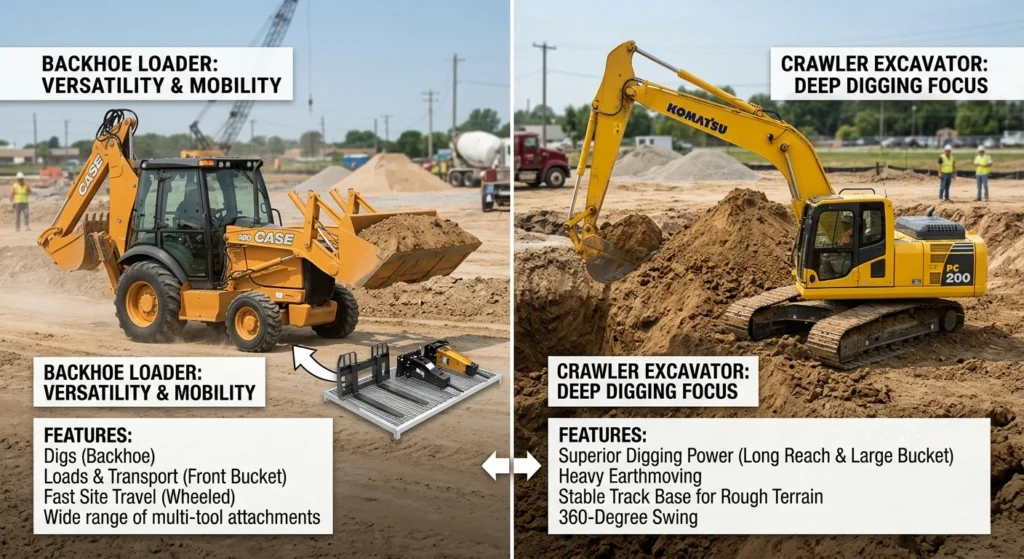
A backhoe and excavator perform overlapping tasks, but they are optimized for different applications.
Backhoes are frequently deployed to minimize overall trench excavation costs on long utility runs, foundations, and drainage ditches.
| Feature | Backhoe | Excavator |
|---|---|---|
| Digging | Excellent | Excellent |
| Loading | Excellent | Good |
| Road mobility | Excellent | Limited |
| 360° rotation | No | Yes |
| Trenching | Excellent | Excellent |
| Deep excavation | Good | Excellent |
| Multiple attachments | Yes | Yes |
| Short-distance travel | Excellent | Poorer |
| Versatility | Very high | High |
Choose a Backhoe When:
- You need both digging and loading
- The machine must move between locations
- The project involves road or utility work
- You have limited equipment space
- You need one versatile machine
Choose an Excavator When:
- Deep excavation is the primary task
- Maximum reach is important
- The machine will remain on one site
- High digging productivity is more important than road mobility
- You need continuous 360-degree rotation
How to Calculate the True Cost of a Backhoe Per Hour?
For rental projects, a practical formula is:
True Hourly Project Cost = Rental Rate + Fuel + Operator + Mobilization + Attachments + Other Fees
For an owned machine:
True Hourly Ownership Cost = Fuel + Maintenance + Repairs + Depreciation + Financing + Insurance + Storage
How Much Does a Backhoe Cost Per Day?
A typical planning approach is to compare:
- Hourly rate
- Daily rate
- Weekly rate
- Monthly rate
If you need the machine for several consecutive days, a daily or weekly rental may provide a lower effective hourly cost.
For example, if a machine costs $100/hour but is rented for an 8-hour day, the hourly equivalent is:
$100 × 8 = $800/day
A contractor offering a $600 daily rate would therefore provide a lower effective hourly cost of:
$600 ÷ 8 = $75/hour
Always compare the actual rental terms rather than assuming hourly pricing is automatically the cheapest option.
When Does Buying a Backhoe Make Sense?
Buying may make sense when the machine will be used frequently throughout the year.
Consider ownership if:
- You operate more than one project at a time
- You need the machine regularly
- Rental costs are consistently high
- You have qualified operators
- You can handle maintenance
- You have suitable storage
- You expect long-term utilization
Renting is often better when:
- The project is short
- Usage is occasional
- You do not want maintenance responsibilities
- You need different machines for different jobs
- You want to preserve capital
How to Reduce Your Backhoe Cost Per Hour?
You can lower your overall project cost by improving productivity rather than simply searching for the cheapest rental rate.
- Choose the right machine size
- Reduce idle time
- Use the correct attachment
- Minimize delivery/mobilization
- Compare total quotes
Frequently Asked Questions
What is the average cost of a backhoe per hour?
A reasonable 2026 planning range is approximately $60–$120 per hour for a standard backhoe, while complete backhoe services with an operator can reach $80–$150+ per hour depending on location and project conditions.
How much does a mini backhoe cost per hour?
A mini or compact backhoe may cost approximately $30–$70 per hour, although actual rental prices vary by market, machine availability, and rental duration.
Is a backhoe cheaper than an excavator?
It depends on the project. A backhoe can be more economical when you need both loading and excavation or when the machine must travel between nearby work areas. An excavator can be more productive for deep excavation and large digging projects.
Does the backhoe hourly rate include an operator?
Not always. Equipment-only rental rates generally do not include an operator. Contractor service rates may include the operator, fuel, insurance, and other overhead. Always confirm what is included before comparing quotes.
How much fuel does a backhoe use per hour?
Fuel consumption varies by machine size and workload. A heavily loaded full-size machine can consume significantly more fuel than a compact backhoe working under light conditions.
Is buying a backhoe cheaper than renting?
Buying can be cheaper over the long term if the machine is used frequently enough to spread depreciation, financing, insurance, and maintenance across many operating hours. For occasional work, renting is often more economical.
Final Verdict: What Does a Backhoe Really Cost Per Hour?
For initial budgeting, expect approximately $30–$70/hour for small or mini machines, $60–$120/hour for standard backhoes, and $90–$150+ per hour for larger or specialized equipment. A complete service with an operator can cost more than the equipment-only rental rate.
However, the advertised hourly price is only the starting point. Your true backhoe cost per hour can include fuel, labor, transportation, attachments, maintenance, depreciation, financing, insurance, and downtime.

Ahmed Ijaz runs this construction rental directory with over 5 years of experience in SEO, content, and web optimization. Every page is built using real research, hands-on expertise, and carefully reviewed information to meet strong EEAT standards.