A tandem dump truck typically holds about 10 to 14 cubic yards of dirt, with around 12 cubic yards being a common planning figure. Depending on the truck’s bed size, material density, moisture content, and legal payload limit, some tandem trucks can carry closer to 15 or 16 cubic yards by volume. A typical dirt payload is roughly 13 to 15 tons, but heavy or wet soil may reduce the number of cubic yards the truck can legally carry.
For estimating a dirt delivery, it is important to consider both cubic-yard capacity and weight. A truck may have enough space for more dirt but reach its legal weight limit first.
What Is a Tandem Dump Truck?
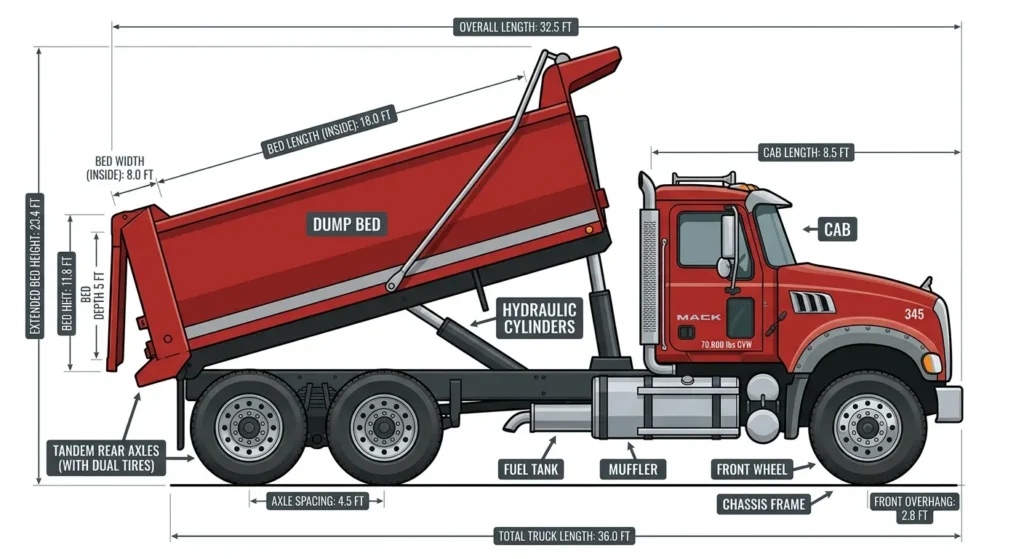
A tandem dump truck is a heavy-duty dump truck with two rear axles, known as a tandem axle group. It uses a hydraulic system to raise the dump bed and unload dirt, gravel, sand, and other loose materials.
Tandem dump trucks are commonly used for:
- Residential grading
- Landscaping projects
- Foundation backfill
- Driveway preparation
- Small and mid-size excavation projects
- Commercial earthwork
A typical dump bed may be approximately 14 to 16 feet long, although dimensions vary by manufacturer and truck configuration.
Compared with a single-axle dump truck, a tandem carries considerably more material. A tri-axle dump truck generally carries more than a tandem but requires more space and may be less convenient for tight residential sites.
Tandem Dump Truck Dirt Capacity in Cubic Yards
A typical tandem dump truck carries approximately 10 to 14 cubic yards of dirt. Around 12 cubic yards is a useful estimate for planning a standard dirt delivery. Some larger configurations may carry 15 or 16 cubic yards when the material and legal weight allow it.
The actual amount depends on the density of the dirt and the truck’s payload rating.
If a supplier advertises a 12-yard tandem load, that generally refers to the loose volume delivered in the truck bed. It does not necessarily mean the truck can legally carry 12 cubic yards of every type of soil.
How Truck Bed Size Determines Cubic Yards?
You can estimate the volume of a dump bed with:
Length × Width × Average Depth ÷ 27 = Cubic Yards
For example, a bed measuring 16 feet long, 7.5 feet wide, and 3 feet deep would have:
16 × 7.5 × 3 ÷ 27 = 13.3 cubic yards
The actual load may be smaller because the truck also has to stay within its payload and axle-weight limits.
Cubic Yards to Tons: How Much Does the Dirt Weigh?
There is no single conversion from cubic yards to tons because dirt weight changes with soil type and moisture content.
For example, a cubic yard of soil can weigh roughly 2,000 to 2,700 pounds for common dry-to-moist topsoil and fill dirt, while wet or clay-heavy material can weigh considerably more.
As a general example:
- 10 cubic yards at 1.1 tons per yard = 11 tons
- 12 cubic yards at 1.1 tons per yard = 13.2 tons
- 14 cubic yards at 1.1 tons per yard = 15.4 tons
This is why a tandem dump truck cannot simply be filled to its maximum physical volume with every type of dirt.
Why Weight Matters More Than Bed Volume?
Dump trucks must comply with applicable gross vehicle weight and axle-weight regulations. On the Interstate System, federal rules generally limit a single axle to 20,000 pounds and a tandem axle group to 34,000 pounds, with the overall vehicle also subject to the federal gross-weight and bridge-formula limits. State rules can differ.
As a result, dense or wet dirt can reach the truck’s legal payload before the dump bed is completely full.
Factors That Affect How Much Dirt a Tandem Truck Holds
Material Density
Different materials weigh different amounts per cubic yard.
Typical examples include:
- Fill dirt: roughly 1.0–1.3 tons per cubic yard
- Dry topsoil: roughly 1.0–1.1 tons per cubic yard
- Moist topsoil: roughly 1.1–1.35 tons per cubic yard
- Wet or clay-heavy soil: can reach about 1.5 tons or more per cubic yard
These are planning ranges rather than fixed values because the actual density depends on the material and its moisture content.
Moisture Content
Wet dirt weighs more than dry dirt. After rain, the same volume of soil can become substantially heavier because of the additional water.
This means a tandem truck that can legally carry a certain volume of dry soil may need a smaller load when hauling wet clay or saturated dirt.
Truck Specifications
Not every tandem dump truck has the same bed size or payload rating. Manufacturer specifications, empty vehicle weight, axle configuration, and local regulations all affect the amount of dirt that can be hauled legally.
Legal Weight Limits
The truck’s legal payload is determined by more than the size of its dump bed. Axle limits, gross vehicle weight, bridge formulas, and state regulations can restrict the load.
That is why the maximum cubic-yard capacity is not always the same as the maximum legal dirt load.
Tandem vs. Tri-Axle vs. Single-Axle Dump Truck
| Truck Type | Typical Dirt Capacity | Approx. Payload | Best Use |
|---|---|---|---|
| Single-axle dump truck | 5–8 cubic yards | 7–10 tons | Small residential jobs |
| Tandem dump truck | 10–14 cubic yards | 13–15 tons | Residential and mid-size projects |
| Tri-axle dump truck | 14–18+ cubic yards | 18–22+ tons | Larger earthwork projects |
These are general planning ranges, not universal truck specifications. The actual capacity depends on the truck and material being hauled.
A tandem dump truck is often a practical choice when you need a substantial amount of dirt but have limited site access. A tri-axle can deliver more material per trip but may require more room to maneuver.
How to Calculate How Much Dirt You Need?
Use these four steps to estimate the number of tandem loads required.
Step 1: Measure the Area
Measure the length and width of the area in feet and determine the required depth.
Step 2: Calculate Cubic Feet
Multiply:
Length × Width × Depth = Cubic Feet
Convert inches to feet before calculating. For example, 6 inches equals 0.5 feet.
Step 3: Convert to Cubic Yards
Divide the cubic-foot measurement by 27:
Cubic Feet ÷ 27 = Cubic Yards
Step 4: Divide by Truck Capacity
Divide the total cubic yards by the estimated tandem capacity.
For example, suppose you need to fill a:
40 ft × 30 ft area at 6 inches deep
The calculation is:
40 × 30 × 0.5 = 600 cubic feet
600 ÷ 27 = 22.2 cubic yards
If you plan around 12 cubic yards per tandem load:
22.2 ÷ 12 = 1.85 loads
You would therefore need 2 tandem loads.
For projects where the soil will settle or be compacted, ordering some additional material may be appropriate. The exact allowance depends on the material and project.
How Much Does a Tandem Load of Dirt Cost?
The cost of a tandem load depends heavily on the type of dirt, location, delivery distance, and supplier.
Fill dirt is generally less expensive than screened topsoil or specialty soil. Suppliers may quote dirt by the cubic yard, by the truckload, or by weight, and delivery may be charged separately.
When requesting a quote, ask:
- How many cubic yards are included?
- Is the price based on volume or weight?
- Is delivery included?
- Is there a minimum order?
- What type of dirt is being delivered?
Comparing the price per cubic yard delivered is usually more useful than comparing the truckload price alone.
Frequently Asked Questions
How many cubic yards does a tandem dump truck hold?
A tandem dump truck typically carries 10 to 14 cubic yards of dirt, with about 12 cubic yards being a common planning figure. Larger trucks may carry more, depending on their specifications and legal payload.
How many tons is a tandem load of dirt?
A typical tandem load of dirt is roughly 13 to 15 tons, although the actual weight depends on the soil type and moisture content. Dense or wet dirt can reduce the number of cubic yards that can be legally hauled.
Can a tandem dump truck carry 20 yards of dirt?
Generally, 20 cubic yards is beyond the typical capacity of a standard tandem dump truck. A larger tri-axle or another heavy-duty configuration may be more appropriate for that volume.
How much does a yard of dirt weigh?
A cubic yard of common soil or fill dirt can weigh roughly 2,000 to 2,700 pounds, depending mainly on soil type and moisture. Wet clay-heavy soil can weigh significantly more.
How many yards of topsoil fit in a tandem dump truck?
A tandem dump truck may carry approximately 10 to 14 cubic yards of topsoil, but the actual amount depends on the truck’s payload rating and the moisture content of the topsoil.
What’s the difference between a tandem load and a tri-axle load?
A tandem load generally comes from a truck with two rear axles and typically carries around 10–14 cubic yards. A tri-axle load uses an additional rear axle and generally carries more material, often around 14–18+ cubic yards.
Conclusion
A tandem dump truck typically holds about 10 to 14 cubic yards of dirt, with approximately 12 cubic yards being a useful estimate for many projects. Its actual payload is often around 13 to 15 tons, but the exact amount depends on the dirt’s density, moisture content, truck specifications, and applicable weight limits.
For an accurate order, calculate your project’s cubic-yard requirement first, then confirm the truck’s legal payload and actual capacity with the dirt supplier. This prevents ordering too little material or exceeding the truck’s weight limit.

Ahmed Ijaz runs this construction rental directory with over 5 years of experience in SEO, content, and web optimization. Every page is built using real research, hands-on expertise, and carefully reviewed information to meet strong EEAT standards.