A tri-axle dump truck typically holds about 15 to 18 cubic yards of dirt, although some larger configurations can reach around 20 cubic yards. The amount of dirt it can legally haul by weight is a separate question because soil density varies significantly with moisture and material type.
For excavation and sitework, a useful planning range is 15–18 cubic yards per truckload, but the truck may need to carry fewer yards when the soil is heavy or wet. A 16-yard tri-axle is a common configuration, while 18-yard models are also available.
Quick Answer: Tri-Axle Dirt Capacity
| Capacity | Typical Range |
|---|---|
| Dirt volume | 15–18 cubic yards |
| Larger configurations | Up to about 20 cubic yards |
| Typical legal payload | Varies by truck, state and axle configuration |
| Dry loose dirt | About 1.0 ton/cu yd |
| Wet clay | About 1.5+ tons/cu yd |
| Common truck size | 16-yard or 18-yard body |
The important point is that a dump body can physically hold a certain volume, but the truck cannot necessarily carry that entire volume legally. Weight limits, axle ratings, truck tare weight and soil density all affect the actual load.
What Is a Tri-Axle Dump Truck?
A tri-axle dump truck is a heavy-duty dump truck with three load-bearing axles. A common arrangement has one steering axle at the front and two rear axles.
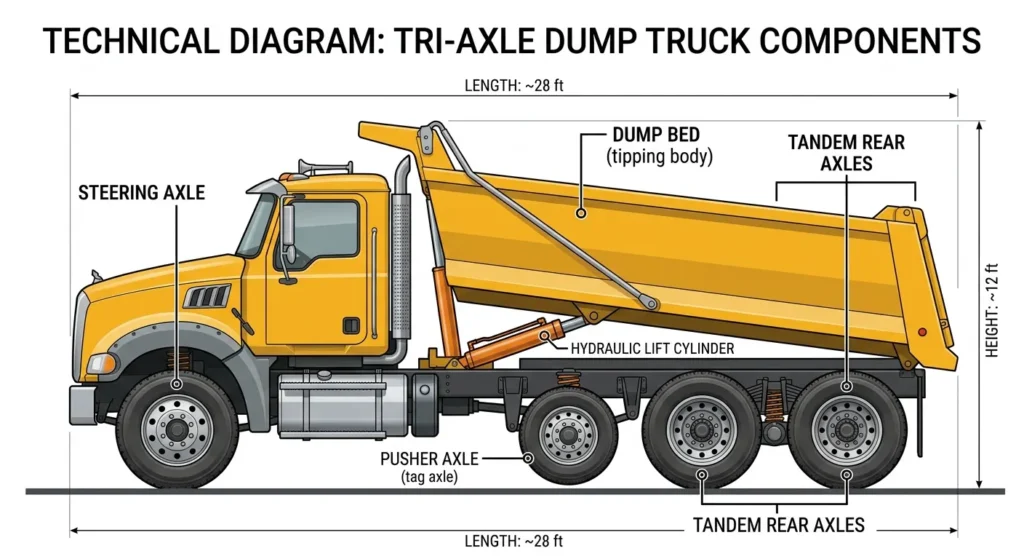
The term can become confusing because some trucks have an additional lift, pusher or tag axle. Therefore, when ordering a truck, it is better to confirm the number of axles, body capacity and legal payload rather than relying only on the term “tri-axle.”
A tri-axle dump truck is commonly used for:
- Excavation spoil removal
- Dirt hauling
- Gravel and aggregate
- Sand delivery
- Demolition debris
- Road construction
- Site preparation
- Landscaping materials
The extra axle configuration allows the truck to distribute weight more effectively than a smaller dump truck.
Tri-Axle vs. Tandem Dump Truck
A tandem dump truck commonly carries around 10–12 cubic yards, while larger tri-axle dump trucks can carry approximately 15–18 cubic yards, depending on the body and chassis.
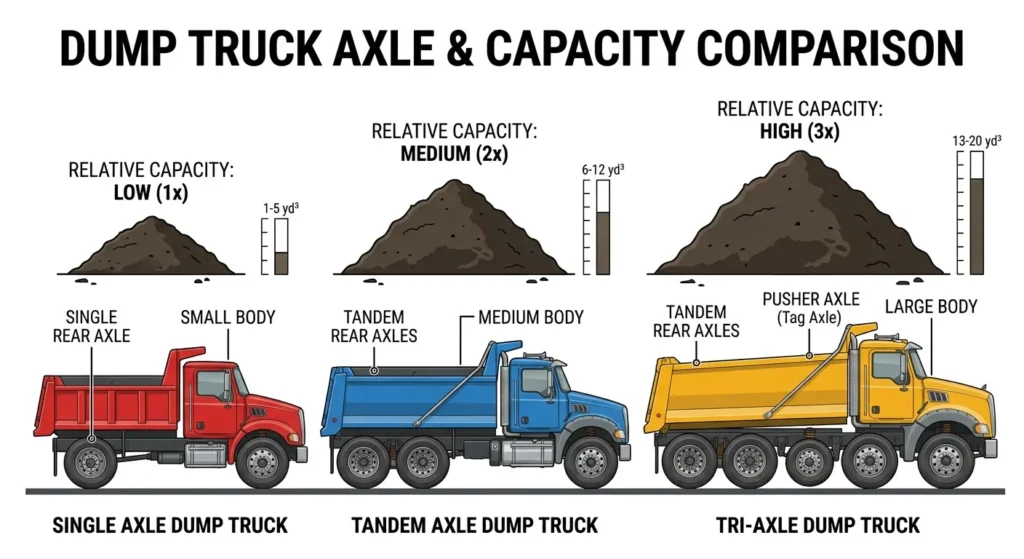
Actual capacities vary by truck. For example, municipal equipment records list 16-yard tri-axle dump trucks, while current rental equipment includes 18-yard tri-axle trucks.
This larger capacity can reduce the number of trips required on an excavation project.
How Many Cubic Yards of Dirt Does a Tri-Axle Hold?
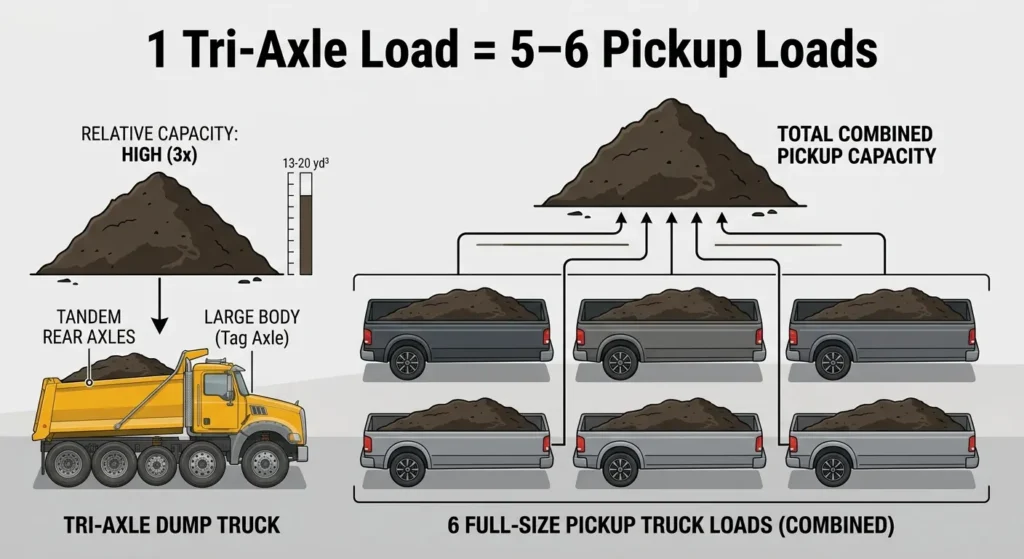
A typical tri-axle dump truck holds approximately 15 to 18 cubic yards of loose material.
A 16-yard dump body is a common specification. For example, Dejana lists a 15.5-cubic-yard dump body, while other equipment specifications identify 16-yard tri-axle trucks.
An 18-yard tri-axle is also available. One current 17-foot tri-axle specification lists an 18-cubic-yard body, with a 17-foot bed and 5-foot side height.
Typical Tri-Axle Capacity
- 15 cubic yards: Smaller or more conservatively specified body
- 16 cubic yards: Very common configuration
- 17–18 cubic yards: Larger dump body
- 20 cubic yards: Possible with certain configurations, but not a universal tri-axle capacity
Therefore, if an excavation contractor says a tri-axle will haul 16 cubic yards, that is a reasonable working figure. You should not automatically assume that every tri-axle carries 18 or 20 yards.
How Much Does a Cubic Yard of Dirt Weigh?
Volume alone does not tell you how much dirt a truck can legally carry.
Soil weight changes according to:
- Moisture content
- Soil type
- Compaction
- Organic content
- Amount of rock or aggregate
- Whether the material is loose or compacted
For example, published density data puts loose dry dirt at about 76 lb/ft³, while loose moist dirt is around 78 lb/ft³. Wet clay can be substantially heavier at about 110 lb/ft³.
Because one cubic yard contains 27 cubic feet, that works out approximately as follows:
| Material | Approx. Weight per Cubic Yard |
|---|---|
| Loose dry dirt | ~2,050 lb / 1.03 tons |
| Loose moist dirt | ~2,106 lb / 1.05 tons |
| Dry clay | ~2,700 lb / 1.35 tons |
| Wet clay | ~2,970 lb / 1.49 tons |
| Dry gravel | ~2,835 lb / 1.42 tons |
| Wet gravel | ~3,375 lb / 1.69 tons |
These are planning values rather than universal numbers. Actual soil delivered from an excavation site can differ.
How Many Tons of Dirt Can a Tri-Axle Carry?
This is where the answer becomes more complicated.
A tri-axle does not automatically carry 15, 18, 20 or 25 tons of dirt simply because its body has that many cubic yards of capacity.
The truck’s allowable payload depends on its:
- Empty weight
- GVWR
- Axle ratings
- Axle spacing
- State and local regulations
- Type and density of material
Federal Interstate rules generally establish 20,000 pounds for a single axle, 34,000 pounds for a tandem axle and 80,000 pounds gross vehicle weight, subject to the Federal Bridge Formula and applicable exceptions.
That does not mean every tri-axle dump truck can legally carry 40 tons of material. The truck itself consumes part of the allowable gross weight, and axle and bridge-formula restrictions can reduce the permissible load.
Why Payload Is Different From GVWR?
Suppose a truck has a gross vehicle weight rating of 66,000 pounds.
If the truck weighs 30,000 pounds empty:
66,000 − 30,000 = 36,000 pounds
That gives a theoretical payload of:
36,000 ÷ 2,000 = 18 tons
But the actual legal payload can still be lower if axle limits, bridge restrictions or state rules impose a lower limit.
This is why the truck’s actual scale weight and applicable regulations matter more than simply multiplying the cubic-yard capacity by a soil-density estimate.
Volume vs. Weight: Which Limits the Load?
There are two different limits:
1. Volume limit
The dump body might physically hold 16–18 cubic yards.
2. Weight limit
The truck might reach its legal payload before the body is completely filled.
This distinction is especially important when hauling excavation soil.
For example, using approximately 1.05 tons per cubic yard for loose moist dirt:
16 cubic yards × 1.05 tons = 16.8 tons
But if the material is wet clay at approximately 1.49 tons per cubic yard:
16 cubic yards × 1.49 tons = 23.8 tons
The same 16 cubic yards can therefore weigh dramatically more.
That is why a truck hauling wet clay may have to leave part of the dump body empty to remain within its legal weight limits.
How to Calculate Dirt Capacity for Your Tri-Axle?
You can estimate your truck’s capacity using two separate calculations.
Step 1: Calculate the Dump Body Volume
Use:
Length × Width × Height ÷ 27 = cubic yards
For example:
16 ft × 8 ft × 4 ft ÷ 27 = 18.96 cubic yards
However, this is a simple rectangular-volume calculation, not necessarily the truck’s rated capacity. Dump bodies have sloped sides, curved floors, tailgates and other design features, so use the manufacturer’s stated capacity when available.
For example, a commercially specified 16-yard dump body may have an internal length and width that produce a different theoretical geometric calculation from its actual rated capacity.
Step 2: Determine the Available Payload
Check:
- GVWR
- Empty truck weight
- Front axle rating
- Rear axle ratings
- Applicable state weight limits
A simplified calculation is:
GVWR − empty truck weight = theoretical payload
But this should not be treated as the final legal payload without checking axle and road restrictions.
Step 3: Convert Pounds to Tons
Payload in pounds ÷ 2,000 = payload in tons
For example:
36,000 lb ÷ 2,000 = 18 tons
Step 4: Convert Weight Capacity to Cubic Yards
Use:
Allowed payload in tons ÷ soil density in tons per cubic yard = maximum yards by weight
For example, if the truck has an 18-ton allowable payload and the soil weighs 1.05 tons per cubic yard:
18 ÷ 1.05 = 17.1 cubic yards
If the soil weighs 1.49 tons per cubic yard:
18 ÷ 1.49 = 12.1 cubic yards
So the same truck could carry roughly 17 cubic yards of lighter soil but only about 12 cubic yards of very heavy wet clay at that assumed payload.
What Factors Affect How Much Dirt a Tri-Axle Holds?
1. Soil Density
This is one of the biggest variables.
Dry, loose dirt is lighter than wet clay, so the truck can carry more cubic yards before reaching its weight limit.
2. Moisture
Rain can significantly increase the weight of excavated soil.
A truck loaded with freshly excavated, wet material can reach its weight limit even though there appears to be plenty of room left in the body.
3. Dump Body Size
A 15.5-yard body and an 18-yard body do not have the same volume.
Current equipment specifications demonstrate this variation: Dejana lists a 15.5-cubic-yard body, while another tri-axle model lists an 18-cubic-yard capacity.
4. Truck Empty Weight
Two trucks with similar dump bodies can have different payload capacities because their chassis, engines, suspensions and equipment weigh different amounts.
5. Axle Configuration
Axle spacing and ratings affect how weight can legally be distributed.
The Federal Bridge Formula specifically considers the number of axles and the distance between the outer axles in a group.
6. State Weight Regulations
Truck weight rules are not identical everywhere.
Federal Interstate limits provide an important baseline, but state-specific rules, grandfathered limits, bridge restrictions and permits can affect actual allowable weight.
How Many Loads Do You Need for an Excavation Project?
If your excavation produces 100 cubic yards of loose dirt and you use a 16-cubic-yard tri-axle:
100 ÷ 16 = 6.25 loads
You would therefore need approximately 7 truckloads based on volume.
But this calculation assumes the truck can legally haul 16 cubic yards of that particular soil.
If the soil is unusually heavy and the truck can only carry 12 cubic yards before reaching its legal weight limit:
100 ÷ 12 = 8.33 loads
You would need approximately 9 loads.
This is why excavation estimates should consider both loose cubic yards and truck payload weight.
Tri-Axle vs. Other Dump Trucks
| Truck Type | Approx. Volume | Typical Use |
|---|---|---|
| Single-axle dump truck | ~5–8 cu yd | Small jobs |
| Tandem dump truck | ~10–12 cu yd | General hauling |
| Tri-axle dump truck | ~15–18 cu yd | Excavation and sitework |
| Larger tri-axle configurations | Up to ~20 cu yd | Higher-volume hauling |
| Dump trailer/semi combination | Varies widely | Large commercial projects |
These are planning ranges rather than universal specifications. Actual capacities depend on the body, chassis and applicable weight restrictions.
Is a Tri-Axle Better for Excavation Dirt?
For many excavation projects, yes.
A tri-axle provides substantially more hauling capacity than a smaller dump truck, which can reduce the number of trips needed to remove excavated soil.
For example, if a project produces 160 cubic yards of loose excavation spoil:
With a 10-cubic-yard truck:
160 ÷ 10 = 16 loads
With a 16-cubic-yard truck:
160 ÷ 16 = 10 loads
That could reduce the required truck trips from approximately 16 to 10, assuming the soil can be legally hauled at the stated volume.
Fewer trips can reduce:
- Trucking time
- Fuel consumption
- Traffic around the jobsite
- Loading and unloading time
- Overall excavation hauling costs
However, heavy or wet soil can reduce the number of yards that can legally be loaded per trip.
What Happens If You Overload a Tri-Axle?
Overloading is not simply a matter of putting more dirt in the truck.
Excess weight can increase:
- Braking distance
- Tire and suspension stress
- Drivetrain wear
- Risk of tire failure
- Difficulty controlling the truck
- Road and bridge damage
- Exposure to overweight penalties
Federal rules use axle and bridge-formula limits to control how truck weight is distributed. FHWA notes that when different applicable limits produce different maximum weights, the lowest applicable limit controls.
For excavation contractors, the safest approach is to load according to the truck’s rated capacity and verify actual weights with a certified scale when necessary.
Frequently Asked Questions
Can a tri-axle dump truck hold 20 cubic yards of dirt?
Some configurations can approach 20 cubic yards, but 20 cubic yards should not be treated as the standard capacity for every tri-axle. 15–18 cubic yards is a more useful general planning range.
How many tons of dirt are in a tri-axle?
It depends on the truck’s legal payload and the soil density. A tri-axle may carry roughly 15–20+ tons in some configurations, but the actual legal amount must be determined from the truck’s weight ratings and applicable regulations.
How many cubic yards does a 16-yard tri-axle hold?
A 16-yard tri-axle is designed to carry approximately 16 cubic yards by body capacity. Whether it can legally carry a full 16 cubic yards depends on the density of the material and the truck’s allowable payload.
How much does 16 cubic yards of dirt weigh?
At approximately 1.05 tons per cubic yard, 16 cubic yards weighs about 16.8 tons. Heavy wet clay at approximately 1.49 tons per cubic yard would weigh about 23.8 tons. Actual soil density varies.
Can a tri-axle haul wet dirt?
Yes, but wet dirt can be substantially heavier than dry loose soil. The truck may therefore need to carry fewer cubic yards to remain within its legal weight limits.
How many tri-axle loads do I need for excavation?
Divide the total loose excavation volume by the truck’s actual legal cubic-yard capacity.
For example:
100 cubic yards ÷ 16 cubic yards per load = 6.25
So you would plan for approximately 7 loads, subject to the soil’s weight and the truck’s legal payload.
Bottom Line
A tri-axle dump truck typically holds about 15–18 cubic yards of dirt, with some larger configurations reaching approximately 20 cubic yards.
For excavation planning, however, don’t assume that the entire physical body capacity can always be loaded with soil. Soil density, moisture, truck weight, axle ratings and state regulations determine the actual legal load.
A useful planning approach is:
Tri-axle volume: 15–18 cubic yards
Common configuration: 16-yard dump body
Larger configuration: about 18–20 cubic yards
Actual payload: determined by truck weight ratings, axle limits and local law
Key limiting factor: often weight rather than body volume, especially with wet clay or other dense material.
For a real excavation estimate, determine the loose cubic yards of dirt, identify the truck’s legal payload, and then calculate how many loads are required. This gives a much more accurate hauling estimate than simply assuming every tri-axle carries a fixed number of tons or cubic yards.

Ahmed Ijaz runs this construction rental directory with over 5 years of experience in SEO, content, and web optimization. Every page is built using real research, hands-on expertise, and carefully reviewed information to meet strong EEAT standards.