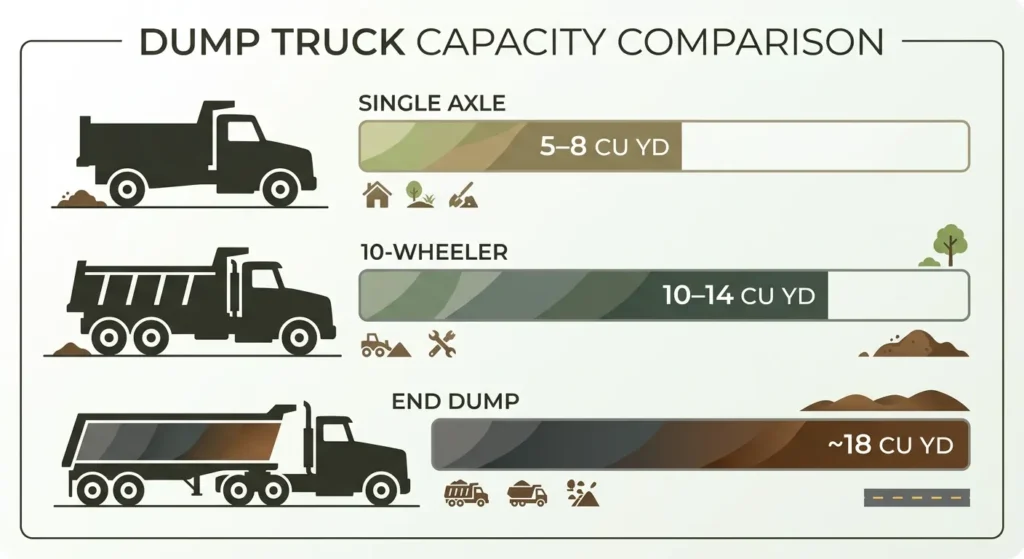
A 10-wheeler dump truck typically holds about 10 to 14 cubic yards of material, with 12 cubic yards being a useful planning figure for many standard tandem dump trucks. The actual load depends on the truck’s bed dimensions, whether the material is struck or heaped, the material’s density, and the truck’s legal weight limit.
For excavation and construction work, cubic-yard capacity is only part of the calculation. A truck may have enough physical space for 12 cubic yards of material but still be unable to legally carry that much if the material is heavy. This is particularly important with gravel, wet soil, clay, and asphalt.
What Is a 10-Wheeler Dump Truck?
A 10-wheeler is commonly used to describe a tandem-axle dump truck with three axles: one steering axle at the front and two rear axles. The term comes from the traditional wheel arrangement rather than a specific standardized bed capacity.
These trucks are widely used for hauling:
- Excavated soil
- Fill dirt
- Topsoil
- Gravel
- Sand
- Crushed stone
- Asphalt
- Construction debris
- Landscaping materials
A tandem dump truck is often useful when a project needs more capacity than a smaller single-axle dump truck but does not require a large tractor-trailer end dump.
Unlike larger end-dump combinations that can carry substantially more material, a 10-wheeler generally offers a useful balance between payload, maneuverability, and access to residential or urban construction sites.
How Many Cubic Yards Does a 10-Wheeler Hold?
A practical planning range is about 10 to 14 cubic yards, although individual trucks can fall outside that range because dump-body dimensions vary.
| 10-Wheeler Configuration | Approximate Capacity |
|---|---|
| Smaller tandem dump body | 10 cu yd |
| Typical tandem dump truck | 10–12 cu yd |
| Larger dump body | 12–14 cu yd |
| Heaped load | More than struck capacity, depending on material |
For estimating an excavation or delivery, 12 cubic yards per load is a reasonable starting figure, but it should not be treated as a guaranteed capacity for every truck.
The best number is the capacity supplied by the truck owner or material supplier for the specific dump body.
Struck vs. Heaped Capacity
The term struck capacity means the material is loaded approximately level with the top of the truck bed.
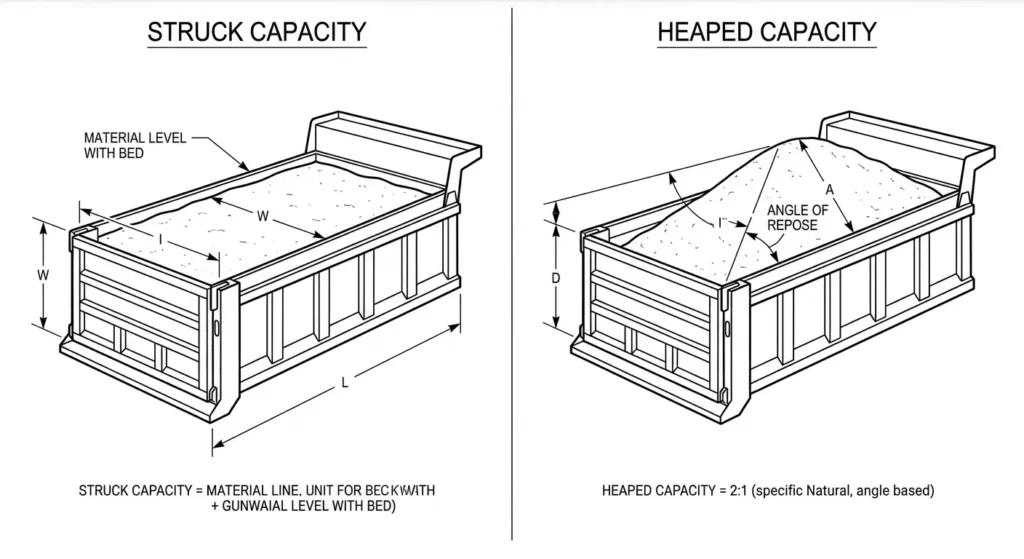
Heaped capacity means the material is mounded above the sides of the bed. The amount added by heaping depends on the material, its angle of repose, the bed design, and how the load is distributed.
This means a truck advertised as a 12-cubic-yard truck may not carry exactly 12 cubic yards in every loading situation.
For excavation estimates, it is safer to calculate the project volume first and then confirm how many cubic yards the supplier considers a legal load for the particular material.
Why a 10-Wheeler Does Not Always Carry the Same Number of Yards?
The biggest mistake when estimating dump-truck capacity is assuming that bed volume automatically equals legal payload.
It does not.
Two factors control the amount a truck can carry:
- Physical volume — how much space is available in the dump body.
- Legal weight — how much the truck can carry without exceeding its applicable weight limits.
Light materials such as mulch can reach the physical capacity of the bed before the truck reaches its payload limit.
Heavy materials such as gravel, wet clay, and dense fill dirt can reach the weight limit before the bed is physically full.
Weight Can Limit Capacity Before the Bed Is Full
For U.S. highway operations, federal rules establish limits including 20,000 pounds for a single axle, 34,000 pounds for a tandem axle, and an 80,000-pound gross weight limit on the Interstate System, subject to the Federal Bridge Formula and applicable state requirements. The actual legal limit for a particular dump truck can be lower because of its configuration, rated capacity, route, or state law.
That is why a dispatcher should not simply tell a driver to “fill the bed” when hauling dense material.
Material Density Matters
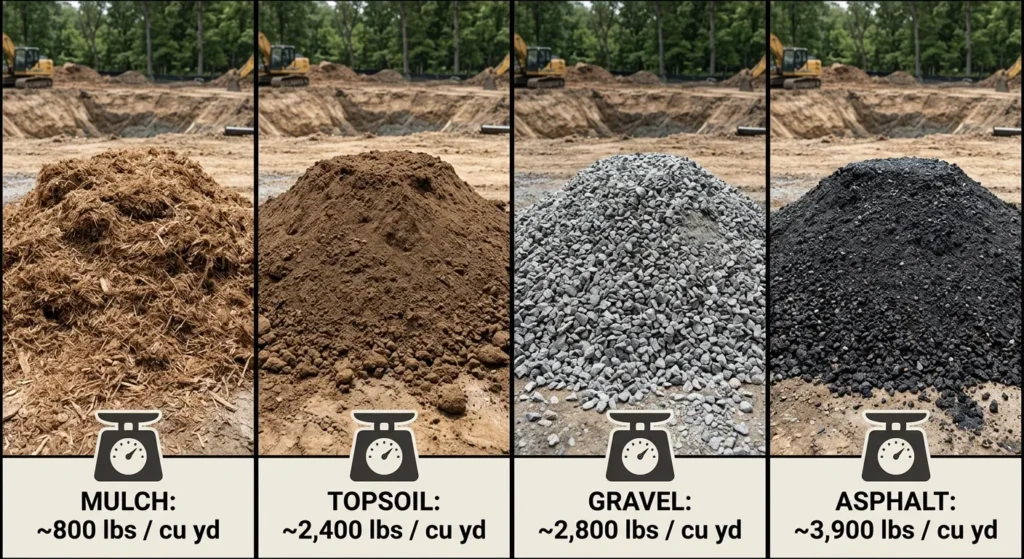
The following figures are useful for understanding the relationship between volume and weight. Actual density varies considerably with moisture content, grading, compaction, and material source.
| Material | General Weight Consideration | What Usually Limits the Load? |
|---|---|---|
| Mulch | Relatively light | Bed volume |
| Wood chips | Relatively light | Bed volume |
| Dry soil | Moderate | Truck payload or volume |
| Fill dirt | Variable | Often weight when wet/dense |
| Gravel | Heavy | Weight |
| Crushed stone | Heavy | Weight |
| Wet clay | Very heavy | Weight |
| Asphalt | Very heavy | Weight |
Here’s what most people get wrong about dump-truck capacity: a 10-wheeler cannot automatically carry a full bed of every material.
For example, filling a tandem dump truck completely with a dense aggregate could exceed its legal axle or gross-weight limits even though the material physically fits inside the body.
FHWA explains that when multiple weight restrictions apply, the lowest applicable limit controls. The Federal Bridge Formula also restricts the allowable weight on groups of consecutive axles.
How to Calculate the Cubic-Yard Capacity of a 10-Wheeler?
If you know the inside dimensions of the dump body, you can estimate its struck capacity with a simple formula.
Cubic Yard Formula
Length × Width × Height ÷ 27 = Cubic Yards
There are 27 cubic feet in one cubic yard.
Example
Suppose a dump body measures:
- Length: 12 feet
- Width: 7 feet
- Side height: 3 feet
Calculate the volume:
12 × 7 × 3 = 252 cubic feet
Then convert cubic feet to cubic yards:
252 ÷ 27 = 9.33 cubic yards
So the approximate struck capacity is 9.3 cubic yards.
A heaped load can hold more than this, but the additional material cannot be assumed to be a specific percentage for every truck and material. The safe approach is to use the manufacturer’s or supplier’s stated capacity.
Why Bed Dimensions Matter?
Two trucks may both be called 10-wheelers but have different dump bodies.
Capacity can change because of:
- Dump-body length
- Body width
- Side-wall height
- Body shape
- Internal bracing
- Hoist components
- Bed liner thickness
- Tailgate design
- Heaping method
Therefore, the number of wheels alone does not determine cubic-yard capacity.
How Many Cubic Yards Can a 10-Wheeler Carry by Material?
The amount you can practically order depends on both the material’s density and the truck’s legal payload.
Topsoil and Fill Dirt
A 10-wheeler can commonly be used for roughly 10 to 14 cubic yards of soil, depending on the truck and material.
Dry, loose soil is much easier to carry by volume than saturated or dense material. Moist fill dirt can become significantly heavier, meaning the truck may need to leave some space in the body to remain within its legal weight.
For an excavation project, do not calculate the number of trucks simply by dividing your excavation volume by 12. Account for the soil’s condition and any increase in loose volume after excavation.
Gravel and Crushed Stone
Gravel is substantially denser than mulch and many other landscaping materials.
A 10-wheeler may therefore be weight-limited before the bed is completely full.
For estimating purposes, a legal gravel load may be around the lower end of the truck’s physical capacity rather than a full heaped bed.
If you are ordering gravel, ask the supplier for the expected legal payload in tons and approximate cubic-yard quantity, rather than simply requesting a “full truck.”
Mulch and Wood Chips
Mulch, wood chips, and similar lightweight materials are usually more likely to be volume-limited.
A 10-wheeler may be able to carry a full or heaped body of these materials without reaching the same weight constraints encountered with gravel or wet soil.
The exact amount still depends on the material’s moisture content and density.
Asphalt
Asphalt is much heavier than mulch and many loose landscaping materials.
Because of that density, the truck may reach its legal payload before the dump body is full.
For asphalt work, the supplier normally calculates the load based heavily on weight, project requirements, and truck configuration rather than simply filling the body to its maximum physical volume.
10-Wheeler Capacity vs. Other Dump Trucks
A 10-wheeler is only one option for hauling excavated material.
| Truck Type | Typical Use |
|---|---|
| Single-axle dump truck | Small residential deliveries |
| 10-wheeler/tandem dump | Residential and medium construction projects |
| Tri-axle dump truck | Larger aggregate and excavation loads |
| End dump trailer | Large-volume commercial hauling |
| Belly dump | Efficient placement of bulk aggregate |
| Transfer dump | Large projects requiring high hauling capacity |
The best truck is not necessarily the one with the largest bed.
A larger truck may carry more material per trip but may have difficulty accessing a residential property, narrow street, small excavation site, or urban infill project.
A 10-wheeler can be a better choice when site access and maneuverability matter as much as hauling volume.
How Many 10-Wheeler Loads Do You Need?
To estimate the number of truckloads, start with the project’s total material volume.
Basic Formula
Number of truckloads = Total material volume ÷ Usable cubic yards per truck
For example, suppose an excavation produces 60 cubic yards of loose material and your hauler confirms that the truck can legally carry approximately 12 cubic yards per load.
60 ÷ 12 = 5 loads
You would need approximately 5 truckloads.
However, excavation calculations require another consideration: soil swell.
When soil is excavated, it is loosened and can occupy more volume than it did in the ground. Therefore, 60 cubic yards of in-place soil does not necessarily become exactly 60 cubic yards of loose material in dump trucks.
For excavation hauling, estimate the loose volume to be transported, not just the original in-place excavation volume.
State Laws and Legal Weight Limits
Dump-truck capacity is not determined by the bed alone. Weight regulations also matter.
In the United States, federal Interstate limits include a 34,000-pound tandem-axle limit and an 80,000-pound overall gross-weight limit, subject to bridge-formula requirements and other provisions. States can have additional rules, and trucks operating away from Interstate highways can be subject to different limits.
Before loading a truck, verify:
- The truck’s rated payload
- Its empty or tare weight
- Applicable axle-weight limits
- Applicable gross-weight limits
- Route restrictions
- State and local requirements
- Whether an overweight permit is required
A weight ticket is also useful because it documents the actual scale weight of the delivered load.
Frequently Asked Questions
How many cubic yards does a 10-wheeler hold of topsoil?
A 10-wheeler commonly carries around 10 to 14 cubic yards of topsoil, depending on its dump-body dimensions and the soil’s density and moisture. Around 12 cubic yards is a useful planning figure, but a wet or dense load may need to be reduced to remain within legal payload limits.
How many cubic yards of gravel can a 10-wheeler carry?
A 10-wheeler may carry roughly 10 to 12 cubic yards of gravel, but the exact amount is weight-dependent. Gravel is dense enough that the truck can reach its legal payload before the bed is completely full. Always confirm the legal payload with the supplier or hauler.
Is a 10-wheeler the same as a tandem dump truck?
In common construction and hauling terminology, yes. A 10-wheeler generally refers to a tandem dump truck with one front steering axle and a tandem pair of rear axles. However, the exact truck configuration and body dimensions can vary, so the term does not guarantee a specific cubic-yard capacity.
How many tons does a 10-wheeler hold?
There is no single payload number for every 10-wheeler. Payload depends on the truck’s empty weight, rated gross weight, axle configuration, applicable regulations, and material density. A typical tandem dump may haul around the mid-teens in tons, but the legal payload must be calculated for the specific truck and route.
How do I calculate cubic yards for my project?
Multiply the material area’s length × width × depth in feet and divide by 27. For example, 30 feet × 10 feet × 1 foot equals 300 cubic feet, or about 11.1 cubic yards. For excavation, also account for soil swell when estimating the loose material that must be hauled away.
Can a 10-wheeler carry 15 cubic yards?
Some larger dump bodies may physically hold 15 cubic yards or more when heaped, but you should not assume that a 15-cubic-yard load is legal for every 10-wheeler. With dense materials, the truck may reach its weight limit before reaching that volume. Confirm the truck’s body capacity and legal payload before ordering.
Conclusion: How Many Cubic Yards Does a 10-Wheeler Hold?
A 10-wheeler dump truck typically holds about 10 to 14 cubic yards, with 12 cubic yards serving as a practical planning figure for many standard tandem dump trucks.
But cubic-yard capacity is only half the calculation. Material density and legal weight limits can reduce the amount you can actually haul. Gravel, wet soil, clay, and asphalt are particularly important because they can make a truck overweight before the bed is full.

Ahmed Ijaz runs this construction rental directory with over 5 years of experience in SEO, content, and web optimization. Every page is built using real research, hands-on expertise, and carefully reviewed information to meet strong EEAT standards.