
Dump fees and hauling fees are two separate costs that can make up a junk removal bill. Dump fees are the disposal charges paid to a landfill, transfer station, or recycling facility, while hauling fees cover the labor, transportation, truck, fuel, and logistics required to move the material. Understanding the difference helps you see what you are actually paying for.
A junk removal company may give you one combined price, but that price usually has several underlying costs. The amount of junk, its weight, disposal requirements, loading difficulty, travel distance, and type of material can all affect the final charge.
What Are Dump Fees?
Dump fees are charges for disposing of waste at a landfill, transfer station, recycling facility, or other permitted disposal site. They are also called landfill tipping fees or disposal fees.
The facility generally determines the charge according to the material, weight, volume, or type of load. Some facilities also have minimum charges and separate rates for materials requiring special handling.
Dump fees vary considerably by location and facility. For example, Fairfax County, Virginia, lists a FY2027 commercial solid-waste tipping fee of $98 per ton, while King County, Washington, lists garbage at $243.38 per ton. These local rates illustrate why there is no single nationwide landfill tipping fee.
How Landfills Calculate Dump Fees?
Many commercial disposal facilities use a scale to determine the weight of a load.
The basic calculation is:
Dump Fee = Chargeable Weight × Disposal Rate
For example, if a facility charges $100 per ton and a load weighs 0.5 tons:
0.5 × $100 = $50 dump fee
However, the actual bill can be affected by minimum charges, material classifications, recycling requirements, and special handling fees.
Some facilities charge different rates for ordinary garbage, construction debris, yard waste, recyclable materials, appliances, mattresses, or special waste.
Weight vs. Volume
One of the most important differences between dump fees and hauling fees is that disposal costs can increase significantly when the material is heavy.
A truck that is half full of lightweight household junk may have a relatively low disposal cost. The same amount of truck space filled with concrete, brick, dirt, roofing materials, or other dense construction debris can weigh substantially more.
This creates an important pricing issue for junk removal companies that use volume-based pricing. The customer pays according to truck space, while the company’s dump fee may be determined by weight.
Specialty Item Disposal Fees
Certain materials can have additional disposal or recycling charges.
| Item | Possible Additional Charge | Reason |
|---|---|---|
| Mattresses | $30+ per item | Separate disposal or recycling |
| Refrigerant appliances | $30+ per unit | Refrigerant handling |
| Electronics | Varies | E-waste processing |
| Tires | Varies | Special disposal requirements |
| Special waste | Varies significantly | Additional handling requirements |
These are examples, not universal prices. For instance, King County currently lists a $33.39 mattress disposal fee and a $30 appliance refrigerant fee, while its special-waste charges are substantially higher.
What Are Hauling Fees?
Hauling fees pay for the work required to collect, load, transport, and deliver junk to its destination.
Unlike dump fees, hauling fees are primarily connected to labor and transportation rather than the disposal facility’s tipping rate.
A hauling charge can include:
- Crew labor
- Loading and carrying
- Truck usage
- Fuel
- Driving time
- Travel distance
- Vehicle maintenance
- Insurance
- Equipment
- Business overhead
The customer may see only one line on the quote, but these costs contribute to the final junk removal pricing.
Labor Costs
Labor is one of the largest components of hauling.
A crew may need to carry furniture down stairs, remove items from a basement, disassemble large objects, sort materials, and load the truck. A simple curbside pickup therefore requires much less labor than a house cleanout involving multiple rooms.
For U.S. context, the Bureau of Labor Statistics reported a $25.39 mean hourly wage for refuse and recyclable material collectors in May 2025. A junk removal company’s actual labor cost is higher than the employee’s wage after payroll costs, insurance, benefits, and other employer expenses.
Truck and Fuel Costs
The hauling fee also helps cover the cost of operating the vehicle.
Fuel increases with driving distance and vehicle size, while truck expenses include financing or depreciation, maintenance, tires, repairs, registration, and commercial insurance.
A company making several trips to a distant disposal facility may therefore have significantly higher transportation costs than one operating close to the landfill.
Overhead Allocation
Not every business expense occurs during the actual pickup.
A junk removal company may also have expenses for:
- Insurance
- Advertising
- Office software
- Phone service
- Licensing
- Accounting
- Truck payments
- Equipment
- Administrative labor
These overhead costs are normally built into the company’s pricing rather than appearing as a separate charge.
How Dump Fees and Hauling Fees Combine?
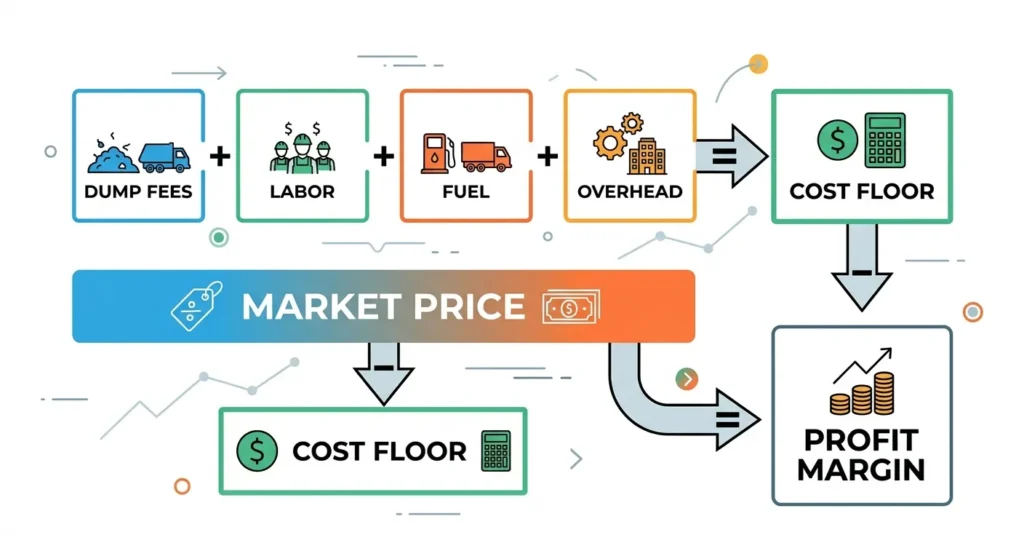
A junk removal quote generally needs to cover both disposal and hauling costs before the company can account for its profit margin.
A simplified cost-floor formula is:
Cost Floor = Dump Fees + Labor + Fuel + Vehicle Costs + Overhead
For example, consider an illustrative junk removal job:
| Cost Component | Example |
|---|---|
| Dump fee | $100 |
| Crew labor | $90 |
| Fuel and vehicle costs | $40 |
| Overhead allocation | $60 |
| Estimated cost floor | $290 |
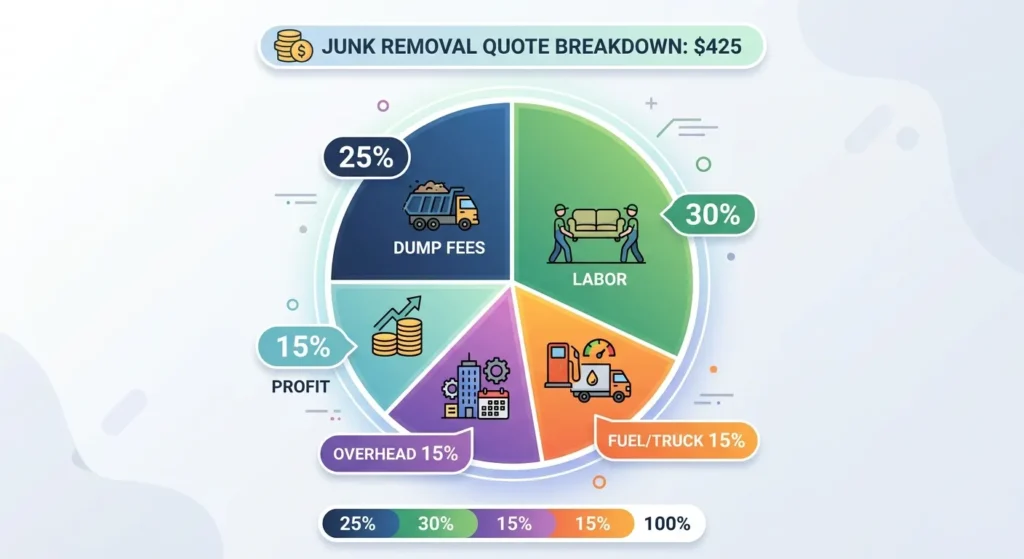
If the customer is charged $425, the difference is not automatically profit. The company may still have other operating costs, taxes, payment-processing expenses, or unexpected job costs.
The actual figures vary by location, material, company, and job complexity.
Why Heavy Loads Can Change the Economics?
Heavy materials create a special problem for volume-based truckload pricing.
Suppose a company quotes a customer based on half a truck. If the truck contains lightweight furniture and household items, the disposal bill may remain manageable.
But if the same space contains concrete or other dense construction debris, the load can reach a much higher weight before the truck looks full.
That means:
More weight → higher dump fee → higher disposal cost
This is why some junk removal companies price heavy materials separately or use weight-based pricing instead of treating every half-truck load the same.
Volume-Based Pricing vs. Weight-Based Pricing
Volume-Based Pricing
With volume-based pricing, the customer pays according to how much truck space the junk occupies.
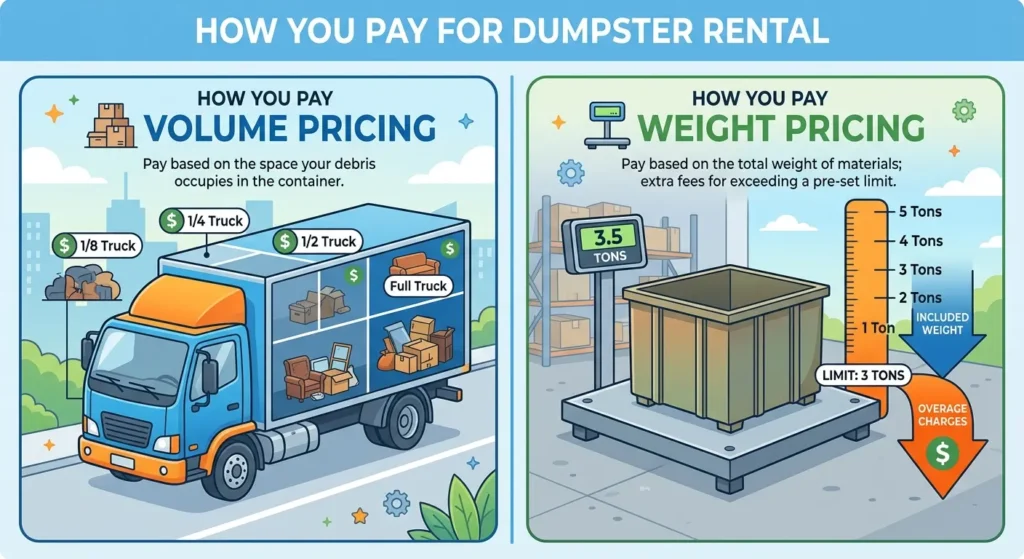
A company may offer prices such as:
- Minimum load
- ¼ truck
- ½ truck
- ¾ truck
- Full truck
This model is easy for customers to understand, but the hauler assumes more risk when material density varies significantly.
A half-truck of cardboard and a half-truck of concrete occupy similar space but can create very different dump fees.
Weight-Based Pricing
Weight-based pricing charges according to the amount of material being disposed of.
This approach is particularly relevant for:
- Dirt
- Concrete
- Brick
- Asphalt
- Roofing materials
- Construction debris
Because the disposal charge is closely connected to weight, this model can better reflect the actual disposal cost for dense materials.
Dumpster Rental vs. Full-Service Junk Removal
Dumpster rental and full-service junk removal shift the responsibility for labor and disposal differently.
| Factor | Dumpster Rental | Full-Service Junk Removal |
|---|---|---|
| Loading | Customer | Removal crew |
| Labor | Usually customer-provided | Included in service |
| Disposal | Based on rental terms and disposal rules | Usually handled by hauler |
| Pricing | Rental + applicable disposal/overage charges | Often volume-, item-, or job-based |
| Best suited for | Multi-day projects | Cleanouts and quick removal |
With a dumpster, you generally load the material yourself. With full-service junk removal, the crew handles loading and transportation.
What to Ask About Dump and Hauling Fees?
Before accepting a quote, ask:
- Is the dump fee included in the quoted price?
- Is the price based on volume, weight, items, or labor?
- Can the price change if the material is heavier than expected?
- Are mattresses, appliances, electronics, or tires subject to surcharges?
- Is there a minimum pickup charge?
- Does the quote include loading and carrying?
- Are fuel or travel charges included?
- Where will the material be disposed of or recycled?
These questions make it easier to compare quotes that appear similar but include different services.
Red Flags in Junk Removal Quotes
Be cautious when a quote does not clearly explain what is included.
Potential warning signs include:
- An unusually vague price with no explanation
- Unexpected disposal charges after loading
- No clarification about heavy materials
- Specialty items not discussed
- A quote that changes substantially without a clear reason
A legitimate company should be able to explain its pricing structure and what the quoted service covers.
How to Reduce Dump Fees?
You can sometimes reduce disposal costs by reducing the amount of material that actually requires landfill disposal.
Separate Recyclable Materials
Separating metal, cardboard, clean wood, or other accepted recyclable materials can reduce the amount of waste sent to disposal facilities. The exact savings depend on local facility rules.
Donate Usable Items
Furniture and other reusable household items may be donated instead of discarded. Habitat for Humanity says many ReStores offer pickup of large donations such as furniture and appliances, although availability varies by location.
Goodwill also notes that pickup availability and accepted items vary by local organization.
Use Municipal Disposal Programs
Some municipalities provide bulk-waste collection or special disposal programs. Check your local government’s rules before paying a private hauler for items that may qualify for a lower-cost public service.
How to Reduce Hauling Fees?
Hauling costs are closely connected to the amount of labor and travel required.
You may reduce the cost by:
- Putting items near the driveway or curb when permitted
- Separating items before the crew arrives
- Disassembling large furniture when safe and practical
- Combining multiple small pickups
- Providing accurate photos when requesting a quote
- Choosing a company located closer to your property
The easier the load is to access and remove, the less time the crew may need on site.
Dump Fees vs. Hauling Fees: Key Differences
| Factor | Dump Fees | Hauling Fees |
|---|---|---|
| What they pay for | Disposal | Collection and transportation |
| Usually determined by | Weight, material, facility rules | Labor, distance, truck and time |
| Paid to | Landfill/transfer/recycling facility | Junk removal company |
| Can include | Tipping, recycling, special handling | Loading, fuel, labor, vehicle costs |
| Main cost driver | Material and weight | Time, distance and job difficulty |
The two costs are related, but they are not the same expense.
The Bottom Line
Dump fees are the disposal costs charged by a landfill, transfer station, or recycling facility, while hauling fees cover the labor and transportation required to move your junk there. A complete junk removal price needs to account for both, along with operating overhead and the company’s required profit margin.
The most important distinction is weight versus work: dump fees can rise when material becomes heavier or requires special disposal, while hauling fees generally rise when a job requires more labor, time, travel, or truck resources.
When comparing junk removal quotes, ask whether disposal is included, how the load is priced, and whether heavy or specialty materials carry additional charges.

Ahmed Ijaz runs this construction rental directory with over 5 years of experience in SEO, content, and web optimization. Every page is built using real research, hands-on expertise, and carefully reviewed information to meet strong EEAT standards.