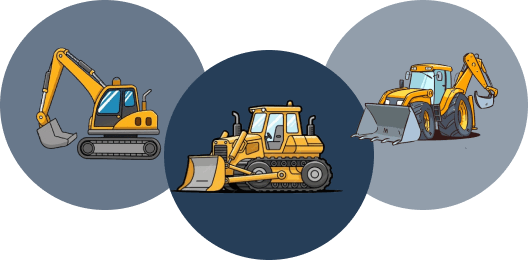
Excavation costs depend on more than the price of labor or equipment. Manual excavation relies mainly on workers using hand tools, while machine excavation uses equipment such as excavators, loaders, and dozers. The more economical option depends on site access, soil type, excavation volume, and project timeline.
For accessible sites with medium or large excavation volumes, equipment generally provides greater productivity and lower unit costs. Manual excavation can make more sense for small, shallow projects, restricted spaces, or areas where precision is critical.
Manual Excavation vs Machine Excavation
Manual excavation involves digging, loading, and moving soil with shovels, picks, wheelbarrows, and other basic tools. Its main cost is labor, calculated according to the number of workers and hours or days required.
Machine excavation uses heavy equipment to remove soil much faster. Its cost includes equipment rental or depreciation, fuel, operator wages, maintenance, and transportation or mobilization.
The fundamental difference is simple: manual excavation has a higher labor requirement, while machine excavation has a higher equipment and operating cost.
How Much Does Manual Excavation Cost?
Manual excavation is commonly priced by man-day, labor hours, or volume of soil removed. A basic labor calculation is:
Total Labor Cost = Daily Wage × Number of Workers × Project Days
The actual cost can increase substantially when workers must dig hard soil, gravel, deep trenches, or material that requires additional shoring.
For example, a small excavation requiring only a few workers for a short period may have a manageable labor cost. The same amount of soil can become expensive when difficult ground conditions extend the project duration.
Factors That Increase Manual Excavation Costs
The main factors include:
- Soil hardness and composition
- Excavation depth
- Amount of material to remove
- Distance soil must be carried
- Number of workers required
- Shoring and safety requirements
- Site access
- Local labor rates
Manual productivity can decrease sharply in hard soil, gravel, and rock, causing labor hours and total project costs to rise.
How Much Does Machine Excavation Cost?
Machine excavation combines several expenses rather than a single equipment rate. The basic calculation is:
Total Machine Cost = Equipment Rate × Operating Time + Fuel + Operator + Transportation/Setup
Depending on the project, maintenance, mobilization, and other site costs may also be included.
Equipment is often charged by the hour, shift, day, or volume of material excavated. A mini excavator may be suitable for restricted locations, while larger excavators can move substantially more soil in less time.
Main Machine Excavation Costs
Machine excavation may include:
- Equipment rental or depreciation
- Fuel
- Operator wages
- Maintenance
- Delivery and pickup
- Mobilization
- Site restoration
A machine can therefore have a higher initial rate while still producing a lower overall excavation cost because it completes the work much faster.
Manual Excavation vs Equipment Cost
| Cost Factor | Manual Excavation | Machine Excavation |
|---|---|---|
| Main expense | Labor | Equipment and operation |
| Speed | Slow | Fast |
| Equipment requirement | Minimal | Significant |
| Small shallow excavation | Can be suitable | May be uneconomical |
| Restricted access | Often suitable | May be impossible |
| Large excavation volume | Labor-intensive | Highly productive |
| Hard soil | Labor cost rises | Generally more efficient |
| Precision work | High control | Requires careful operation |
| Mobilization | Minimal | May add cost |
| Site disturbance | Usually lower | Can be higher |
The comparison should focus on the complete project cost, not simply the cheapest hourly or daily rate.
When Is Manual Excavation Cheaper?
Manual excavation may be more economical when the excavation is small, shallow, difficult for equipment to access, or requires highly controlled digging.
A narrow backyard, indoor area, utility corridor, or sensitive landscape may not provide enough room for a standard excavator. In some cases, a machine cannot physically reach the excavation area.
Manual work can also be useful around underground utilities where uncontrolled machine digging could damage existing infrastructure.
For restricted access, the source framework identifies openings under roughly 1.5 meters as situations where machines may not be able to enter.
When Is Machine Excavation More Cost-Effective?
Machine excavation generally becomes more practical as the volume of soil increases or the project requires completion within a short timeframe.
Machines have a major productivity advantage in accessible areas. Hard soil, gravel, and rock also make manual excavation substantially slower, increasing the amount of labor required.
For larger projects, equipment can remove material in a fraction of the time required by a manual crew. The source framework notes that once excavation volume reaches the scale of tens of cubic meters, machine unit-cost advantages can become increasingly apparent when site access is adequate.
How Soil Type Changes the Cost Comparison?
Soil conditions can change the economics of excavation significantly.
Soft soil: Both methods may be practical for smaller work, although machines provide greater productivity.
Hard soil or gravel: Manual digging becomes considerably slower, increasing labor requirements.
Rock: Mechanical excavation is generally required because hand digging becomes impractical.
This means a project that appears inexpensive based only on excavation volume can become much more expensive when difficult ground conditions are discovered.
How Site Access Affects Excavation Cost?
Site access is one of the first factors to evaluate before comparing labor and equipment.
A site with more than 2–3 meters of usable access and no major overhead obstacles can generally accommodate larger excavation equipment. Narrow passages, indoor locations, backyard access, overhead restrictions, or obstacles may require manual excavation or smaller equipment.
Equipment must also be transported to the property, so even when a machine can technically reach the excavation area, delivery and mobilization costs can affect the final price.
Hidden Costs of Manual Excavation
Manual excavation has costs that may not appear in the initial labor rate.
The biggest is time. A slow excavation can extend project schedules and create additional management, supervision, and site-related expenses.
Deep excavation also introduces safety requirements. Shoring and other protective measures may be necessary, particularly when workers are operating inside or near trenches.
However, manual digging can reduce the risk of damaging underground utilities or sensitive areas because workers have greater direct control over the excavation.
Hidden Costs of Machine Excavation
Equipment also comes with additional expenses beyond its rental rate.
Common examples include:
- Mobilization and transportation
- Fuel
- Minimum rental or billing periods
- Damage to pavement or landscaping
- Restoration after excavation
- Restricted access
- Operator costs
Small projects can be particularly affected by minimum equipment rental periods. Paying for a full shift or minimum rental period may make a machine less economical when only a small amount of soil needs to be removed.
Manual vs Machine Excavation: Which Should You Choose?
Use the following decision process:
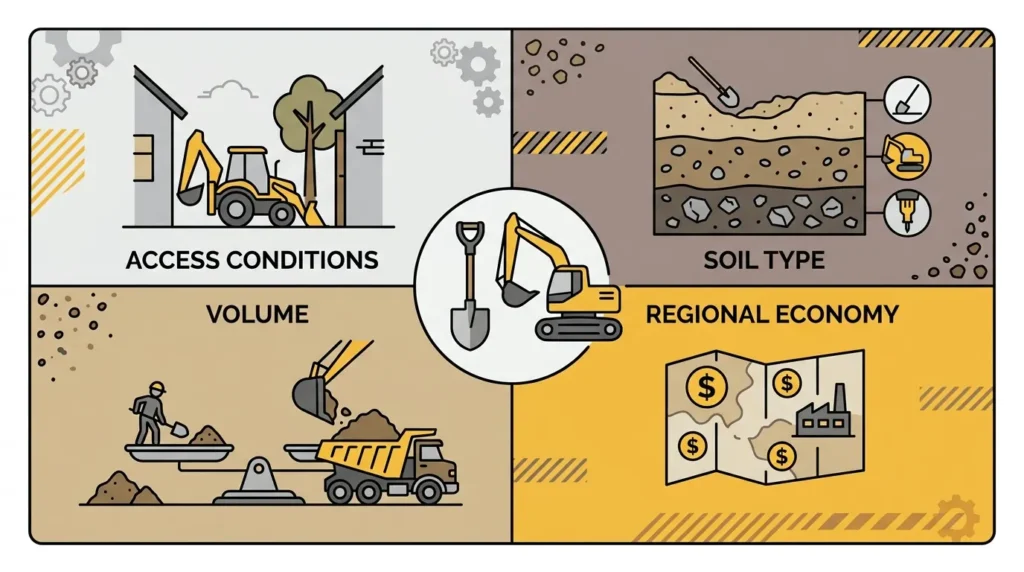
- Check access first. If equipment cannot physically reach the excavation area, manual digging or smaller equipment may be necessary.
- Estimate excavation volume. Larger quantities generally favor machines because of their higher productivity.
- Identify the soil type. Hard soil, gravel, and rock increase the labor required for manual excavation.
- Consider the deadline. A short project timeline can make equipment more economical even when its hourly rate is higher.
- Check underground utilities. Precision digging may require manual work around sensitive utility locations.
- Calculate the complete cost. Include labor, equipment, fuel, transportation, safety requirements, disposal, and restoration.
This approach follows the four major decision dimensions in the source: access, soil conditions, project volume/timeline, and regional labor economics.
Is Manual Excavation Always Cheaper Than Machine Excavation?
No. Manual excavation is not automatically cheaper simply because it requires little equipment.
For a very small excavation in a restricted area, manual labor may cost less. For accessible sites with larger volumes, machine productivity can reduce the total cost despite higher equipment expenses.
The correct comparison is the total project cost and completion time, rather than labor cost or equipment rental cost alone.
What Is the Cheapest Excavation Method for a Small Job?
For a small, shallow excavation, manual digging may be economical when labor is reasonably priced and equipment access is difficult.
However, equipment may still be worthwhile if the soil is hard, the excavation volume is substantial, or the project must be completed quickly.
The site conditions should be evaluated before choosing either method.
Can Manual and Machine Excavation Be Used Together?
Yes. A hybrid excavation approach can combine both methods.
An excavator can perform the bulk earthwork while workers handle areas requiring greater precision, such as utility crossings, edges, sensitive landscaping, or final trimming.
This approach can reduce machine operating time while retaining manual control where accuracy matters.
Final Cost Comparison
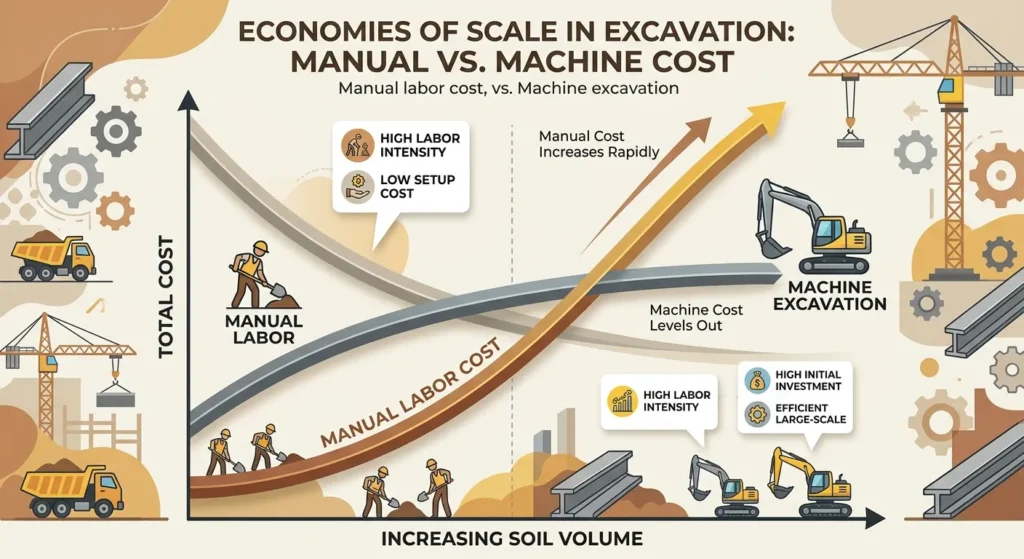
There is no single excavation method that has the lowest cost for every project. The deciding factors are access, soil type, excavation volume, labor rates, equipment availability, and required completion time.
Manual excavation is most applicable to small or restricted projects where equipment cannot reach or where precision is important. Machine excavation becomes increasingly practical as excavation volume, soil difficulty, or schedule requirements increase.
Before hiring workers or renting equipment, calculate the complete excavation cost, including labor, equipment, fuel, mobilization, safety requirements, disposal, and potential restoration. Comparing the full project cost provides a more accurate basis for choosing the excavation method.

Ahmed Ijaz runs this construction rental directory with over 5 years of experience in SEO, content, and web optimization. Every page is built using real research, hands-on expertise, and carefully reviewed information to meet strong EEAT standards.