
An excavation quote is a written contractor proposal that explains the excavation scope, estimated quantities, pricing, site conditions, exclusions, schedule, and payment terms. It shows the client exactly what excavation work is included before the project begins and provides a basis for comparing contractors.
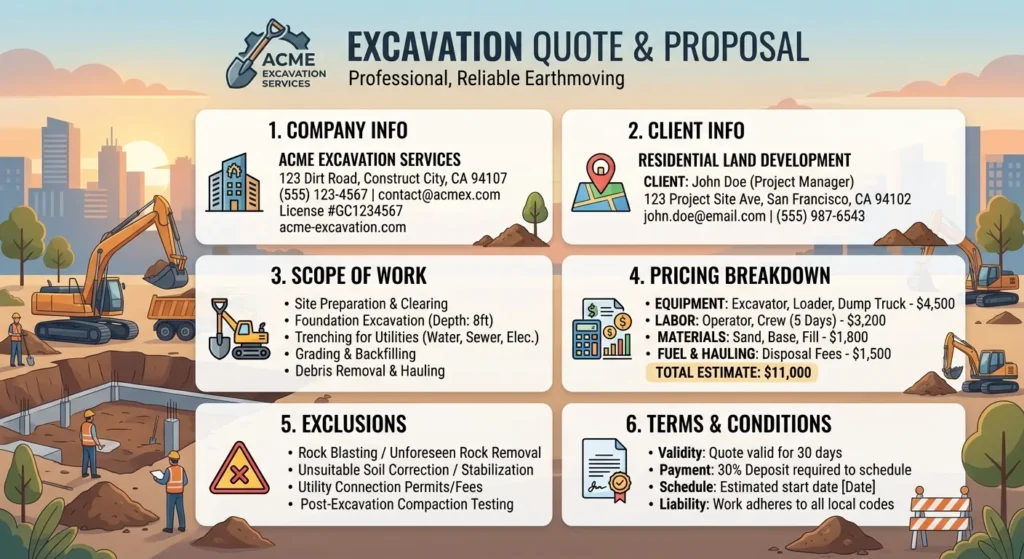
What Is Included in an Excavation Quote?
A complete excavation quote normally includes the contractor and client information, scope of work, itemized pricing, excavation quantities, soil handling, exclusions, assumptions, project schedule, and payment terms. For larger earthwork projects, it should also identify cut-and-fill quantities, equipment requirements, haul-off, disposal, and conditions that could result in additional costs.
Contractor and Client Information
An excavation quote should begin by identifying the contractor, client, and project. The contractor’s information generally includes the company name, contact details, license information where required, insurance information, quote number, and date. The client section should identify the property owner or company, project address, contact information, and site contact.
The quote or estimate number provides a useful reference when the contractor issues revisions or later prepares invoices for the same project.
Scope of Work
The scope of work explains exactly what the contractor will perform. Depending on the project, this may include site clearing, stripping, excavation, foundation digging, building pad preparation, grading, backfilling, subgrade preparation, and cleanup.
A precise scope should reference the applicable plans, drawings, and specifications and identify important measurements such as excavation depths, dimensions, grades, slopes, and estimated quantities.
A clearly defined scope helps prevent disagreements about what the quoted price covers.
Itemized Pricing
The pricing section explains how the contractor arrived at the excavation price. Depending on the project, it can include labor, equipment, mobilization, materials, hauling, disposal, permits, and applicable taxes.
Labor may cover equipment operators, laborers, or foremen. Equipment costs can include excavators, loaders, bulldozers, compactors, and other machinery. Materials may include imported fill, gravel, aggregate, or topsoil. The contractor may present these as separate line items or include them within a lump-sum price.
A detailed quote does not necessarily have to show every individual expense, but it should make the major cost components understandable.
Excavation and Cut-and-Fill Quantities
For projects involving substantial earthwork, an excavation quote should identify estimated material quantities when those figures are available. These may include the amount of soil to be excavated, imported fill, exported material, and material that can be reused on site.
Quantities are commonly measured in cubic yards (CY). For example, a grading project might estimate 3,200 cubic yards of excavation and 2,400 cubic yards of imported fill.
Including these quantities connects the quoted price to the grading plan and gives the client a clearer understanding of the amount of earthwork being priced.
Soil Handling and Disposal
The quote should explain what will happen to excavated soil after it is removed. Suitable material may be stockpiled and reused on the property, while excess material may require loading, trucking, and off-site disposal.
Haul-off should not be assumed to be included. The quote should state whether soil removal, transportation, and disposal fees are part of the price. Disposal costs can vary based on soil type, quantity, hauling distance, site access, and disposal facility fees.
If topsoil will be stripped and preserved for later finish grading or landscaping, the quote should also explain where it will be stockpiled and whether that work is included.
Exclusions and Assumptions
Exclusions define work that is outside the quoted excavation price. Common exclusions include rock excavation, dewatering, utility locating or relocation, geotechnical testing, compaction testing, contaminated soil, unsuitable soil, and work performed by other trades.
The contractor may also make assumptions about normal soil conditions, adequate equipment access, available working space, and standard working hours. These assumptions matter because the quoted price generally depends on the conditions described when the estimate was prepared.
A quote with clearly stated exclusions makes it easier to identify additional work before it becomes a change order.
Site Access and Working Conditions
Site access can directly affect excavation production, equipment selection, and cost. The quote should address known conditions such as narrow entrances, limited equipment space, steep terrain, existing structures, overhead obstructions, restricted work areas, or limited space for soil stockpiling.
If difficult access is already known, the contractor should account for it in the quote rather than leaving the condition undefined.
Grading, Subgrade, and Compaction
When excavation is part of site preparation, the quote should explain the required grading and finished conditions. It may specify rough grading, finish grading, building pad preparation, foundation subgrade, trench bottoms, backfill, or compaction requirements.
The quote should also state whether compaction testing is included. Placing and compacting fill and independently testing that fill are separate responsibilities unless the contractor specifically includes both.
Permits and Utility Responsibilities
An excavation quote should clarify who is responsible for permits, inspections, and utility coordination. Depending on the project, this may include excavation permits, required inspections, public utility locates, private utility locating, and right-of-way requirements.
Clearly assigning these responsibilities prevents the client and contractor from assuming that the other party is handling them.
Project Schedule
The schedule section provides an estimated timeframe for the excavation work. It may identify the expected mobilization date, start date, excavation duration, grading period, and cleanup time.
The contractor should also identify known restrictions on working hours or site access. The stated duration is generally an estimate because weather, inspections, material availability, and unexpected site conditions can affect excavation progress.
Payment Terms and Quote Validity
An excavation quote should state the financial terms agreed upon by the contractor and client. This can include the deposit, progress payments, final payment, payment due dates, and procedures for additional work.
The quote should also state how long the pricing remains valid. A contractor may specify that the price is valid for 30 days. After that period, labor, equipment, fuel, material, hauling, or disposal costs may require the contractor to update the quote.
Change Orders
The quote should explain how additional work will be handled if actual conditions or project requirements differ from the original scope. Additional charges can result from unexpected rock, unsuitable soil, extra excavation, additional haul-off, imported fill, dewatering, restricted access, or changes to the plans.
A clear change-order procedure should explain how the additional work is priced and whether the contractor needs written approval before proceeding.
What Should You Look for in an Excavation Quote?
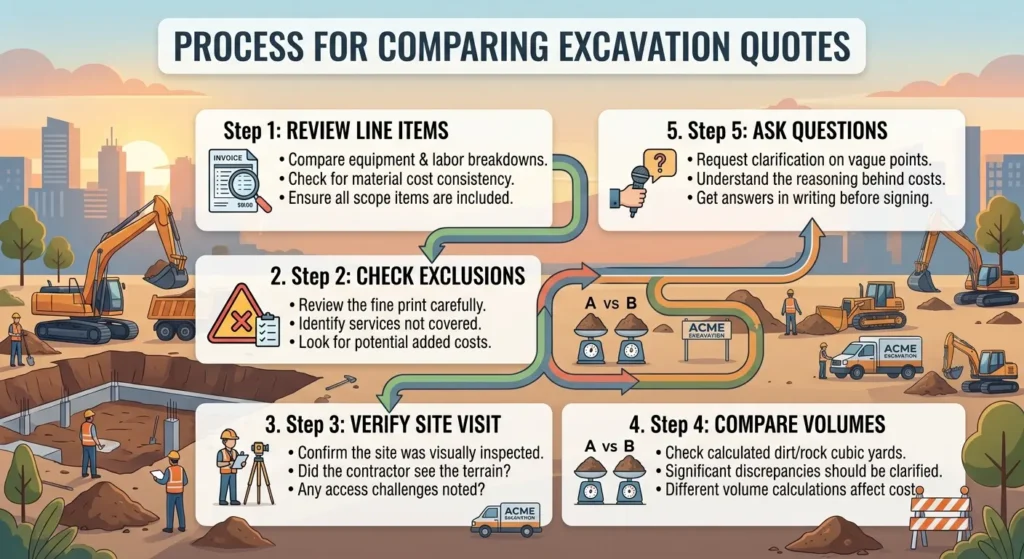
When comparing excavation quotes, make sure each contractor is pricing the same scope. Pay particular attention to excavation quantities, required grades, equipment, mobilization, soil reuse, haul-off, disposal, grading, compaction, permits, exclusions, and additional-work procedures.
A quote with a lower total price may simply include less work. Comparing the scope and assumptions alongside the price gives a more accurate picture of what each contractor is actually offering.
Excavation Quote vs. Estimate vs. Bid
An excavation quote generally presents a contractor’s proposed price and scope for a specific excavation project. An estimate usually represents an expected cost based on available information and assumptions. A bid commonly refers to pricing submitted for a defined project using plans, specifications, or bid documents.
Contractors may use these terms differently, so the document’s actual contents are more important than its title. The proposal should clearly define the scope, price, exclusions, assumptions, and terms.
Frequently Asked Questions
Does an excavation quote include dirt removal?
Not necessarily. The quote should specifically state whether loading, trucking, and disposal of excavated soil are included.
Does an excavation quote include grading?
Only when grading is included in the stated scope. The quote should specify whether it covers rough grading, finish grading, or both.
Are rock excavation and dewatering included?
They may be included or excluded depending on the project. The quote should clearly explain how these conditions will be handled and priced.
Should an excavation quote show cubic yards?
For projects involving significant earthwork, estimated cubic-yard quantities are useful because they connect the price to the excavation and grading requirements.
How long is an excavation quote valid?
The contractor determines the validity period. A quote may state that its pricing remains valid for 30 days or another specified period.
Can the final cost differ from the excavation quote?
Yes. A change in scope or actual site conditions that differ significantly from the quote’s assumptions can result in additional work and costs. The quote should explain how such changes are approved and priced.
Conclusion
An excavation quote should clearly connect the project’s scope to its price. It should define the work, quantities, labor, equipment, soil handling, haul-off, exclusions, assumptions, schedule, and payment terms.
Before accepting a quote, review the details that most often affect the final excavation cost, especially excavation quantities, grading, soil disposal, rock excavation, dewatering, compaction, permits, and change-order conditions. A precise quote gives both the contractor and client a clear understanding of what the excavation price covers.

Ahmed Ijaz runs this construction rental directory with over 5 years of experience in SEO, content, and web optimization. Every page is built using real research, hands-on expertise, and carefully reviewed information to meet strong EEAT standards.