Boom lift weight is one of the most important specifications to consider before renting, transporting, or operating an aerial work platform. Whether you’re moving equipment between job sites, calculating floor load capacity, or ensuring OSHA compliance, understanding boom lift weight can help prevent costly mistakes and safety hazards.
For contractors operating in Colorado, check jobsite delivery and machine weight capabilities for local boom lift rentals in Denver.
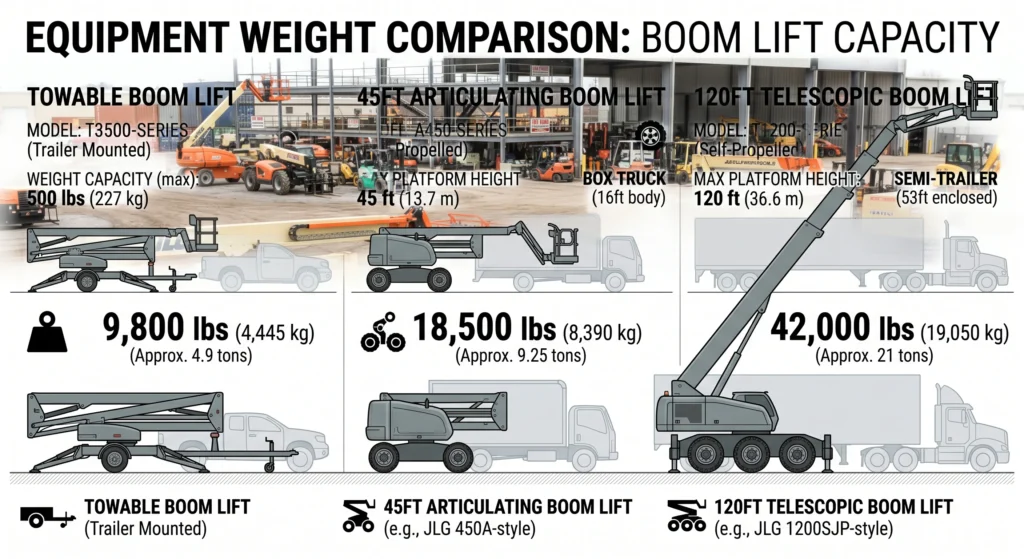
The average boom lift weight ranges from approximately 3,500 lbs (1.6 tons) to 48,000 lbs (21.8 tons) depending on the machine type, working height, power source, and manufacturer.
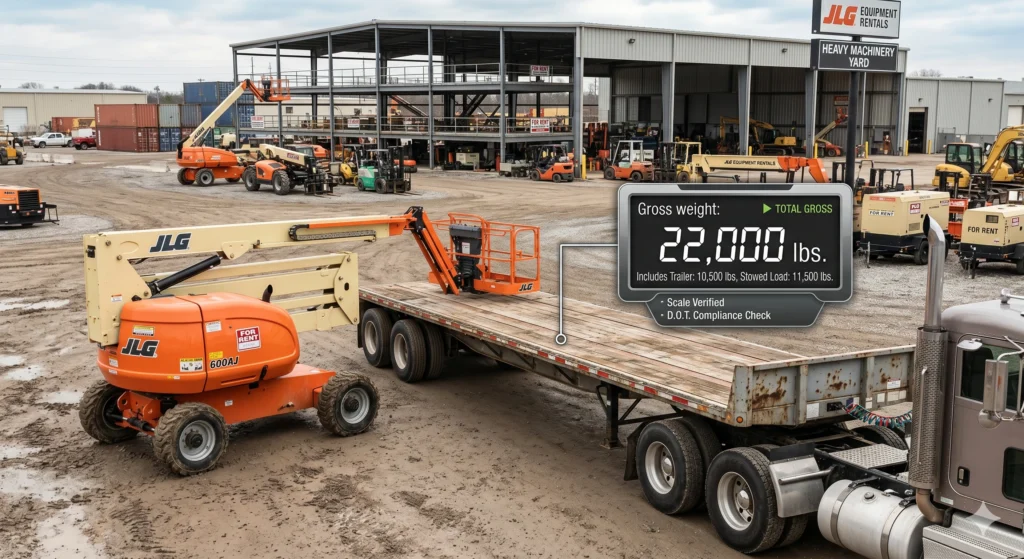
Unlike the heavier, ground-hugging design of many scissor lifts, boom lift weights fluctuate considerably. In general, articulating boom lifts weigh less than comparable telescopic boom lifts, while electric models are often lighter than diesel-powered units. Ultimately, this weight whether you’re hauling a scissor lift or a boom directly affects transport requirements, ground pressure, trailer selection, and whether a commercial driver’s license (CDL) is required.
Weight by Boom Lift Type
The weight of a boom lift varies significantly depending on its design and intended application.
| Boom Lift Type | Typical Weight Range | Common Models | Primary Use |
|---|---|---|---|
| Towable Boom Lift | 3,500–5,500 lbs | JLG T350, Genie TZ-50 | Light-duty outdoor work |
| Compact Crawler Boom Lift | 2,200–4,000 lbs | Spider Lifts | Sensitive surfaces and tight access |
| Electric Articulating Boom Lift | 11,000–15,000 lbs | Genie Z-45/25J DC | Indoor maintenance |
| Diesel Articulating Boom Lift | 22,000–26,000 lbs | JLG 600AJ | Construction sites |
| Telescopic Boom Lift | 30,000–48,000 lbs | Genie S-85 XC | Heavy-duty high-reach projects |
Towable Boom Lift Weight
Towable boom lifts are among the lightest aerial lifts available. Their compact design allows them to be transported behind pickup trucks or utility vehicles.
Typical Weight Range:
- 3,500–5,500 lbs
Examples:
- JLG T350: Approximately 3,500 lbs
- Genie TZ-50: Approximately 4,850 lbs
These lifts are popular for tree trimming, signage work, and residential maintenance.
Compact Crawler Boom Lift Weight
Crawler boom lifts, often called spider lifts, utilize tracked undercarriages to distribute weight over a larger surface area.
Typical Weight Range:
- 2,200–4,000 lbs
Benefits:
- Lower ground pressure
- Better rooftop access
- Suitable for sensitive flooring
These lifts can often access areas where traditional wheeled boom lifts would cause damage.
Electric Articulating Boom Lift Weight
Electric articulating lifts provide emission-free operation and are commonly used indoors.
Typical Weight Range:
- 11,000–15,000 lbs
Example:
- Genie Z-45/25J DC: Approximately 14,000 lbs
The battery pack contributes significantly to machine weight while maintaining zero-emission operation.
Diesel Articulating Boom Lift Weight
Diesel-powered articulating lifts offer greater reach and rough-terrain capability.
Typical Weight Range:
- 22,000–26,000 lbs
Example:
- JLG 600AJ: Approximately 23,000–24,000 lbs
These machines are commonly used on construction sites and infrastructure projects.
Telescopic Boom Lift Weight
Telescopic boom lifts feature straight booms designed for maximum horizontal outreach.
Typical Weight Range:
- 30,000–48,000 lbs
Example:
- Genie S-85 XC: Approximately 37,000 lbs
- 120-ft class models: Up to 48,000 lbs
Because of their extended boom sections and structural reinforcements, telescopic lifts generally weigh more than articulating models.
Manufacturer-Specific Boom Lift Weight Examples
JLG Boom Lift Weights
| Model | Platform Height | Approximate Weight |
|---|---|---|
| JLG 450A | 45 ft | 13,000 lbs |
| JLG 600AJ | 60 ft | 23,000 lbs |
| JLG 860SJ | 86 ft | 36,000 lbs |
| JLG 1350SJP | 135 ft | 44,000+ lbs |
Genie Boom Lift Weights
| Model | Platform Height | Approximate Weight |
|---|---|---|
| Genie Z-33 | 33 ft | 8,000 lbs |
| Genie Z-45/25J | 45 ft | 14,000 lbs |
| Genie S-65 | 65 ft | 24,000 lbs |
| Genie SX-135 XC | 135 ft | 47,000+ lbs |
Haulotte, Skyjack, and MEC Comparisons
| Manufacturer | Typical Weight Range |
|---|---|
| Haulotte | 10,000–45,000 lbs |
| Skyjack | 11,000–42,000 lbs |
| MEC | 9,000–35,000 lbs |
While specifications vary, all major manufacturers publish operating weight data in their technical manuals.
Components That Add Weight
Several machine components significantly influence total operating weight.
Battery Packs
Battery technology can substantially affect machine mass.
Lead-Acid Batteries
- Heavier
- Lower upfront cost
Lithium-Ion Batteries
- Typically 300–800 lbs lighter
- Faster charging
- Longer service life
Outriggers and Stabilizers
Outriggers provide additional stability but increase overall machine weight and transport dimensions.
Platform Construction
Steel Platforms
- More durable
- Heavier
Aluminum Platforms
- Lighter
- Corrosion resistant
Engine Type
Dual-Fuel Engines
- Heavier due to additional fuel systems
Electric Motors
- Generally lighter overall
Enclosed Operator Cabs
Weather-protected cabs can add hundreds of pounds to total machine weight.
Lift Capacity vs. Machine Weight
One of the most misunderstood specifications is the difference between lift capacity and machine weight.
| Specification | Meaning |
|---|---|
| Lift Capacity | Maximum load the platform can safely carry |
| Operating Weight | Weight of the machine itself |
| Gross Vehicle Weight (GVW) | Machine + operator + tools + fuel + payload |
Example
A boom lift may have:
- Platform Capacity: 500 lbs
- Operating Weight: 14,000 lbs
Despite lifting only 500 lbs, the machine itself weighs nearly seven tons.
Why This Matters for Floor Loading ?
Engineers frequently calculate floor loading in PSF (Pounds Per Square Foot).
Formula:
PSF = Total Load ÷ Contact Area
A heavy boom lift can exceed the load limits of warehouses, parking garages, mezzanines, and rooftops if proper calculations are not performed.
Transport & Legal Weight Limits
Understanding transport regulations is essential when moving boom lifts between sites.
Can You Tow a Boom Lift with an F-250?
It depends on:
- Tow vehicle rating
- Trailer rating
- Boom lift weight
- Combined GVWR
Towable boom lifts under 5,000 lbs can often be transported with a properly equipped pickup truck.
Towable Boom Lift Trailer Requirements
Class III Hitch
- Up to 5,000 lbs
Class IV Hitch
- Typically up to 10,000 lbs
Always verify manufacturer towing specifications.
CDL Requirements
Larger boom lifts frequently require commercial transport.
CDL Threshold
A CDL is generally required when:
- Combined GVWR exceeds 26,000 lbs
DOT Axle Weight Limits
Common federal limits include:
| Configuration | Maximum Weight |
|---|---|
| Single Axle | 20,000 lbs |
| Tandem Axle | 34,000 lbs |
How to Determine CDL Requirements ?
Step 1
Check boom lift operating weight.
Step 2
Add trailer GVWR.
Step 3
Add tow vehicle GVWR.
Step 4
Compare combined weight against CDL thresholds.
Step 5
Verify state-specific requirements.
Weight Impact on Job Site Surfaces
Machine weight directly affects ground pressure and surface protection requirements.
What Is Ground Pressure?
Ground pressure measures the force exerted by a machine over the contact area of its tires or tracks.
High ground pressure can:
- Damage asphalt
- Crack concrete
- Cause sinking in soft soil
- Overload suspended slabs
Outrigger Pads and Matting
Load-distribution mats help reduce concentrated loads.
Benefits include:
- Lower PSI
- Improved stability
- Surface protection
Rooftop Case Study
Consider an 18,000-lb boom lift:
Wheeled Lift
- High point loading
- Increased rooftop stress
Crawler Lift
- Larger footprint
- Reduced ground pressure
For rooftop work, crawler boom lifts often provide a safer solution.
How to Find Exact Weight for Any Boom Lift ?
Never rely solely on estimates when transporting equipment.
Check the Serial Number
Manufacturers maintain databases that can identify exact specifications.
Locate the Data Plate
The machine nameplate is usually located:
- Near lower controls
- On the chassis frame
- Adjacent to the serial number plate
Review the Operator’s Manual
The specifications section typically lists:
- Operating weight
- Platform capacity
- Axle loads
- Transport dimensions
Always use official manufacturer specifications when planning transport or floor loading.
Frequently Asked Questions
How much does a 40 ft boom lift weigh?
Most 40-foot boom lifts weigh approximately 15,000–18,000 lbs, depending on power source and manufacturer.
How much does a 60 ft boom lift weigh?
A typical 60-foot boom lift weighs approximately 20,000–26,000 lbs.
How much does a 120 ft boom lift weigh?
Most 120-foot class boom lifts weigh between 40,000 and 48,000 lbs.
Is a 10,000 lb lift heavy enough for most jobs?
Yes. A 10,000-pound articulating lift is suitable for many maintenance, warehouse, and commercial construction applications.
Can two people lift a towable boom lift?
No. Even the lightest towable boom lifts generally weigh more than 4,000 lbs, making manual lifting impossible.
Choosing the Right Lift by Weight
Selecting the right boom lift requires balancing working height, transport requirements, and job site conditions.
Height vs. Weight vs. Transport Method
| Working Height | Typical Weight | Transport Method |
|---|---|---|
| 35–50 ft | 3,500–15,000 lbs | Pickup or equipment trailer |
| 50–80 ft | 15,000–30,000 lbs | Heavy-duty trailer |
| 80–120 ft | 30,000–48,000 lbs | Commercial transport |
| 120+ ft | 40,000–50,000+ lbs | CDL-required hauling |
Before renting or purchasing a boom lift, always verify:
- Operating weight
- Lift capacity
- Ground pressure requirements
- Trailer capacity
- Tow vehicle ratings
- Floor load limits
Always confirm both floor capacity and transport ratings before moving or operating a boom lift. Doing so protects workers, equipment, and job site infrastructure while ensuring compliance with transportation and safety regulations.

Ahmed Ijaz runs this construction rental directory with over 5 years of experience in SEO, content, and web optimization. Every page is built using real research, hands-on expertise, and carefully reviewed information to meet strong EEAT standards.