No, in the US you do not need a government-issued “skid steer license” to operate the machine. You are legally required to be properly trained, formally evaluated, and certified as competent by your employer before you can get behind the controls on any worksite.
In short, the state does not hand out a little card that says “Licensed Skid Steer Operator,” but your boss absolutely must document that you know what you are doing. There are a few narrow exceptions, such as specific public works projects or using the machine as a crane in certain countries, but for the typical construction, landscaping, or agricultural operator, the answer is a clear “no license, but yes certification.”
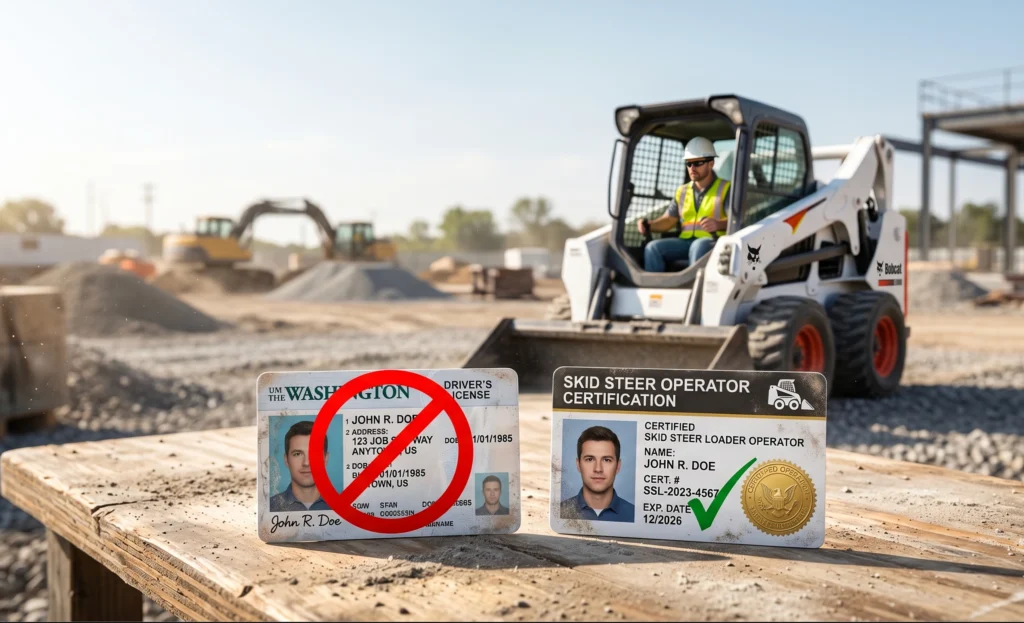
Understanding this distinction can prevent costly fines, serious injuries, and legal nightmares. What follows is a detailed breakdown of the rules, terminology, and steps required to become a legitimate, compliant skid steer operator.
Compliance: License vs. Certification vs. Training
Much of the confusion comes from how we use these words interchangeably when the law treats them very differently.
- License: A formal permit issued by a government agency like a driver’s license from the DMV. It is a legal document that grants you permission to perform an activity. A standard automobile license is generally not sufficient to operate a skid steer in a commercial setting, but the government also does not issue a separate “skid steer operating license.”
- Certification: A document, often called an operator card, wallet card, or certificate of competency, issued by an employer or an accredited third-party organization. It verifies that you have completed required training and passed both written and practical assessments.
- Training: The actual process of learning to operate the machine safely. Training is the foundation of everything else. Without it, any piece of paper is meaningless.
What the law demands, almost everywhere, is documented training and employer-issued certification. The terminology matters because asking “Do I need a license?” often leads to the wrong paperwork.
The Regulatory Framework in the United States
In the U.S., the requirements cascade from federal to state to local level, and the core obligation falls squarely on the employer.
- Federal Level (OSHA): There is no federal skid steer license. The Occupational Safety and Health Administration does not issue one, nor does it demand one. What OSHA does require, under the General Duty Clause and standards like 29 CFR 1926.21 (the construction safety training standard), is that every employer instruct each employee in the safe operation of any equipment they are required to use. For skid steers, this means the employer must provide and document training on controls, stability, load limits, hazard recognition and safe work practices specific to the machine. Employers must also evaluate the operator’s competence and keep records that include the operator’s name, trainer’s name, training date, and equipment covered.
- State and Local Variations: Some states, counties, or municipalities add extra layers. For instance, a skid steer operated on a public road often for snow removal or street sweeping may require a valid driver’s license and, in some places, a special municipal equipment operator permit. On transportation, if you need to move the skid steer on a trailer that puts the combined vehicle weight over 26,001 pounds, you will need a Commercial Driver’s License (CDL) for the truck and trailer, but that is a vehicle license for the tow rig, not the skid steer itself.
Always check with your local department of transportation and the permitting office for any public works project, as they can mandate their own operator qualifications.
Requirements in Other Countries
The answer stays largely the same globally “no, not a government license, but you must be certified” with a few important national twists.
- Canada: There is no single federal operator’s card. Each province sets its own rules, usually through occupational health and safety regulations. Ontario, for example, expects skid steer operators on construction sites to have completed accredited training and to be evaluated under a program aligned with the Provincial Equipment Operator (PEO) standard. Alberta requires a safety training course with an assessment of competence. In all provinces, the employer retains the duty to verify and document competence.
- United Kingdom: You do not need a government-issued “skid steer licence” from the DVLA. However, under the Provision and Use of Work Equipment Regulations 1998 (PUWER), all equipment must be operated by people who have received adequate training. In construction, the widely accepted proof of competence is a valid Construction Plant Competence Scheme (CPCS) card or the newer NPORS/CSCS equivalents—which serves as an industry-recognized certificate. Operating without it can shut down a site, even if no law specifically says it is a driver’s license.
- Australia: The Australian model is the closest to a true licensing system for certain uses. For most construction and earthmoving work, a nationally recognized unit of competency (often called a “ticket” or “yellow card”) is the standard requirement—this is certification, not a government licence. However, as of late 2025, if a skid steer is used as a mobile crane to suspend loads (for example, lifting a concrete pipe with a sling), a High-Risk Work Licence (HRWL) is explicitly required. Additionally, driving a skid steer on public roads typically requires a standard Class C car licence or a heavy-vehicle licence depending on its weight. So for the vast majority of operators just moving dirt, no HRWL is needed; the standard ticket suffices.
The Role of Employers
Regardless of geography, the employer bears the ultimate legal responsibility. You, as an operator, cannot simply claim you know how to run the machine; your employer must be able to prove it. This means:
- Ensuring every operator receives formal instruction and hands-on practical training on the exact make and model they will use.
- Maintaining a written record of that training, including dates, topics covered, and the name of the qualified evaluator.
- Conducting periodic re-evaluations at least every three years is a common benchmark, but also after any accident, near miss, or observation of unsafe behavior.
- Providing refresher training whenever a new attachment (like a grapple bucket or auger) is introduced, or when working conditions change significantly (e.g., moving from flat ground to steep slopes).
If an inspector from OSHA or a provincial Ministry of Labour visits your job site and asks to see the training records, “I’ve been doing this for twenty years” is not a legal defense. The paper trail is what keeps the company compliant and the operator protected.
Steps to Becoming a Qualified Skid Steer Operator
To bridge the gap between “I want to run a skid steer” and “I am legally allowed to run one under my employer’s authority,” take these steps:
- Formal Instruction: Enroll in a recognized training program. This can be offered by a trade school, a union apprenticeship program, an equipment dealership, or your employer’s own qualified trainer. The course should cover pre-start inspections, control functions, load charts, stability triangles, safe entry and exit, worksite hazard assessment, and emergency procedures.
- Hands-On Practical Training: This is the non-negotiable part. You must get seat time with an instructor in a controlled area, practicing everything from basic travel and bucket control to precise grading and operating on slopes. Online-only courses will not satisfy the practical evaluation requirement.
- Evaluation and Certification: After training, you will undergo a written exam and a practical skills test. Once you demonstrate competence, you receive a certificate or card from your employer or the training organization. That card is your evidence of qualification. Keep it on you while operating.
Consequences of Non-Compliance
Skipping the training and certification requirements is not a victimless shortcut, it carries severe consequences.
- Safety Risks: Skid steers are powerful, compact machines with a high center of gravity and significant blind spots. Untrained operators are far more likely to cause rollovers, run-overs, or caught-in-between injuries. The most common fatalities involve the operator being crushed by the bucket or lift arms, often after bypassing safety interlocks. Training directly prevents these tragedies.
- Financial Penalties: In the United States, OSHA fines for serious violations can exceed $15,000 per incident, while willful or repeated violations can easily surpass $1.5 million. In the United Kingdom, breaches of PUWER may result in unlimited fines for companies and, in the most severe cases, imprisonment for company directors. Similarly, workplace safety regulators in Australia can impose substantial six-figure penalties for non-compliance.
- Legal Liability: If an untrained operator causes an injury or property damage, the employer’s liability insurance may refuse to cover the claim. The employer can be sued directly, and supervisors may face personal criminal charges in some jurisdictions. The operator themselves may be found negligent and held personally liable.

Ahmed Ijaz runs this construction rental directory with over 5 years of experience in SEO, content, and web optimization. Every page is built using real research, hands-on expertise, and carefully reviewed information to meet strong EEAT standards.