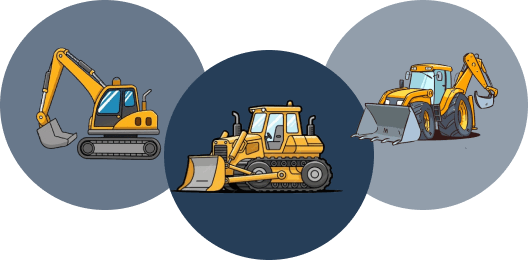
The primary differences differentiating these classifications revolve around physical dimensions, operating weight, engine horsepower, and the complexity of their hydraulic architectures. While a standard excavator is meticulously engineered for maximal volumetric material movement, deep trenching, and heavy-duty extraction across commercial and mining sites , the mini excavator prioritizes agility, minimal ground disturbance, and unparalleled accessibility in highly restricted topologies.
The distinction, however, extends far beyond mere physical scaling. The exponential scaling of these machines alters their thermodynamic efficiency profiles, dictates strict transportation legalities, necessitates varying operator certification requirements, and defines rigorous lifecycle maintenance algorithms. This report provides an exhaustive, multi-dimensional analysis of the parameters separating mini and standard excavators, integrating metallurgical, hydraulic, economic, regulatory, and logistical data to construct a definitive comparative framework.
Morphological and Structural Taxonomy
While the functional architecture remains largely homologous across size classifications relying on the principles of fluid power to articulate steel appendages, the structural engineering of specific components diverges drastically to accommodate varying stress loads and application requirements.
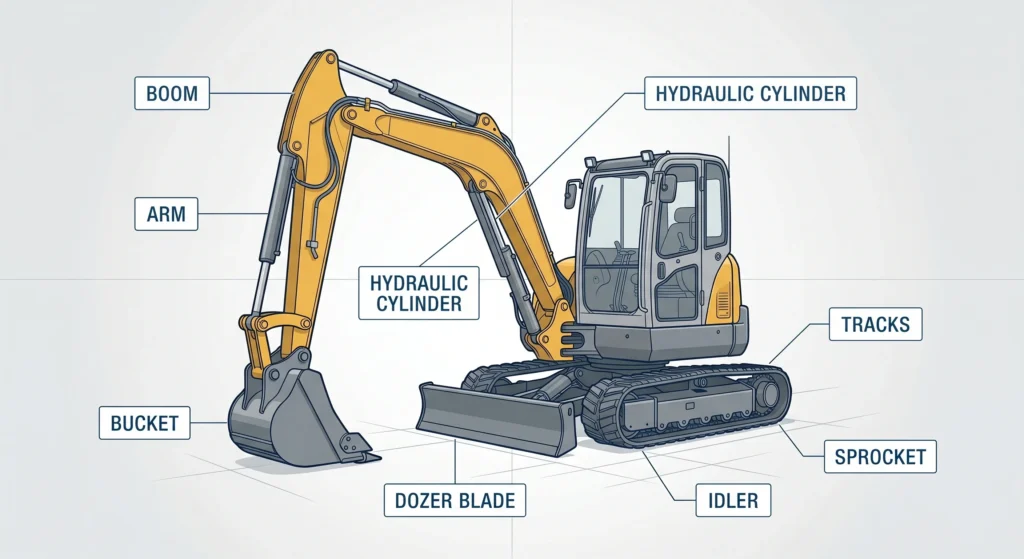
The Workgroup: Boom, Arm, and Terminal Attachments
The workgroup, colloquially referred to as the front-end attachment, is the primary operational apparatus of the excavator, responsible for the kinematic manipulation of earth and materials.
The boom is the foundational lifting structure attached directly to the upper carriage of the machine. Standard excavators typically feature fixed, high-tensile steel mono-booms designed to withstand immense downward force, torsional stress, and sheer load during heavy extraction and deep digging operations. Conversely, mini excavators frequently utilize a swing boom or an articulated boom configuration. This highly specialized pivot mechanism allows the operator to swing the boom laterally, entirely independent of the rotating house or cab, which facilitates perfectly parallel digging against foundations, fences, and structural walls.
The arm, alternately designated as the stick or dipper, acts as the secondary mechanical linkage connecting the distal end of the boom to the bucket. The length and geometry of the arm dictate the machine’s maximum digging reach and vertical depth capabilities. Standard excavators often employ variable-length sticks or specialized long-reach configurations purpose-built for deep foundations, civil marine dredging, or high-reach demolition. For instance, specialized long-reach models like the Caterpillar 340 Long Reach and 352 Long Reach can achieve staggering maximum dig depths of 42 feet and 8 inches.
At the terminus of the arm lies the bucket, the primary earthmoving apparatus, though the excavator’s role as a universal tool carrier means this is frequently swapped for other implements. The articulation of these components is driven by hydraulic cylinders—linear actuators categorized into the boom cylinder, arm cylinder, and bucket cylinder. Standard excavators demand hydraulic cylinders with massive bore diameters to generate breakout forces capable of fracturing bedrock, whereas mini excavator cylinders are optimized for speed and precise articulation in tight spaces.
The Upper Structure and Operator Environment
The upper structure, or house, rotates continuously on a heavy-duty slew ring (swing bearing) and contains the primary propulsion, hydraulic generation, and control systems.
The operator cab serves as the central nervous system of the machine, housing the main control valves, ergonomic joystick manipulators, and advanced diagnostic LCD monitors. Behind the cab sits the prime mover—typically a diesel engine, though increasingly an electric motor and battery pack—and the main hydraulic pumps that convert rotational mechanical energy into high-pressure fluid flow.
Affixed to the rear of the upper structure is the counterweight, a critical mass of cast iron designed to counterbalance the payload suspended at the end of the workgroup, thereby preventing longitudinal tipping. The precise geometry of the counterweight largely dictates the machine’s tail swing profile, an attribute that radically defines the machine’s suitability for specific job sites.
The Undercarriage and Locomotion Systems
The undercarriage is the heavy-duty lower chassis that provides platform stability, tractive effort, and optimal weight distribution. Because excavators operate continuously in highly abrasive and harsh environments, the undercarriage constitutes a highly significant portion of the machine’s capital cost and lifecycle maintenance expenditure.
The core structure is the track frame, which anchors the locomotive assemblies to the center carbody, functioning similarly to the axles of a traditional wheeled vehicle. The locomotive mechanisms themselves consist of tracks, sprockets, idlers, and rollers.
The tracks present a major point of divergence between the classes. Mini excavators predominantly utilize continuous, steel-reinforced rubber tracks. Rubber tracks are exceptionally versatile, minimizing ground disturbance on paved surfaces, finished turf, and sensitive residential terrains. Furthermore, they reduce operational decibel levels and dampen vibrations transferred to the operator cab. Standard and heavy excavators, in stark contrast, almost exclusively employ segmented steel tracks composed of forged track links, pins, bushings, and heavy-duty bolted track shoes. Steel track assemblies are mandatory for surviving the severe abrasive friction of demolition rubble, sharp quarry rock, and punishing forestry applications, environments that would shred rubber tracks in hours.
The tracks are propelled by hydraulic final drives and drive sprockets, while a network of bottom track rollers and front idlers maintains track tension, guides the chain, and supports the immense weight of the machine across the length of the undercarriage. Finally, the dozer blade is a defining morphological feature ubiquitously integrated into mini excavators to provide a secondary stabilization anchor during digging and to facilitate backfilling operations. Dozer blades are exceptionally rare on standard excavators, which rely purely on their massive static weight for stabilization.
Classification By Weight, Dimensions, and Mechanical Capabilities
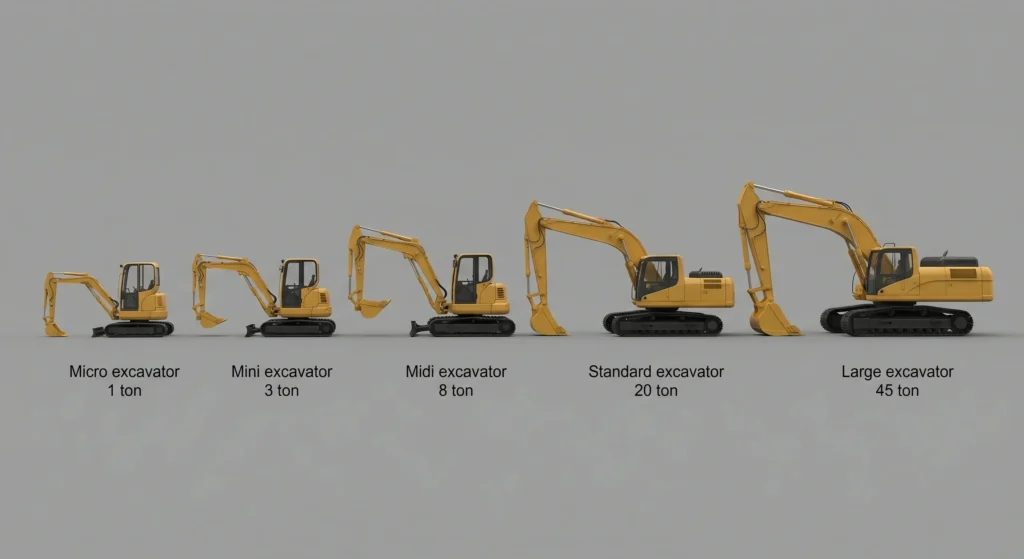
The Association of Equipment Manufacturers (AEM) and overarching global industry standards categorize crawler excavators into rigid weight classes. While exact boundary definitions can fluctuate marginally among manufacturers, the prevailing industry taxonomy relies on operating weight as the defining metric, as weight directly dictates ground pressure, transportation logistics, and the absolute limits of mechanical lifting capacity.
Micro, Mini, and Compact Excavators
The compact segment encompasses earthmoving equipment with operating weights up to approximately 6 to 7 metric tons (roughly 13,000 to 15,000 lbs). This broad category is frequently subdivided into lightweight and standard configurations.
Lightweight or micro mini excavators weigh under 2 metric tons (approximately 2,000 to 4,000 lbs) and are engineered for extreme spatial restriction. These highly specialized machines feature retracting undercarriages that allow them to navigate through standard 36-inch residential doorways, narrow fence gates, and highly congested interior demolition sites. They are characterized by nominal engine outputs ranging from 13 to 20 horsepower and maximum digging depths constrained to 6 to 8 feet. For example, the AHM AX-12B weighs 2,138 pounds, delivers 13.5 horsepower, and offers a 69-inch dig depth, making it entirely exempt from specialized transportation requirements.
Standard mini excavators command the core of the compact market, weighing between 2 and 6 metric tons (4,000 to 12,000 lbs). These machines strike an optimal equilibrium between urban maneuverability and meaningful breakout force, which can reach up to 12,000 lbs of tearing power. With engine power outputs ranging up to 55 horsepower and maximum digging depths expanding to between 9 and 14 feet, these models are the industry standard for urban utility trenching, residential foundation repairs, retaining wall construction, and intensive landscaping.
Midi and Small Excavators
Occupying the transitional space between compact agility and full-sized industrial power, midi (or small) excavators typically weigh between 7 and 10 metric tons (15,400 to 22,000 lbs). These units are strategically designed to retain the highly desirable low tail swing characteristics of mini excavators while offering significantly enhanced digging depth, reach, and hydraulic flow. They are universally deployed on municipal infrastructure projects and urban roadway expansions where a standard excavator would fatally disrupt adjacent active traffic lanes or collide with utility poles. Models in this class generally feature 55 to 100 horsepower engines and can achieve digging depths approaching 21 feet.
Standard (Medium) Excavators
Standard excavators form the irrefutable backbone of commercial construction, mass civil excavation, and heavy demolition. This classification encompasses machines ranging in operating weight from approximately 10 to 45 metric tons (22,000 to 99,200 lbs).
The mechanical specifications of standard excavators enable massive earthmoving campaigns. Engine power ratings scale from 100 horsepower up to 275 horsepower. These machines achieve standard maximum digging depths of 22 to nearly 25 feet. For instance, the Caterpillar 320, a paradigm of the mid-size segment, weighs 49,400 lbs, delivers 157 horsepower, and reaches a digging depth of 21 feet and 9 inches. Standard excavators are designed to command bucket capacities ranging from 0.5 to over 2.0 cubic yards and utilize high hydraulic flow rates capable of supporting aggressive heavy-duty attachments.
Large and Heavy-Duty Excavators
Equipment exceeding 45 metric tons (99,200 lbs) is classified into the large or heavy-duty category. These massive mechanisms are purpose-built for continuous, unrelenting production in deep mining operations, large-scale aggregate quarrying, and massive civil infrastructure developments.
These machines require immense power plants, with engine ratings stretching from 275 to an astonishing 542 horsepower. Digging depths routinely exceed 26 to 31 feet in standard configurations. Models such as the Caterpillar 349 feature an operating weight of 52.6 tons and a dig depth of over 25 feet, while the even larger Caterpillar 352 weighs 55.3 tons.
| Excavator Classification | Operating Weight Range | Typical Engine Power | Maximum Digging Depth Range | Primary Application Environments |
| Micro/Mini | 1 to 6 tons (2,000–12,000 lbs) | 13 – 55 HP | 6 – 14 feet | Residential landscaping, interior demolition, tight urban utilities, shallow trenching |
| Midi/Small | 6 to 12 tons (12,000–24,000 lbs) | 55 – 100 HP | 19.8 – 21.0 feet | Municipal infrastructure, road shoulders, commercial utility installations |
| Standard/Medium | 12 to 35 tons (24,000–70,000 lbs) | 100 – 275 HP | 22.0 – 23.8 feet | Commercial construction site prep, mass earthmoving, structural demolition |
| Large/Heavy-Duty | 35+ tons (70,000+ lbs) | 275 – 542 HP | 26.0 – 42.0+ feet | Deep aggregate mining, large-scale civil infrastructure, mass quarry extraction |
Hydraulic Architecture: Flow Dynamics and Fluid Power Delivery
The true differentiator between excavator classes lies not merely in their static dimensional bulk, but in their complex fluid dynamics. An excavator’s mechanical efficiency, control responsiveness, and capacity for executing multi-function compound movements are entirely dictated by the engineering of its internal hydraulic circuit.
Open-Center Systems and Fixed Displacement Dynamics
Hydraulic systems are fundamentally categorized into open-center and closed-center architectures. In an open-center system, hydraulic fluid continuously circulates from the main pump, flows straight through the directional control valves, and returns to the hydraulic fluid reservoir, even when the operator’s joysticks remain in the neutral, untouched position.
These systems typically utilize simpler, fixed-displacement gear pumps. Because the volumetric flow of fluid is constant regardless of demand, maintaining high pressure generates significant parasitic heat and requires continuous, uninterrupted engine horsepower. The hydraulic pressure in neutral returns to near zero, but when a valve switches, the response speed is virtually instantaneous as the fluid path is abruptly redirected into the cylinder. Open-center systems are noticeably cheaper to manufacture, structurally smaller, and easier to debug, making them the prevalent choice for budget-tier and lightweight mini excavators.
However, open-center systems suffer severe performance degradation during complex compound operations—such as simultaneously booming up, swinging the house, and curling the bucket. Because hydraulic fluid obeys the laws of physics and follows the path of least resistance, varying load pressures across different cylinders make it extraordinarily difficult to coordinate multi-axis movements seamlessly without installing independent, dedicated pumps for each individual actuator.
Closed-Center Load-Sensing (CCLS) Systems
Conversely, standard excavators and premium modern mini excavators rely on highly sophisticated Closed-Center Load-Sensing (CCLS) systems. In a closed-center configuration, the control valves block the flow of oil when in the neutral position. This system utilizes an advanced, pressure-compensated variable displacement piston pump.
When the operator’s controls are neutral, the pump mechanically destrokes, reducing fluid flow output to near zero and effectively halting the parasitic horsepower drain on the diesel engine, preventing massive heat generation. When the operator commands an action, a load-sense line transmits a hydraulic pressure signal backward to the variable pump, instantaneously instructing it to stroke up and provide the exact required flow and pressure to overcome the current mechanical load. This maintains a perfectly constant pressure drop across the control valve orifice, regardless of the fluctuating weight of the earth being moved.
The scale and implications of CCLS are profound. The high volumetric displacement required to lift a 30-ton machine’s boom while simultaneously rotating the upper structure demands flawless fluid management. CCLS ensures that an operator can perform precision grading by combining boom, stick, and bucket movements smoothly and predictably. Furthermore, the mechanical power saved by not continuously pumping fluid across high-pressure relief valves translates to drastic fuel efficiency improvements over the machine’s extended lifecycle. While standard excavators universally deploy CCLS, the market is witnessing the miniaturization of these systems into premium 3-to-6-ton mini excavators to mimic the precision and fuel economy of their larger counterparts, despite the higher initial capital cost.
Operational Productivity and Efficiency Paradigms
Productivity in earthmoving operations is quantified strictly by the volume of material successfully excavated and moved per unit of time, typically expressed in bank cubic yards (BCY) or loose cubic yards per hour. This production rate is a complex mathematical function of bucket capacity, hydraulic cycle time, hydraulic breakout force, material density, and operator proficiency.
Volumetric Production Rates and Breakout Constraints
Mini excavators present a modest but highly targeted production profile. A standard 1 to 5-ton mini excavator typically moves between 15 and 30 cubic yards of material per hour under standard conditions. Operating steadily over an optimal workday, this equates to roughly 153 to 229 cubic meters (200 to 300 cubic yards) of daily material movement. The physical limiting factors are their diminutive bucket capacities, which range from a mere 0.02 to 0.10 cubic yards, and their lower hydraulic breakout forces, generating between 3,000 and 12,000 lbs of tearing power. While a 5-ton machine can dig an impressive 15 feet down in soft soil, hard clay or rocky ground significantly degrades its theoretical digging capacity, often necessitating secondary loosening tools.
As machine operating weight increases, production scales logarithmically. A small-to-medium standard excavator (11 to 25 tons) accelerates production to between 60 and 120 cubic yards per hour. Moving into the heavy-duty tier, large excavators (26 to 50+ tons) are equipped with massive high-capacity buckets ranging from 0.5 to over 4.0 cubic yards. Utilizing immense breakout forces that easily exceed 20,000 to 100,000+ lbs, these behemoths achieve staggering production rates of 120 to over 200 cubic yards per hour, seamlessly tearing through deep frost, hard-packed clay, and sedimentary rock.
Fuel Efficiency Thermodynamics and Cost Per Cubic Yard
A superficial analysis of fuel consumption might erroneously conclude that mini excavators are the most efficient machines on site, as their absolute fuel consumption is remarkably low—typically burning only 1 to 3 gallons of diesel per hour. In contrast, standard and large excavators feature voracious appetites, burning between 8 and 25+ gallons per hour depending on engine load.
However, pure economic and thermodynamic efficiency in heavy earthmoving is measured by the fundamental metric of cost per cubic yard moved. While a lightweight 3.5-ton mini excavator burns far less fuel per hour than a heavy 25-ton standard excavator, the standard machine moves material up to ten times faster. Therefore, for large-scale, heavy-duty applications—such as digging deep commercial foundations, mass grading a subdivision, or surface mining—the standard excavator requires significantly less aggregate time and operator labor to complete the contract. This results in a vastly superior fuel-to-volume ratio and a substantially lower overall cost per cubic yard.
Conversely, deploying a 30-ton standard excavator to perform shallow, surface-level trenching for residential water lines results in catastrophic economic inefficiency. The machine’s massive hydraulic potential is wasted on light soil, and its high fixed operating costs rapidly outpace the low production requirements of the task. Operator technique further influences these metrics; studies indicate that proper training and technique optimization can reduce fuel consumption by an additional 8% to 12% across both size classes.
Site Suitability, Spatial Topologies, and Application Specialization
The selection between a mini and standard excavator is ultimately dictated not by raw power, but by the spatial geometry, geotechnical constraints, and the environmental sensitivity of the project topology.
Spatial Restrictions and Tail Swing Dynamics
In densely populated urban environments, residential zones, or enclosed industrial facilities, physical operating space is the primary constraining variable. Mini excavators are uniquely architected to thrive within these restrictions. A critical engineering specification in compact equipment design is the tail swing radius—the maximum lateral distance the rear counterweight extends beyond the edge of the undercarriage tracks when the upper house rotates.
Many modern mini excavators feature a Zero Tail Swing (ZTS) or minimal tail swing configuration. Through clever packaging of the engine and hydraulics, the rear of the machine never rotates beyond the outer boundary of the tracks. This geometric advantage allows operators to dig immediately adjacent to structural walls, residential fences, or active pedestrian walkways without the omnipresent risk of the rear counterweight colliding with obstacles and causing severe property damage.
Standard excavators, conversely, almost universally utilize a conventional tail swing design. Their massive rear counterweights protrude significantly beyond the tracks. While this conventional design maximizes lifting leverage, enhances stability, and simplifies engine maintenance access, it demands a wide, completely unobstructed operational radius, rendering them highly hazardous and entirely unsuitable for congested urban tasks or tight residential property lines.
Ground Pressure and Attachment Versatility
The distribution of the machine’s gross weight across the surface area of its tracks determines its ground pressure. Mini excavators, leveraging their low mass and flexible rubber tracks, exert remarkably low ground pressure. This characteristic prevents the fracturing of decorative concrete driveways, the destruction of established turf, and the catastrophic severing of shallow subterranean utilities. Consequently, they are the superior choice for high-end landscaping, post-construction retrofitting, and environmentally sensitive projects. Their attachment utilization mirrors this light-duty focus, commonly running tools such as hydraulic auger drives for fencing, brush cutters for clearing overgrowth, and delicate stump grinders.
Standard excavators are designed for undisturbed, raw, or heavily industrialized terrain. Their extreme operating weights and aggressive steel grousers (track cleats) will instantly pulverize asphalt infrastructure and deeply rut soft earth. However, this high ground pressure and aggressive traction are precisely the mechanical anchors required to maintain absolute stability while ripping through severe frost layers, heavy wet clay, or solid rock. Standard excavators power heavy industrial tools, including massive hydraulic impact hammers, concrete crushers, steel tree shears, and high-capacity production buckets.
Operator Cab Safety and Structural Certification Regimens
Excavators are machines inherently designed to manipulate massive, unbalanced weights across highly unstable, uneven, and unpredictable environments. They present severe occupational hazards, most notably the risk of catastrophic machine tip-overs and operator exposure to massive falling debris. To mitigate fatalities, international regulatory bodies, including ISO and OSHA, enforce draconian structural testing protocols for the operator cabin structure across all weight classes.
The certification framework relies on specific structural protections:
- ROPS (Roll-Over Protective Structure): ROPS is designed to absorb massive impact energy and maintain a rigidly defined, crush-resistant survival volume for the operator in the event the machine rolls over due to steep gradients, collapsed trench walls, or center-of-gravity shifts. Testing involves immense, controlled horizontal and vertical loads applied hydraulically to the cab structure to verify it crushes in a strictly controlled manner.
- FOPS (Falling Object Protective Structure): Exceedingly crucial in demolition, forestry, and deep mining applications, FOPS heavily reinforces the canopy roof against devastating impacts from falling quarry rocks, massive tree limbs, or collapsing concrete debris.
- TOPS (Tip-Over Protective Structure): This certification is specifically engineered for and mandated on mini excavators. Due to their narrow track bases and lightweight frames, mini excavators are uniquely susceptible to rapid, lateral tip-overs, particularly when lifting dense loads over the side of their tracks.
- OPS (Operator Protective Structure): Guards the frontal and lateral aspects of the cabin against the rapid intrusion of objects, such as whipping forestry branches or snapping steel rebar, from penetrating the cabin glass and striking the operator.
These cab certifications are not theoretical; they require destructive, physical testing by specialized heavy machinery engineering firms, which apply extreme loads—sometimes reaching up to 1 million pounds of force—to ensure the metallurgical integrity of the cab frame meets stringent standards. Adherence to standard directives, such as ISO 3471 for general ROPS and ISO 12117-2 specifically for construction excavators over 6 tonnes, is an absolute legal mandate in modern jurisdictions.
Technological Integration and Advanced Avionics
The modern standard excavator has transcended its origins as a purely mechanical apparatus to become a highly digitized, semi-autonomous node within the broader construction site ecosystem. Technological integration currently represents a major point of divergence between the classes, as standard excavators heavily leverage advanced avionics and intelligent grade control to maximize their massive production rates and minimize material waste.
Machine Control, 3D Grading, and Automation
Factory-integrated 2D and 3D machine control systems are fundamentally transforming the economics of standard excavation. Premium OEM systems—such as Komatsu’s intelligent Machine Control (iMC), Caterpillar’s Cat Grade, and John Deere’s SmartGrade—utilize advanced GNSS (Global Navigation Satellite System) receivers, highly sensitive IMU (Inertial Measurement Unit) sensors on the boom and stick, and localized RTK base stations to track the exact geospatial position of the bucket teeth in three-dimensional space.
In a 3D-equipped standard excavator, the operator uploads a digital CAD topographical model directly into the cabin monitor. The machine’s onboard computer then semi-automates the hydraulic boom and bucket movements. If the operator attempts to dig below the digitally programmed target grade, the machine’s hydraulic valves automatically intervene, restricting fluid flow to prevent over-excavation. This technological intervention eliminates the costly need for manual grade checking, drastically reduces ground surveying labor, prevents expensive over-digging that would require backfilling with expensive aggregate, and ensures sub-centimeter accuracy.
While major brands like Volvo, Hitachi, and Case rely heavily on aftermarket bolt-on machine control solutions, Komatsu and John Deere offer these tightly integrated systems straight from the factory floor, potentially saving contractors $25,000 to $45,000 in aftermarket installation costs while delivering superior, lag-free hydraulic integration. While these ultra-expensive systems are primarily deployed on standard excavators due to the high return on investment in mass grading , manufacturers are gradually beginning to scale aftermarket and basic 2D systems down to the premium mini excavator tier to aid in precise utility trenching.
Telemetry and Real-Time Payload Management
Beyond grade control, telematics solutions, such as Cat Product Link and John Deere’s JDLink, transmit real-time data streams regarding machine GPS location, precise fuel consumption rates, operational hours, idle time percentages, and predictive diagnostic fault codes directly to off-site fleet managers. Furthermore, integrated payload weighing systems utilize highly sensitive hydraulic pressure transducers mounted in the boom cylinders to dynamically calculate the exact weight of the material scooped into the bucket. This instantly prevents the dangerous and illegal overloading of articulated dump trucks, while also eliminating the highly inefficient practice of under-loading, ensuring perfectly optimized logistics cycles on large-scale sites.
Total Cost of Ownership (TCO) and Economic Modeling
Procuring and operating earthmoving equipment requires highly sophisticated capital allocation strategies. For fleet managers, the initial sticker price is merely the deceptive apex of the total cost of ownership (TCO) calculation, representing only 40% to 60% of the true lifetime financial expenditure. Hidden operational costs, brutal depreciation curves, and fuel burdens fundamentally dictate the economic viability of the asset.
Capital Acquisition Costs and Depreciation
In the 2025–2026 heavy equipment market, pricing scales steeply and non-linearly with machine tonnage, premium brand reputation (e.g., Caterpillar, Komatsu vs. budget brands), and technological optionality.
For mini excavators, new models ranging from 1 to 5 tons carry initial purchase prices between $20,000 and $90,000, with highly spec’d premium 5-to-6-ton models reaching $85,000 to $110,000. The used secondary market provides highly robust alternatives; 1-to-3-year-old mini excavators typically sell for $20,000 to $75,000, while 8-plus-year-old models depreciate to the $10,000 to $30,000 bracket. Mini excavators maintain exceptional residual value and flatter depreciation curves due to their extraordinarily broad appeal across professional landscaping, residential construction, and intense demand within the DIY homeowner rental markets.
Moving up to standard and large excavators necessitates massive capital outlays. New mid-sized models (6 to 20 tons) cost between $90,000 and $200,000. Large models (21 to 45 tons) command prices ranging from $200,000 to $600,000, while specialized extra-large or ultra-heavy mining machines easily exceed $750,000 to well over $1.5 million. Doubling the operating weight of a machine typically increases its purchase price by a factor of 60% to 80%.
Hourly Operational Expenditure Modeling
Beyond the initial acquisition, fleet managers must calculate the hourly operational burden. This complex metric encompasses fuel burn, routine maintenance, heavy repair allocations, machine insurance, annualized depreciation, and certified operator wages.
Operating a mini excavator incurs a relatively low total hourly operational cost ranging from $45 to $65 per hour (including the operator). Their highly efficient fuel consumption (1-3 gal/hr at $6-$75/hr depending on market prices), simpler engineering, and minimal insurance burdens keep fixed costs exceptionally low.
Conversely, operating a 20-ton mid-size standard excavator incurs total costs of $85 to $125 per hour. This expanded rate accounts for heavier fuel consumption ($18-$28/hr), higher maintenance allocations ($12-$18/hr), complex repair funds ($8-$15/hr), and accelerated, high-dollar depreciation ($22-$35/hr). When scaling to large excavators, the hourly rate swells to $150 to $250+ per hour, reflecting massive 12-gallon-per-hour fuel burn rates and the strict necessity of paying premium wages to highly specialized operators.
The Rent Versus Buy Arbitrage
The financial decision to rent versus purchase an excavator hinges entirely on precise, annualized utilization rates. For rental businesses, mini excavators are lucrative assets, generating rental returns of 1% to 2% of their purchase price per week, buoyed by utilization rates that sit 10% to 15% higher than their massive standard counterparts.
For the end-user in 2025, typical rental rates for a mini excavator sit between $200 and $450 daily, $700 and $1,500 weekly, and $2,500 and $4,000 monthly. Standard excavators demand far steeper rates; a 25,000-lb to 35,000-lb medium machine rents for $632 to $886 daily, and $1,522 to $2,295 weekly. Massive large excavators run nearly $1,000 daily and up to $3,675 weekly.
A critical break-even analysis demonstrates the peril of over-renting. If a firm utilizes a mini excavator for merely three projects per year, with each lasting two weeks (totaling three weeks of active machine time), the annualized rental fees and associated transportation costs will exceed $5,100. Over a short two-year horizon, these accumulated rental fees result in a pure, unrecoverable profit loss equivalent to a substantial cash down payment, or the outright purchase of an older used machine. Therefore, long-term rental is economically viable only for highly specialized, short-duration tasks, or to temporarily augment fleet capacity during peak seasonal demand spikes, avoiding long-term depreciation, financing interest, and off-season storage liabilities.
| Economic Category | Mini Excavator (1-6 tons) | Mid-Size Standard Excavator (11-25 tons) | Large Excavator (26-50+ tons) |
| New Purchase Price Range | $20,000 – $110,000 | $90,000 – $350,000 | $300,000 – $750,000+ |
| Used Purchase Price (1-7 yrs) | $15,000 – $75,000 | $50,000 – $150,000 | $150,000 – $400,000 |
| Total Hourly Operating Cost | $45 – $65/hr | $85 – $125/hr | $150 – $250+/hr |
| Average Daily Rental Rate | $200 – $450 | $632 – $886 | $969 – $1,200+ |
| Average Weekly Rental Rate | $700 – $1,500 | $1,522 – $2,295 | Up to $3,675 |
Preventative Maintenance and Lifecycle Management
The lifecycle optimization of an excavator—the strict operational discipline required to transform a failing 5,000-hour machine into a resilient 10,000-hour asset—depends rigidly on uncompromising adherence to OEM preventative maintenance protocols. A single day of unexpected downtime caused by deferred maintenance can cost a contractor $5,000 to $15,000 in lost project productivity, dwarfing the cost of routine service. Deferred maintenance on complex hydraulic systems virtually guarantees catastrophic, budget-crippling failures. Maintenance intensity and capital requirements scale proportionally with machine size and operational severity.
Prescriptive Service Intervals and Scope
Maintenance schedules are universally governed by the machine’s electronic hour meter, providing a strict chronology for fluid and component replacement.
The absolute foundation of heavy equipment fleet management is the daily visual inspection (every 8 to 10 hours). Taking 15 to 20 minutes, operators must rigorously check engine oil, hydraulic fluid, and coolant levels, while inspecting the tracks for excessive wear, missing shoes, or improper track sag tension. Crucially, operators must lubricate high-friction grease points—specifically the swing bearing, boom, arm, and bucket pivot pins—to prevent catastrophic metallic galling and joint failure. Industry data proves this daily 15-minute habit prevents 80% of major mechanical failures.
The 250 to 500-hour interval represents the standard routine or seasonal service. This involves the critical replacement of engine oil, primary and secondary fuel filters, and hydraulic bypass filters. For a standard mini excavator, this routine service incurs annualized costs between $3,000 and $8,000, depending heavily on total utilization hours.
The 1,000 to 2,000-hour interval dictates intensive hydraulic system maintenance. This requires the complete draining and replacement of massive volumes of highly specialized hydraulic fluid and final drive gear oils. Fleet managers increasingly utilize fluid analysis and condition monitoring at this stage to detect microscopic metallic particulates, successfully predicting catastrophic variable pump failures before they manifest. Annual hydraulic maintenance costs range strictly from $2,000 to $6,000.
As machines cross the 2,000 to 4,000-hour threshold, major structural undercarriage components (sprockets, track chains, rollers, idlers) begin to reach the end of their consumable lifespan. Replacing the massive steel undercarriage on a standard excavator is a major capitalization event, costing between $4,000 and $12,000. Finally, reaching 8,000 to 12,000 hours necessitates complete engine and powertrain overhauls, commanding vast capital investments ranging from $15,000 to $45,000.
| Maintenance Category | Frequency Interval | Average Annual Cost Range | Core Impact on Machine Health |
| Routine Service / Oil & Filters | Every 250 – 500 hours | $3,000 – $8,000 | Maintains basic engine performance; extends component life |
| Hydraulic System Flushing | Every 1,000 – 2,000 hours | $2,000 – $6,000 | Protects sensitive variable pumps; prevents valve seizing |
| Track / Undercarriage Rebuild | Every 2,000 – 4,000 hours | $4,000 – $12,000 | Restores critical locomotion; prevents thrown tracks |
| Total Engine Overhaul | Every 8,000 – 12,000 hours | $15,000 – $45,000 | Resets machine lifecycle; critical for 10,000+ hour longevity |
Maintenance Disparities Between Classes
Mini excavators present unique maintenance profiles. Often powered by highly reliable compact power plants, such as the ubiquitous Kubota D722 diesel engine, these mechanisms are tightly packaged into highly constricted, high-heat rear compartments. Consequently, they require meticulous and frequent attention to radiator cleaning and cooling system integrity, as air flow restriction rapidly leads to fatal engine overheating. However, owing to their smaller fluid capacities and mechanically simpler open-center hydraulic architectures, mini excavators generate overall lifecycle maintenance costs that run 20% to 30% lower than their standard counterparts.
Standard excavators, conversely, demand highly complex fluid analysis programs, massive-volume synthetic oil replacements, and costly heavy-duty multi-stage filtration systems to protect their ultra-sensitive, high-pressure closed-center variable displacement pumps. Blown hydraulic pumps from clogged filters on a 30-ton machine represent devastating financial losses.
Logistics, Transportation, and Regulatory Compliance
The logistical friction associated with legally and safely mobilizing heavy equipment to and from the job site heavily influences initial equipment selection and ongoing project bidding. The Federal Motor Carrier Safety Administration (FMCSA) and the Department of Transportation (DOT) enforce strict weight limits and licensing parameters across the United States that create profound operational hurdles for equipment fleet managers.
Commercial Driver’s License (CDL) Thresholds
The legal line between standard transport and heavily regulated commercial haulage is rigidly defined by weight. Federal regulations mandate that a driver hold a Class A Commercial Driver’s License (CDL) if the Gross Combination Weight Rating (GCWR) of the towing truck and the attached trailer exceeds 26,001 pounds, and the Gross Vehicle Weight Rating (GVWR) of the trailer strictly exceeds 10,000 pounds.
This specific regulatory threshold acts as a massive strategic and economic advantage for mini excavators. A lightweight mini excavator (weighing roughly 2,000 to 4,000 lbs, such as the AHM AX-17 or AX-12B) paired with a standard heavy-duty pickup truck (e.g., an F-250 or F-350) and a standard dual-axle equipment trailer routinely falls safely below the 26,001 lbs GCWR and 10,000 lbs trailer limit. This critical exemption allows independent landscaping firms, local plumbers, and residential general contractors to legally transport their mini excavators using standard-licensed drivers. This avoids the severe labor scarcity, steep regulatory compliance, and premium hourly wages commanded by CDL-certified drivers.
However, as a contractor scales up to larger mini excavators (approaching the 5 to 6-ton mark, or roughly 11,000 to 13,000 lbs), the sheer weight of the machine necessitates a trailer with a capacity well over 10,000 lbs. Paired with a heavy-duty truck, this instantly pushes the transportation rig over the 26,001 lbs GCWR threshold, thrusting the operation directly into mandatory Class A CDL territory and radically altering the firm’s logistical operating costs. While certain explicit exemptions exist—such as farmers transporting agricultural machinery within a 150-mile radius in farm-plated vehicles, or firefighters operating emergency equipment—commercial contractors enjoy no such leniency.
Heavy Haulage, Superheavy Loads, and Oversized Permitting
Transporting standard and large excavators forces a firm to operate in an entirely different, highly complex logistical paradigm. A 20-ton standard excavator requires a dedicated Class 8 semi-truck paired with a specialized heavy-duty lowboy or gooseneck trailer. This specialized transportation incurs massive variable costs, often requiring contractors to hire dedicated commercial haulers charging hundreds of dollars per hour merely for mobilization and demobilization.
When scaling up to large excavators (exceeding 45 tons), the equipment routinely surpasses legal dimension and weight limits for standard public highways. Moving these behemoths requires navigating a dense labyrinth of state-specific Oversize/Overweight (OS/OW) load permits. For example, the Texas Department of Motor Vehicles requires highly specific permits for non-divisible loads, ranging from General Single-Trip permits to “Superheavy” permits for gross weights exceeding 254,300 lbs or 200,000 lbs with less than 95 feet of axle spacing.
Furthermore, these regulations frequently mandate the use of massive “OVERSIZE LOAD” signage—specifically dictated in states like Washington to be exactly 7 feet long and 18 inches high, with black lettering at least 10 inches high on a yellow background. Haulers must frequently utilize specialized pilot or escort vehicles, adhere strictly to designated non-interstate routing to protect load-restricted or aging bridges, and obey rigid curfew hours that legally prevent travel during commuter peaks, weekends, holidays, or nighttime.
Consequently, the mobilization costs for a standard or large excavator can be prohibitively expensive and logistically exhausting. This effectively rules them out for short-duration projects where the transportation fees and permit delays would vastly overshadow the actual excavation billing, further reinforcing the mini excavator’s dominance in rapid-deployment, short-duration urban tasks.
Verdict
Conversely, standard and large excavators remain the undisputed, irreplaceable titans of massive volumetric earthmoving. Their immense structural integrity, highly complex closed-center load-sensing hydraulic supremacy, and seamless factory integration with sub-centimeter 3D GNSS machine control systems yield staggering economies of scale that simply cannot be replicated by smaller, lighter machines. While their massive capital acquisition costs, severe CDL-dependent logistical friction, and high hourly operational burns represent significant financial barriers to entry, their unrivaled, highly efficient cost-per-cubic-yard metrics make them indispensable and highly profitable for mass excavation, deep foundational engineering, and heavy surface mining.

Ahmed Ijaz runs this construction rental directory with over 5 years of experience in SEO, content, and web optimization. Every page is built using real research, hands-on expertise, and carefully reviewed information to meet strong EEAT standards.