Choosing the right skid steer isn’t just about buying the biggest machine your budget allows. A skid steer that’s too small can struggle with lifting capacity, productivity, and attachment performance. On the other hand, a machine that’s too large may damage finished surfaces, fail to fit through gates, exceed trailer limits, and increase operating costs.
The wrong size can lead to unsafe operation, increased risk of machine tip-over, higher maintenance expenses, and reduced job site efficiency.
The good news? Selecting the right skid steer becomes simple once you understand three key factors: Rated Operating Capacity (ROC), horsepower, and frame size.
By the end of this guide, you’ll know exactly how to match ROC, hydraulic flow, and machine dimensions to your specific jobs, attachments, and site conditions.
Core Attributes That Define Skid Steer Size
Many buyers focus on machine weight or engine horsepower alone. However, skid steer sizing is determined by a combination of three critical factors.
Frame Size Class
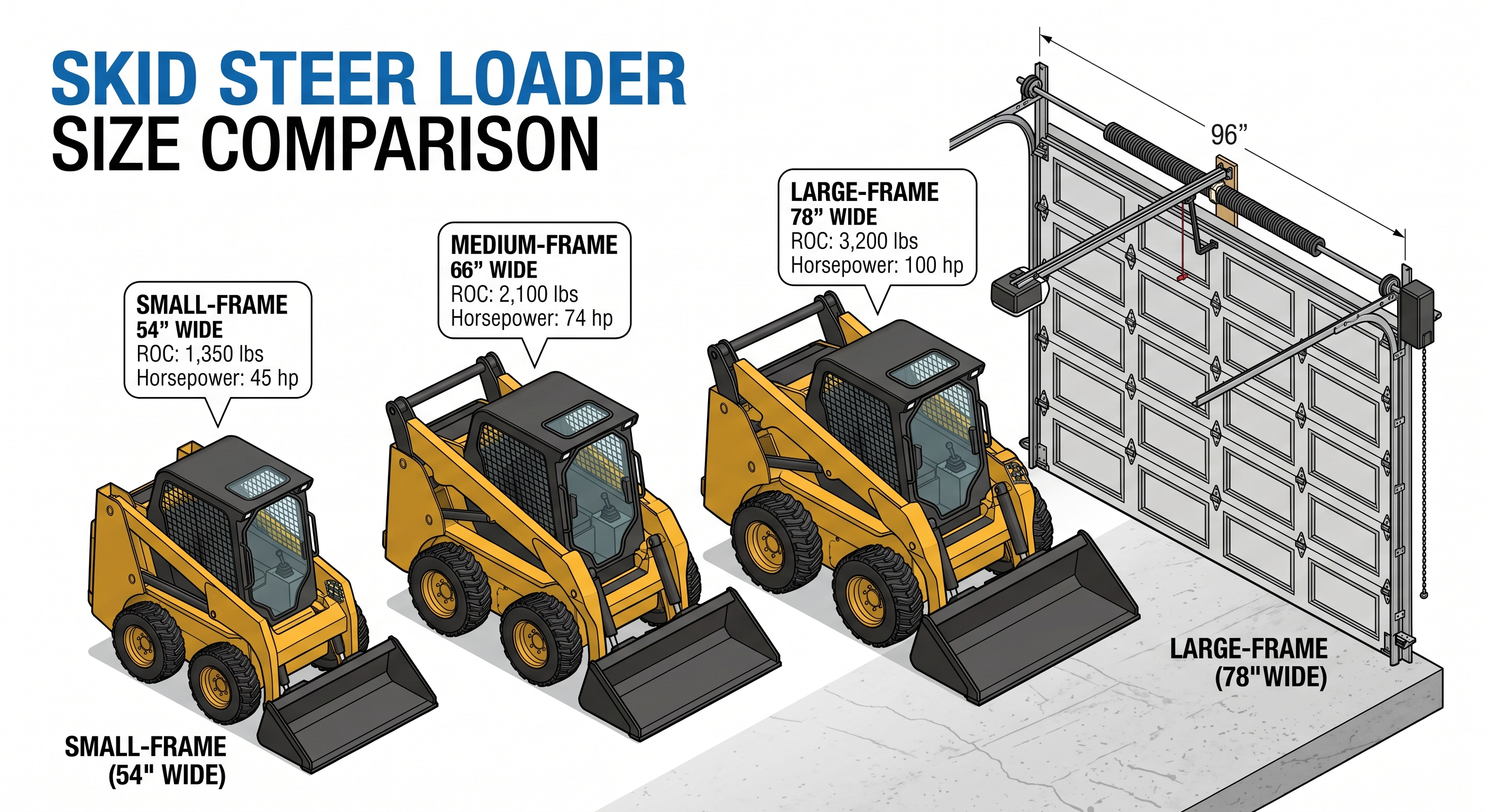
Frame size is the foundation of skid steer classification and directly affects lifting capacity, machine dimensions, and stability.
| Frame Size | Typical ROC | Best For |
|---|---|---|
| Small Frame | 450–700 lbs | Landscaping, residential work, narrow access |
| Medium Frame | 700–1,200 lbs | Construction, material handling, contractors |
| Large Frame | 1,200–2,000+ lbs | Excavation, demolition, agriculture |
Small-frame machines excel in tight spaces and minimize turf damage. Medium-frame models represent the most popular category because they balance power, versatility, and resale value. Large-frame machines deliver maximum lifting capability and attachment performance.
Operating weight also increases with frame size and directly contributes to machine stability.
Rated Operating Capacity (ROC) – The Most Important Sizing Factor
If you’re asking, “What size skid steer do I need?” the answer usually starts with ROC.
Rated Operating Capacity measures the maximum safe load a skid steer can handle during normal operation.
For most machines:
- Radial-lift skid steers: ROC = Tipping Load ÷ 2
- Vertical-lift skid steers: ROC = Tipping Load ÷ 1.5
Important Safety Rule
Never exceed 50% of a machine’s tipping load during routine operation.
Many first-time buyers mistakenly compare machine weight instead of ROC. In reality, ROC is the best indicator of real-world lifting performance and safety.
Horsepower (HP) and Hydraulic Flow
Horsepower affects digging force, travel speed, and attachment performance.
Hydraulic flow determines which attachments a skid steer can operate.
Standard Flow
- 15–20 GPM
- Buckets
- Pallet forks
- Augers
- Basic brush cutters
High Flow
- 25–40+ GPM
- Forestry mulchers
- Cold planers
- Snow blowers
- Heavy-duty brush cutters
- Stump grinders
If you plan to use demanding hydraulic attachments, hydraulic flow may become more important than horsepower alone.
Match Your Job to the Correct Skid Steer Size
The easiest way to choose a skid steer is to start with the primary work you’ll perform.
| Job Type | Recommended Frame Size | ROC Needed | HP / Flow | Why It Works |
|---|---|---|---|---|
| Landscaping & Light Grading | Small Frame | Under 700 lbs | 40–50 HP / Standard Flow | Compact, turf-friendly, excellent maneuverability |
| General Construction & Pallet Moving | Medium Frame | 800–1,200 lbs | 60–70 HP / Standard Flow | Versatile and cost-effective |
| Heavy Excavation & Stump Removal | Large Frame | 1,500+ lbs | 70+ HP / High Flow | Greater breakout force and stability |
| Agriculture & Hay Handling | Large Vertical Lift | 1,800+ lbs | 80+ HP / High Flow | Improved reach for trucks and bale stacking |
For most contractors, a medium-frame skid steer offers the best combination of lifting capacity, attachment compatibility, and transport convenience.
Site Constraints That Override the Rule of Thumb
Even if a skid steer has sufficient ROC, physical site limitations can instantly eliminate certain models.
Doorway and Gate Width
Always measure your narrowest access point before purchasing.
| Machine Size | Typical Width |
|---|---|
| Small Frame | 54–60 inches |
| Medium Frame | 60–70 inches |
| Large Frame | 70–78 inches |
A machine that can’t fit through your gate or doorway won’t help productivity.
Trailer and Towing Capacity
Transportation is one of the most overlooked sizing factors.
| Equipment Combination | Approximate Gross Weight |
|---|---|
| Small Skid Steer + Trailer | Around 7,000 lbs |
| Large Skid Steer + Trailer | 14,000+ lbs |
Depending on local regulations, heavier combinations may trigger additional licensing or commercial transportation requirements.
Ground Pressure
Ground pressure affects turf damage, flotation, and traction.
Wheeled Skid Steers
Best for:
- Concrete
- Asphalt
- Hard-packed surfaces
Advantages:
- Lower operating costs
- Faster travel speeds
Tracked Skid Steers
Best for:
- Soft soil
- Mud
- Finished lawns
- Wet conditions
Advantages:
- Lower PSI
- Better flotation
- Reduced turf disturbance
Attachment Mapping: Your Implements Dictate Machine Size
Many buyers choose a machine first and attachments second. The smarter approach is often the reverse.
Buckets
Large buckets require additional machine stability.
A 72-inch bucket is generally best paired with a large-frame skid steer to reduce tipping risk.
Augers
| Auger Size | Recommended Machine |
|---|---|
| 9–12 inches | Any Frame Size |
| 18–24 inches | Medium or Large Frame with sufficient hydraulic flow |
Tree Mulchers
Forestry mulchers demand:
- High-flow hydraulics
- Additional cooling capacity
- Greater machine weight
A large-frame skid steer is typically required.
Pallet Forks
Always size ROC based on the heaviest pallet you’ll handle.
For example:
- Pallet weight: 1,000 lbs
- Recommended ROC: 2,000+ lbs
This provides a significant safety margin and improves stability during transport.
How to Calculate the Exact Skid Steer Size You Need?
What Size Skid Steer Do I Need?
Calculate the ideal skid steer size based on lifting capacity, job type, access limitations, trailer requirements, and attachment needs.
Your Recommended Skid Steer
Small Frame
ROC 450–700 lbs. Great for landscaping, residential projects, and tight access areas.
Medium Frame
ROC 700–1,200 lbs. Best balance of versatility, lifting power, and resale value.
Large Frame
ROC 1,200–2,000+ lbs. Ideal for excavation, agriculture, demolition, and heavy lifting.
Follow this simple five-step process.
Step 1: Identify Your Heaviest Material
Examples include:
- Wet dirt
- Gravel
- Concrete rubble
- Landscape boulders
- Pallets of pavers
Determine the maximum weight you’ll regularly lift.
Step 2: Apply a Safety Factor
Use the formula:
Material Weight × 1.5 = Minimum ROC
Example:
- Material weight = 1,000 lbs
- Minimum ROC = 1,500 lbs
This creates a practical safety buffer.
Step 3: Choose Your Lift Path
Radial Lift
Best for:
- Digging
- Pushing
- Backfilling
- Ground-level work
Advantages:
- Strong breakout force
- Simpler design
Vertical Lift
Best for:
- Loading trucks
- Pallet handling
- Agriculture
- High stacking
Advantages:
- Greater reach at full lift height
Step 4: Match the Frame Size
Use the ROC ranges below:
| ROC Requirement | Recommended Frame |
|---|---|
| 450–700 lbs | Small Frame |
| 700–1,200 lbs | Medium Frame |
| 1,200–2,000+ lbs | Large Frame |
Step 5: Verify Access and Transportation
Before finalizing your purchase, confirm:
- Gate width
- Doorway clearance
- Trailer capacity
- Tow vehicle rating
- Surface conditions
Common Skid Steer Sizing Mistakes
Avoiding these mistakes can save thousands of dollars and improve productivity.
Buying Based on Machine Weight Alone
Machine weight does not equal lifting capability.
ROC remains the most reliable sizing metric.
Ignoring Attachment Hydraulic Requirements
Many attachments require high-flow hydraulics.
A mismatch between attachment demands and machine capability results in poor performance and premature wear.
Oversizing for Stability
Bigger isn’t always better.
An oversized machine may:
- Damage finished surfaces
- Increase transport costs
- Restrict site access
- Reduce maneuverability
The goal is finding the smallest machine that safely handles your workload.
Quick Reference Chart: Skid Steer Size by Job Title
| Job Title | Best Frame Size | ROC Range | Typical Model Example |
|---|---|---|---|
| Homeowner / Hobby Farm | Small | 450–600 lbs | Bobcat S450, Cat 226D |
| Landscape Contractor | Small–Medium | 700–900 lbs | Kubota SSV65, New Holland L220 |
| General Contractor | Medium | 900–1,200 lbs | Bobcat S590, Deere 316GR |
| Heavy Civil Contractor / Demolition | Large | 1,400–2,000+ lbs | Cat 272D3, Bobcat S770 |
Frequently Asked Questions
What size skid steer do I need to lift a pallet of concrete pavers weighing 2,500 lbs?
A large-frame skid steer is recommended. Aim for at least 1,700 lbs ROC, although a machine closer to 2,000 lbs ROC provides a much larger safety margin and better stability.
Can I use a small skid steer for stump grinding?
Only for very small stumps under approximately 8 inches in diameter. Larger stumps generally require a medium or large-frame machine with high-flow hydraulics.
What’s the smallest skid steer that can run a brush cutter?
Many small-frame machines with 40+ horsepower and at least 15 GPM standard hydraulic flow can operate light-duty brush cutters.
Is a tracked skid steer better than a wheeled skid steer?
Tracked machines perform better on soft ground, mud, and turf because they distribute weight over a larger area. Wheeled machines are often faster and more economical on hard surfaces.
Should I choose radial lift or vertical lift?
Choose radial lift for digging and grading. Choose vertical lift if you’ll frequently load trucks, stack materials, or handle pallets.
Final Verdict: A Simple 3-Question Filter
If you’re still unsure what size skid steer you need, answer these three questions:
1. What’s the Heaviest Thing You’ll Lift?
Your answer determines the minimum ROC requirement.
2. Will You Work Inside Buildings, Gates, or Trailers?
Your answer determines the maximum machine width and height.
3. Do You Need High-Flow Attachments?
Your answer determines hydraulic requirements and horsepower needs.
Bottom Line
For most homeowners and landscapers, a small-frame skid steer with 450–700 lbs ROC is sufficient. Most contractors achieve the best balance of performance and versatility with a medium-frame machine offering 800–1,200 lbs ROC. Heavy excavation, demolition, forestry, and agricultural applications typically require a large-frame skid steer with 1,500+ lbs ROC and high-flow hydraulics.
When in doubt, size the machine around your heaviest lift, verify attachment requirements, and confirm access and towing constraints before purchasing. That approach consistently delivers the safest, most productive, and most cost-effective skid steer for the job.

Ahmed Ijaz runs this construction rental directory with over 5 years of experience in SEO, content, and web optimization. Every page is built using real research, hands-on expertise, and carefully reviewed information to meet strong EEAT standards.