USA Construction Rentals

Home > Blog > How Much Does a Mini Excavator Cost Per Hour?

How Much Does a Mini Excavator Cost Per Hour?

Picture of Ahmed Ijaz

Ahmed Ijaz

How Much Does a Mini Excavator Cost Per Hour?

A mini excavator typically costs $30–$110+ per hour, depending on the machine size, rental arrangement, location, operator, attachments, and whether you rent or own the equipment.

For a basic U.S. rental, a reasonable planning range is approximately $30–$60 per hour. If you hire the excavator with an operator, the total can rise to roughly $70–$110+ per hour.

However, the advertised hourly rental rate is only part of the real cost.

Fuel, delivery, pickup, maintenance, insurance, attachments, operator labor, depreciation, and resale value can all change your actual cost per productive hour.

This guide explains the complete mini excavator cost per hour, including rental rates, ownership expenses, operating costs, hidden fees, and how to decide whether renting or buying is the better option.

Mini Excavator Cost Per Hour at a Glance

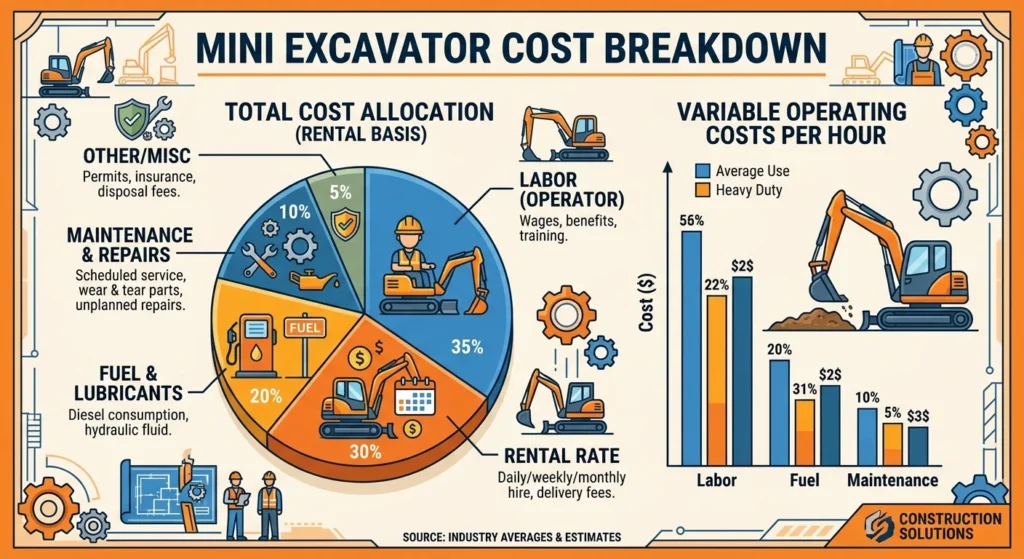
mini excavator cost breakdown
Cost factorIndicative cost
Mini excavator rental$30–$60/hour
Mini excavator with operator$70–$110+/hour
Daily rental$197–$416/day
Weekly rental$600–$8,000/week
Micro 0.8-ton fuel use1–2 L/hour
3-ton fuel use4–5 L/hour
Fuel budget$50–$150/day
Annual servicing$2,000–$4,500
Track replacement$3,000–$8,000
Australian new-equipment reference$40,000–$120,000 AUD
Australian used-equipment reference$18,000–$65,000 AUD

Important: These figures are planning ranges based on the supplied outline. Actual prices vary significantly by market, machine, rental company, project conditions, fuel prices, and equipment availability.

What Determines the Cost of a Mini Excavator?

The hourly cost of a mini excavator can be divided into several major components:

  1. Rental or ownership cost
  2. Fuel
  3. Operator labor
  4. Maintenance and repairs
  5. Attachments
  6. Transportation
  7. Insurance
  8. Depreciation
  9. Financing
  10. Resale value

A useful way to think about the total cost is:

True hourly cost = equipment cost + fuel + labor + maintenance + attachments + transportation + insurance + other applicable expenses

This calculation is more useful for project budgeting than looking at the rental company’s advertised hourly rate alone.

Mini Excavator Rental Cost Per Hour

For homeowners, landscapers, and contractors completing short-term projects, renting is often the simplest way to access a mini excavator.

Typical U.S. planning figures put basic mini excavator rentals at approximately $30–$60 per hour.

A machine supplied with an operator can cost approximately $70–$110+ per hour.

Rental companies may not always quote an hourly price. Instead, they may use daily, weekly, or monthly rates.

Typical Mini Excavator Rental Rates

Rental arrangementIndicative cost
Hourly machine rental$30–$60/hour
Machine with operator$70–$110+/hour
Daily rental$197–$416/day
Weekly rental$600–$8,000/week

The wide weekly range demonstrates why you should compare like-for-like equipment. A micro excavator and a larger 5-ton mini excavator are not directly comparable.

Rental pricing can also depend on:

  • Machine operating weight
  • Digging depth
  • Engine type
  • Brand and model
  • Local demand
  • Rental duration
  • Attachments
  • Delivery distance
  • Insurance requirements
  • Seasonal availability

How Much Does a Mini Excavator Cost With an Operator?

Hiring a mini excavator with an operator can cost approximately $70–$110+ per hour.

Although this is more expensive than renting the machine alone, an experienced operator can improve productivity and reduce the risk of damage.

An experienced operator can:

  • Select efficient digging techniques
  • Position the excavator correctly
  • Minimize unnecessary movement
  • Reduce idle time
  • Use attachments properly
  • Work safely around structures
  • Identify potential site hazards
  • Complete excavation more quickly

For a project with a tight deadline, paying for an experienced operator may actually reduce the total project cost, even if the hourly rate is higher.

Mini Excavator Ownership Costs

Buying a mini excavator changes the calculation completely.

Instead of paying only a rental rate, an owner must account for the machine’s entire lifecycle.

Ownership costs include:

  • Purchase price
  • Financing
  • Interest
  • Depreciation
  • Insurance
  • Warranty
  • Fuel
  • Maintenance
  • Repairs
  • Storage
  • Transportation
  • Attachments
  • Resale value

As an Australian market reference, the supplied figures indicate approximately $40,000–$120,000 AUD for new mini excavators and $18,000–$65,000 AUD for used equipment, depending on size, brand, age, specifications, hours, and condition.

The purchase price alone does not tell you whether owning is economical.

Depreciation and Resale Value

Depreciation is one of the most important ownership costs.

A machine purchased for $60,000 does not necessarily cost $60,000 to own if it can later be sold for $30,000.

A simplified capital-cost calculation is:

Purchase price − resale value = net depreciation

For example:

$60,000 − $30,000 = $30,000

If the excavator produces 1,000 productive hours during its ownership period:

$30,000 ÷ 1,000 = $30 per productive hour

This is only the depreciation component. Fuel, maintenance, insurance, financing, and other costs still need to be added.

Mini Excavator Fuel Cost Per Hour

Fuel consumption varies considerably according to machine size and workload.

A micro excavator around 0.8 tons may consume approximately 1–2 liters per hour.

A 3-ton machine may use approximately 4–5 liters per hour.

Actual consumption depends on:

  • Engine size
  • Excavation depth
  • Soil conditions
  • Hydraulic load
  • Operator technique
  • Idle time
  • Attachment
  • Digging versus grading
  • Machine maintenance

How to Calculate Fuel Cost?

Use this formula:

Hourly fuel cost = fuel consumption per hour × fuel price per liter

For example, if a machine consumes 4 liters per hour and diesel costs $1.75 per liter:

4 × $1.75 = $7/hour

Over an eight-hour workday:

$7 × 8 = $56/day

The supplied planning range of $50–$150 per day illustrates how fuel expenses can vary depending on machine size, fuel prices, and workload.

Mini Excavator Maintenance Costs

Maintenance is another major expense for owners.

Common maintenance requirements include:

  • Engine oil changes
  • Oil filter replacement
  • Fuel filter replacement
  • Air filter servicing
  • Hydraulic system inspection
  • Track inspection
  • Track tension adjustment
  • Greasing
  • Hydraulic hose inspection
  • Undercarriage maintenance

A general planning figure for annual servicing is approximately $2,000–$4,500, although actual costs depend on machine age, usage, service intervals, labor rates, and repairs.

Some maintenance schedules call for oil and filter servicing at intervals such as 500 operating hours, but always follow the manufacturer’s maintenance schedule for the specific machine.

Track Replacement Costs

Tracks are wear components and can become a significant long-term expense.

The supplied planning range for track replacement is approximately $3,000–$8,000.

Track life depends on:

  • Ground conditions
  • Operating technique
  • Machine weight
  • Track quality
  • Tension
  • Turning practices
  • Frequency of use

Operating continuously on abrasive surfaces can accelerate undercarriage wear.

Preventive maintenance can help extend track and undercarriage life and reduce unexpected downtime.

Mini Excavator Cost by Machine Size

Machine size has a direct impact on both rental price and operating cost.

Micro Excavator: Around 0.8 Ton

Micro excavators are designed for restricted-access work.

They are useful for:

  • Backyard landscaping
  • Small trenches
  • Garden excavation
  • Drainage work
  • Narrow access projects
  • Residential construction

Their smaller engines generally consume less fuel.

Compact Excavator: 1–2 Tons

These machines offer a balance between maneuverability and digging performance.

They are suitable for:

  • Residential excavation
  • Landscaping
  • Drainage
  • Utility trenches
  • Small construction projects

Standard Mini Excavator: 3–6 Tons

Larger mini excavators provide greater digging and lifting capability.

They can be appropriate for:

  • Large landscaping projects
  • Site preparation
  • Deeper excavation
  • Construction work
  • Utility installation
  • Material handling

The cheapest machine is not always the most economical. If a machine is too small, additional operating hours can outweigh its lower rental rate.

Zero Tail Swing and Compact Radius Excavators

Machine design can also affect rental cost.

Zero tail swing excavators minimize the amount the rear of the machine extends beyond the tracks when rotating.

This is particularly useful when working:

  • Beside buildings
  • Along walls
  • On narrow residential lots
  • Near roads
  • In confined construction areas

Compact-radius machines offer similar benefits where space is limited.

You may pay a higher rental rate for specialized equipment, but the increased maneuverability can reduce project time and make otherwise difficult work possible.

Electric vs. Diesel Mini Excavators

Electric mini excavators are becoming an alternative to conventional diesel machines for suitable applications.

The supplied figures suggest that electric models can potentially achieve 60–80% energy-cost savings in appropriate operating conditions.

Electric equipment can be attractive for:

  • Indoor construction
  • Urban projects
  • Noise-sensitive areas
  • Emission-restricted locations
  • Projects with suitable charging infrastructure

However, energy cost is only one part of the equation.

Compare:

  • Purchase price
  • Battery capacity
  • Charging time
  • Charging infrastructure
  • Daily operating hours
  • Energy prices
  • Maintenance
  • Resale value

before determining whether an electric excavator is actually cheaper for your project.

How Project Type Changes Hourly Operating Cost?

The machine does not consume fuel at the same rate during every task.

Heavy digging can place a greater load on the engine and hydraulic system than light grading.

For example:

Digging

Generally requires greater hydraulic power and can increase fuel consumption.

Grading

May involve lighter loads and more controlled machine movement.

Lifting

Fuel consumption and operating requirements depend on load weight, boom movement, and working cycle.

Demolition

Using a hydraulic breaker can increase machine load and component wear.

Therefore, cost per clock hour and cost per productive hour are not always the same thing.

Mini Excavator Attachment Costs

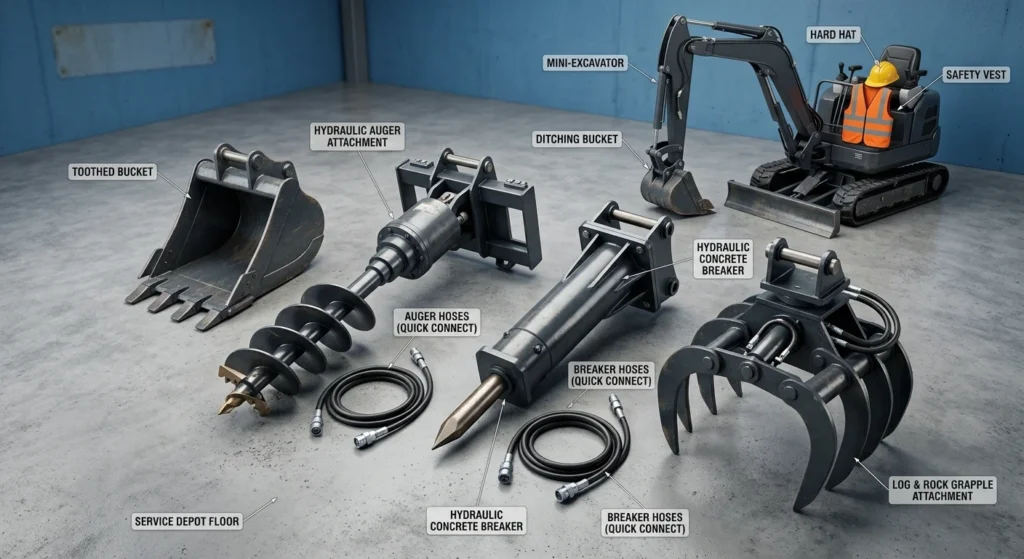
mini excavator attachments

Attachments can significantly affect the final project price.

Common mini excavator attachments include:

  • Digging buckets
  • Grading buckets
  • Hydraulic breakers
  • Augers
  • Grapples
  • Tilt buckets
  • Compaction wheels

A standard bucket may be included with a rental, while specialized attachments may cost extra.

Before renting, ask:

“Which attachments are included in the quoted rate?”

This simple question can prevent an unexpected addition to your invoice.

Delivery, Pickup, and Transportation Costs

Transportation is one of the most frequently overlooked mini excavator expenses.

You may need to pay for:

  • Delivery
  • Pickup
  • Trailer hire
  • Mobilization
  • Demobilization
  • Long-distance transport

For a one-day project, these charges can represent a significant percentage of the total cost.

For example:

$300 rental + $150 transportation + $50 fuel = $500 total

The machine’s effective cost is therefore:

$500 ÷ 8 hours = $62.50 per productive hour

That is considerably higher than the headline rental price.

Other Hidden Mini Excavator Costs

Before signing a rental agreement, ask about:

Insurance

Does your existing insurance cover rented construction equipment?

Damage waiver

What damage is covered, and what exclusions apply?

Refueling

Does the machine need to be returned with a full tank?

Overtime

Does the daily rate include a specific number of operating hours?

Minimum rental period

Some companies may have minimum rental charges.

Attachments

Are specialized tools charged separately?

Transportation

Are delivery and pickup included?

Cleaning

Could excessive dirt or damage result in additional fees?

Understanding these conditions helps you calculate the true mini excavator rental cost.

International Mini Excavator Cost Differences

Mini excavator costs vary substantially between countries.

The supplied market references include:

MarketIndicative reference
United States rental$30–$60/hour
United States with operator$70–$110/hour
Canada operator wages$28–$35/hour
India₹850–₹1,200/hour
China¥135–¥145/hour
Australia, new equipment$40,000–$120,000 AUD
Australia, used equipment$18,000–$65,000 AUD

These figures should not be treated as direct international price equivalents.

Local wages, taxes, fuel prices, transportation, equipment supply, machine specifications, exchange rates, and rental practices all influence the final price.

When Does Renting a Mini Excavator Make Sense?

Renting is usually attractive for short-term equipment requirements.

Choose rental when:

  • You have a one-off project.
  • You only need the machine for a few days.
  • You do not have equipment storage.
  • You want a newer, well-maintained machine.
  • You need different machine sizes for different jobs.
  • You want to avoid depreciation.
  • You do not want long-term maintenance responsibilities.

For a homeowner excavating a drainage trench or landscaping a backyard, buying a mini excavator is rarely justified solely for that one project.

When Does Buying a Mini Excavator Make Sense?

Buying becomes more attractive when equipment utilization is high.

Consider ownership if:

  • You operate a contracting business.
  • Excavation work is frequent.
  • You have predictable projects.
  • You can store the equipment.
  • You have maintenance capabilities.
  • You can finance the purchase responsibly.
  • You expect to use the machine for several years.
  • You can recover part of the investment through resale.

The more productive hours you accumulate, the more effectively you spread fixed ownership costs.

Total Cost of Ownership Formula

A basic mini excavator total-cost-of-ownership calculation is:

TCO = purchase price + financing + insurance + maintenance + repairs + fuel + storage + transportation − resale value

To determine the hourly ownership cost:

Hourly ownership cost = TCO ÷ productive operating hours

A more detailed calculation can separate fixed and variable expenses:

Hourly cost = fixed ownership costs ÷ productive hours + variable operating costs per hour

This approach gives you a much more realistic comparison against rental rates.

Example: Five-Year Ownership Calculation

Suppose you purchase a mini excavator for $60,000 and expect to sell it for $30,000 after five years.

Assume:

  • Purchase price: $60,000
  • Resale value: $30,000
  • Other fixed costs: $5,000
  • Productive use: 1,000 hours

The capital and fixed-cost component is:

($60,000 − $30,000 + $5,000) ÷ 1,000 = $35/hour

Now add:

  • Fuel
  • Maintenance
  • Repairs
  • Insurance
  • Financing
  • Transportation

The final effective hourly cost could be substantially higher.

The calculation demonstrates why machine utilization is critical.

Cost-Saving Strategies for Mini Excavator Owners and Renters

1. Choose the Correct Machine

Do not pay for a 5-ton excavator when a 1.5-ton machine can efficiently complete the job.

Conversely, avoid choosing an undersized machine that takes twice as long.

2. Plan the Site Before Excavation

Identify:

  • Access points
  • Utility locations
  • Spoil areas
  • Digging zones
  • Material storage
  • Machine parking
  • Attachment requirements

Good planning reduces idle time and unnecessary movement.

3. Perform Regular Maintenance

Check:

  • Engine oil
  • Hydraulic fluid
  • Coolant
  • Filters
  • Track condition
  • Track tension
  • Grease points

Preventive maintenance can reduce costly downtime.

4. Use the Correct Attachment

The right attachment can dramatically improve productivity.

5. Minimize Idling

An excavator that runs without performing productive work still consumes fuel and accumulates engine hours.

6. Compare All-In Rental Prices

Ask rental companies to provide:

  • Equipment cost
  • Delivery
  • Pickup
  • Fuel requirements
  • Insurance
  • Attachments
  • Overtime charges
  • Damage terms

Compare the complete quote rather than the advertised base rate.

Operator Training and Productivity

An operator’s skill can have a measurable impact on the total cost of excavation.

A trained operator can often:

  • Reduce unnecessary machine movement
  • Improve digging cycles
  • Protect the machine
  • Reduce fuel waste
  • Work more safely
  • Reduce attachment misuse
  • Minimize avoidable damage

Training and certification requirements vary by location and work environment, so operators should verify the rules that apply to their particular job.

Safety and Compliance Costs

Safety should be included in every excavation budget.

Potential requirements include:

  • Operator training
  • Competency certification
  • Hard hats
  • Safety glasses
  • Gloves
  • High-visibility clothing
  • Site inspection
  • Hazard assessment
  • Underground utility locating
  • Appropriate excavation procedures

One of the most important steps before excavation is identifying underground utilities.

Electrical cables, gas lines, water pipes, telecommunications infrastructure, and other buried services can create serious safety and financial risks.

A small investment in site preparation and utility locating can prevent a major incident.

How to Calculate Your Actual Mini Excavator Cost Per Hour?

Use this five-step process.

Step 1: Determine the equipment cost

For rental:

Rental cost ÷ included operating hours

For ownership:

Fixed ownership costs ÷ expected productive hours

Step 2: Add fuel

Fuel consumption × local fuel price

Step 3: Add labor

Include operator wages if you are not operating the excavator yourself.

Step 4: Add other expenses

Include:

  • Maintenance
  • Attachments
  • Transportation
  • Insurance
  • Financing
  • Storage
  • Repairs

Step 5: Calculate productive-hour cost

Divide your total project equipment expenses by the number of hours the excavator actually performs productive work.

This final number is more valuable than the advertised rental rate.

Frequently Asked Questions

How much does it cost to rent a mini excavator for a day?

A general planning range is approximately $197–$416 per day. Actual prices depend on machine size, location, rental duration, attachments, demand, and rental-company policies.

Is it cheaper to rent or buy a mini excavator?

For occasional projects, renting is usually simpler and can be more economical because you avoid depreciation, storage, maintenance, insurance, and financing. Buying can make financial sense for contractors with frequent and predictable equipment use.

How much fuel does a mini excavator use per hour?

A micro excavator around 0.8 tons may consume approximately 1–2 liters per hour, while a 3-ton excavator may consume approximately 4–5 liters per hour. Actual consumption varies according to workload, machine condition, engine, operator, and site conditions.

Do I need a license to operate a mini excavator?

Requirements vary by jurisdiction, employer, project, and worksite. Some applications require specific training or certification, while requirements differ for private and commercial work. Check the regulations applicable to your location before operating the machine.

What size mini excavator do I need for my project?

Consider access width, digging depth, soil conditions, lifting requirements, operating weight, attachment requirements, and project size. Micro excavators work well in tight residential spaces, while 3–6-ton machines provide greater capacity for demanding excavation and site-preparation work.

What is the cheapest way to rent a mini excavator?

Compare the total rental package, not just the hourly rate. Ask multiple rental companies about daily or weekly pricing, delivery, pickup, fuel, insurance, attachments, and minimum rental periods.

Is a mini excavator expensive to operate?

The operating cost depends on fuel consumption, machine size, maintenance, labor, utilization, and rental or ownership costs. Smaller machines generally consume less fuel, but a larger machine may complete demanding work faster and therefore have a lower cost per completed task.

Does an operator make a mini excavator more expensive?

Yes, the hourly rate generally increases when an operator is included. However, a skilled operator can improve productivity and reduce wasted time, fuel consumption, and equipment damage, potentially lowering the total project cost.

Final Answer: What Does a Mini Excavator Cost Per Hour?

The typical mini excavator cost per hour is approximately $30–$110+, depending on whether you rent the equipment alone, hire it with an operator, or calculate the complete cost of ownership.

A useful starting point is:

  • $30–$60/hour: basic rental planning range
  • $70–$110+/hour: machine with operator
  • $50–$150/day: general fuel planning range
  • $2,000–$4,500/year: indicative servicing range
  • $3,000–$8,000: potential track replacement expense

But the real cost can be higher after adding fuel, transportation, attachments, insurance, maintenance, operator labor, depreciation, financing, and other fees.

For a one-time project, renting is generally the more practical choice. For a contractor with consistent excavation work, buying can become attractive when enough productive hours are generated to spread fixed ownership costs.

Before making a decision, obtain several local quotes and ask for the complete, all-in project cost.

The best equipment decision is not necessarily the machine with the lowest hourly rate. It is the machine that delivers the lowest total cost per productive hour while completing the job safely and efficiently.

Search For Rentals Near You

USA Construction Rentals compares the best rental companies near you