The amount of dirt that fits in a pickup truck depends on its bed size, payload capacity, and the weight of the soil. Most half-ton pickup trucks can carry approximately 0.75 to 1 cubic yard of average dirt, provided the truck’s actual payload rating allows it. Midsize trucks may carry less, while heavy-duty pickups can handle larger loads.
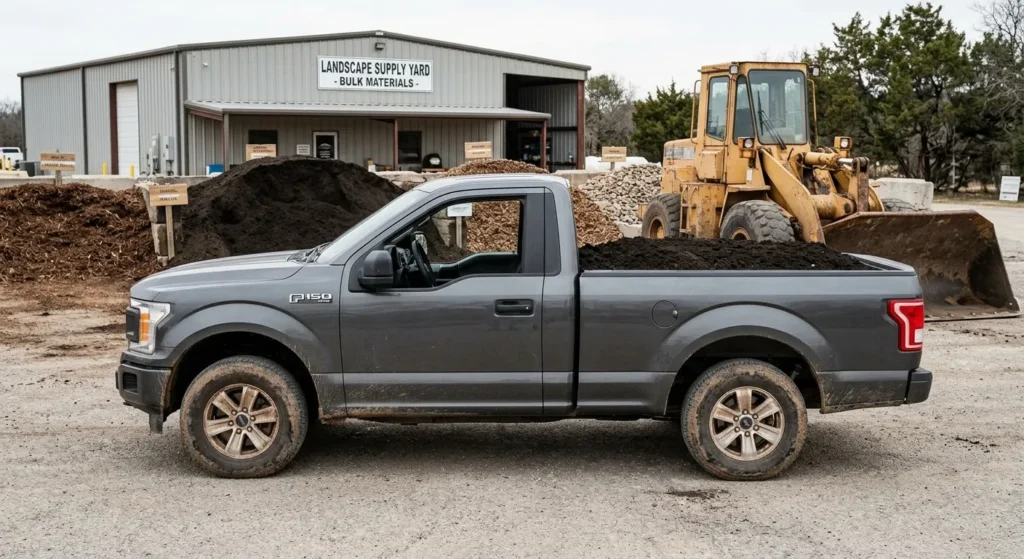
Although a pickup bed might physically hold 2 or more cubic yards of dirt, that does not mean the truck can safely carry that much weight. Wet soil and clay can weigh considerably more than dry topsoil, making payload capacity the most important factor when hauling dirt for landscaping, grading, or excavation projects.
How Many Cubic Yards of Dirt Can a Pickup Truck Hold?
A pickup truck’s bed volume determines how much dirt fits physically, but its payload rating determines how much weight it can safely carry. The following estimates assume average soil and typical truck configurations; your vehicle’s door-jamb payload label takes priority over these general figures.
| Pickup truck type | Approximate conservative dirt load |
|---|---|
| Midsize pickup (Toyota Tacoma, Ford Ranger) | 0.5–0.75 cubic yards |
| Half-ton pickup (Ford F-150, Chevrolet Silverado 1500) | Around 0.75–1 cubic yard |
| Three-quarter-ton pickup (Ford F-250, Chevrolet Silverado 2500) | Around 1–1.5 cubic yards |
| One-ton pickup (Ford F-350, Chevrolet Silverado 3500) | Around 1.5–2 cubic yards |
These are planning estimates, not guaranteed capacities. A truck with a lower payload rating, heavy accessories, passengers, or wet soil may need a smaller load. Some configurations can carry more, but always calculate capacity using the actual vehicle and material weight.
How Much Does a Cubic Yard of Dirt Weigh?
A cubic yard of dirt can weigh roughly 1,000 to 3,000 pounds or more, depending on soil composition, moisture, and compaction. Dry, loose topsoil can be relatively light, while wet clay and dense soil can quickly exceed a pickup’s available payload.
| Dirt type | Approximate weight per cubic yard |
|---|---|
| Light, dry topsoil | 1,000–1,500 pounds |
| Typical soil or topsoil | 2,000–2,400 pounds |
| Dense or wet soil | 2,500–3,000+ pounds |
These ranges are approximate, not universal material specifications. Soil suppliers may quote different weights depending on the material and its moisture content.
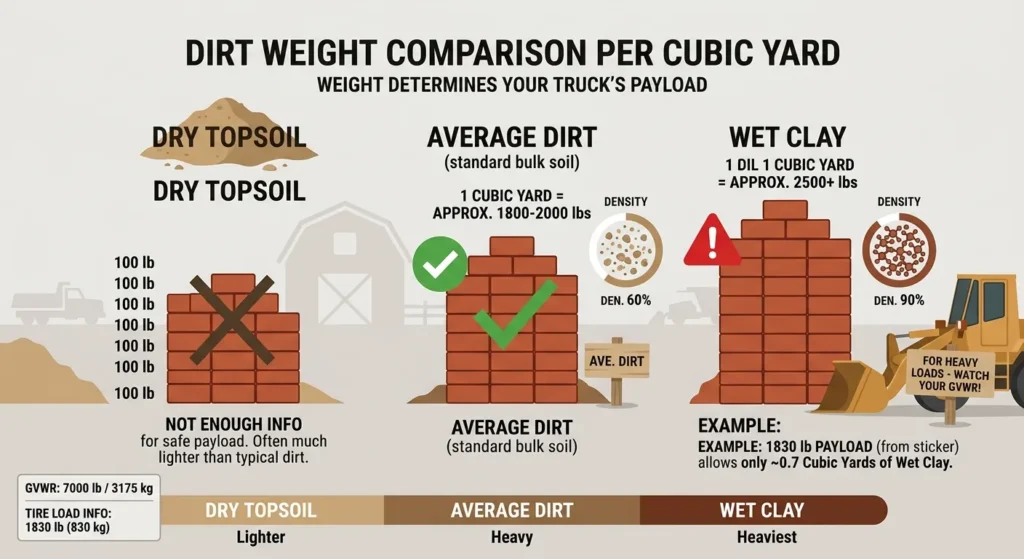
For example, if one cubic yard of the soil you are buying weighs 2,200 pounds, a pickup with 1,800 pounds of available payload cannot safely carry a full cubic yard. Its theoretical limit would be about 0.82 cubic yards before accounting for passengers, tools, and other cargo.
Remember: One cubic yard equals 27 cubic feet. A cubic yard measures volume, while pounds and tons measure weight.
How Much Dirt Fits in a Pickup Bed by Size?
Pickup beds vary by model, cab style, and configuration. The following estimates illustrate the physical space available in common bed sizes, assuming a reasonably rectangular load contained within the bed.
| Approximate bed size | Approximate volume |
|---|---|
| Midsize pickup with a 5-foot bed | 30–43 cubic feet |
| Full-size pickup with a 6.5-foot bed | Around 62 cubic feet |
| Full-size pickup with an 8-foot bed | Around 77–89 cubic feet |
To convert cubic feet to cubic yards, divide the volume by 27.
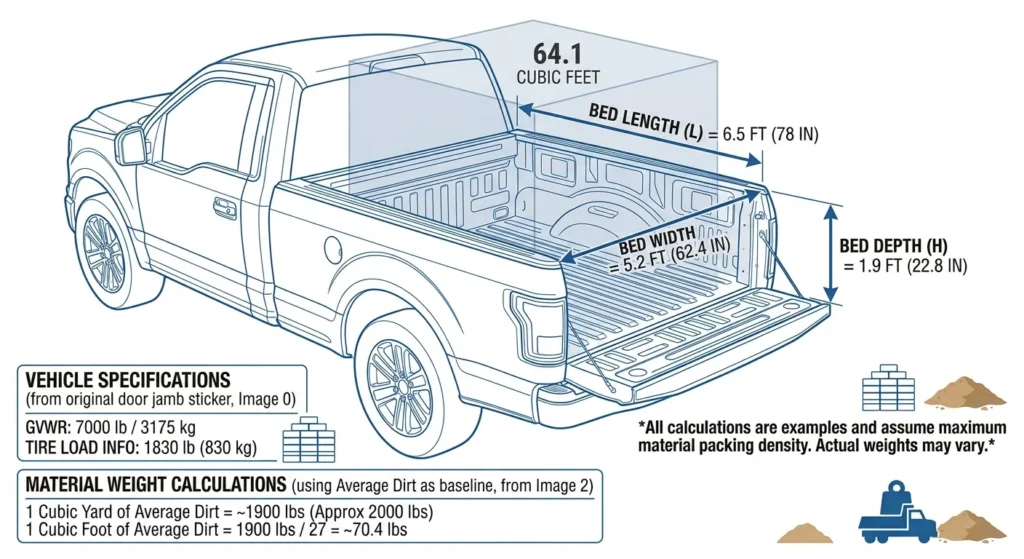
For example, a bed measuring approximately 62 cubic feet holds about 2.3 cubic yards of material by volume. However, this is a physical-volume estimate, not a recommendation to load 2.3 cubic yards of dirt.
The actual volume will also depend on the bed’s width, wheel-well intrusions, sidewall height, and the shape of the load.
Can a Pickup Truck Carry 2 Cubic Yards of Dirt?
A pickup truck may have enough bed space for 2 cubic yards of dirt, but most half-ton pickups cannot safely carry that quantity of average soil.
If the soil weighs 2,200 pounds per cubic yard, two cubic yards would weigh approximately 4,400 pounds. That load exceeds the available payload of many half-ton pickups, even before adding passengers or equipment.
A heavy-duty pickup may have a higher payload rating, but you still need to check its specific limits. Two cubic yards of light, dry topsoil will weigh less than two cubic yards of wet clay.
The key rule is simple: bed volume tells you how much fits; payload capacity tells you how much weight your truck can carry.
How to Calculate Your Pickup Truck’s Dirt Capacity?
Use this formula to estimate the maximum dirt volume your truck can carry:
Dirt capacity (cubic yards) = Available payload (pounds) ÷ Dirt weight per cubic yard (pounds)
The result is the theoretical weight-based limit. Your actual load must also fit within the bed and comply with the vehicle’s gross vehicle weight rating, axle ratings, tire limits, and applicable road regulations.
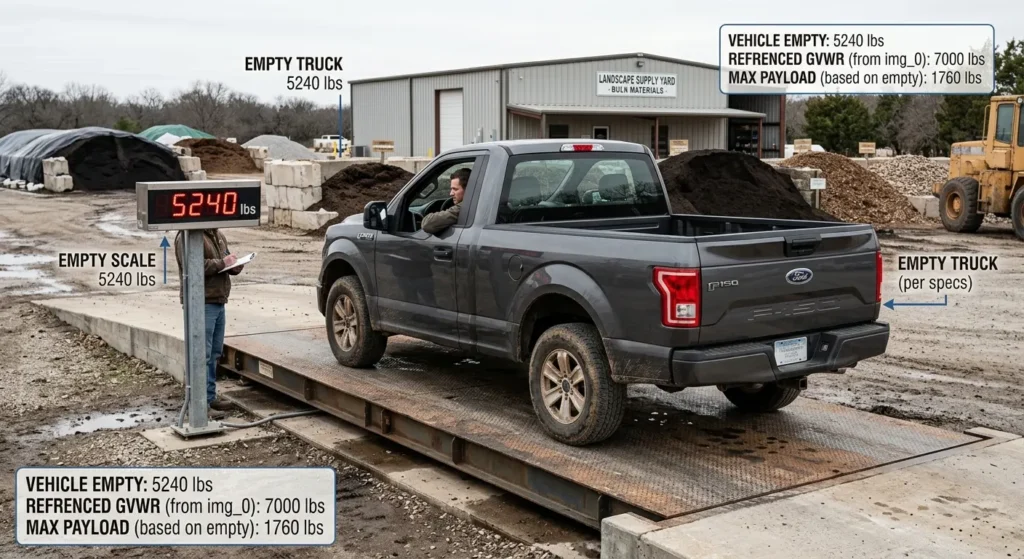
Example: Half-Ton Pickup
Suppose your truck has 1,800 pounds of available payload and the soil weighs 2,200 pounds per cubic yard.
- Available payload: 1,800 pounds.
- Soil weight: 2,200 pounds per cubic yard.
- Calculation: 1,800 ÷ 2,200 = 0.82 cubic yards.
The theoretical maximum is approximately 0.82 cubic yards, assuming the 1,800-pound figure is the payload remaining after accounting for occupants, accessories, tools, and other cargo. In practice, leave a suitable safety margin rather than aiming to use every pound of rated capacity.
Example: Three-Quarter-Ton Pickup
Suppose a truck has 3,000 pounds of available payload and the same soil weighs 2,200 pounds per cubic yard.
3,000 ÷ 2,200 = 1.36 cubic yards.
The theoretical weight-based limit is approximately 1.36 cubic yards. The actual safe load may be lower depending on the truck’s configuration, axle distribution, bed volume, and other restrictions.
How to Check Your Truck’s Payload Capacity?
Before loading dirt, follow these steps:
- Find the payload label. Open the driver’s door and check the Tire and Loading Information sticker. It states the combined weight of occupants and cargo that the vehicle was designed to carry.
- Account for other weight. Include passengers, tools, accessories, and any other cargo when determining the remaining payload.
- Ask about soil weight. Contact the supplier for the estimated weight per cubic yard, especially if you are buying wet soil, clay, or dense fill.
- Calculate the load. Divide your remaining payload by the soil’s weight per cubic yard.
- Check all vehicle limits. Do not exceed the gross vehicle weight rating, axle ratings, tire limits, or any applicable legal limits.
Do not rely solely on the truck’s model name or its advertised maximum towing capacity. Towing capacity and payload capacity are different ratings.
Common Mistakes When Hauling Dirt in a Pickup
Assuming the Bed Can Carry Its Full Volume
A bed that holds 2.3 cubic yards does not necessarily have the payload capacity for that much soil. Always calculate the weight before loading.
Ignoring Wet Soil
Rain can increase soil weight substantially. A load that is manageable when dry may become too heavy after absorbing moisture.
Loading Dirt Above the Bed Rails
A high pile can spill during transport and make the vehicle less stable. Keep the load contained, distribute it evenly, and secure it appropriately. Do not assume that staying below the bed rails makes an overweight load safe.
Estimating the Load by Eye
It is difficult to judge cubic yards accurately from the appearance of a pile. Use the supplier’s measurements, known material weights, and a scale when available.
Forgetting Passengers and Equipment
Payload includes people and cargo, not just dirt. A truck’s available capacity decreases when passengers, toolboxes, bed accessories, or construction equipment are added.
Is a Pickup Truck Enough for an Excavation Project?
A pickup truck can be useful for hauling small quantities of topsoil, moving material for minor grading, or transporting fill for landscaping. However, larger excavation jobs may generate more soil than a pickup can reasonably carry.
For foundation excavation, trenching, basement digging, or substantial site preparation, a dump truck or professional hauling service may be more practical. The best option depends on the excavation volume, hauling distance, access to the site, disposal fees, and the number of loads required.
If you are estimating material removal for a construction job, calculate the excavation volume first, then compare the total quantity with the pickup’s safe dirt capacity. This helps you estimate the number of trips and avoid overloading the vehicle.
Frequently Asked Questions
How many cubic yards of dirt can a half-ton pickup hold?
A half-ton pickup may safely carry around 0.75 to 1 cubic yard of average dirt, depending on its available payload and the soil’s weight. Dense or wet soil can reduce that amount.
How much does one pickup truck load of dirt weigh?
The weight depends on the quantity and type of soil. For example, 0.75 cubic yards of soil weighing 2,200 pounds per cubic yard weighs approximately 1,650 pounds.
Can an F-150 carry one cubic yard of dirt?
Some Ford F-150 configurations can carry one cubic yard of certain soils, but others may not have enough available payload. Check the specific truck’s door-jamb label and account for passengers, accessories, and cargo.
How many bags of dirt equal one cubic yard?
The answer depends on bag size. One cubic yard equals 27 cubic feet, so it is equivalent to approximately 27 bags containing 1 cubic foot each or 54 bags containing 0.5 cubic foot each.
Is it cheaper to haul dirt yourself or have it delivered?
For a small quantity and a nearby supplier, hauling dirt yourself may be convenient if your vehicle can carry it safely. For larger excavation or landscaping projects, delivery by a suitable dump truck may reduce repeated trips, fuel costs, and loading time. Compare the complete costs before deciding.
Conclusion
Most half-ton pickup trucks can safely carry approximately 0.75 to 1 cubic yard of average dirt, while some heavy-duty pickups can carry more. The actual amount depends on available payload, soil density, moisture, bed dimensions, and other vehicle limits.
Before hauling dirt for landscaping or excavation, check your truck’s payload label and calculate the load by weight. Never use bed volume alone to decide how much dirt your pickup can carry.

Ahmed Ijaz runs this construction rental directory with over 5 years of experience in SEO, content, and web optimization. Every page is built using real research, hands-on expertise, and carefully reviewed information to meet strong EEAT standards.