A cubic yard of dirt takes approximately 5 to 14 wheelbarrow loads, depending on the wheelbarrow’s capacity. A 6-cubic-foot contractor wheelbarrow requires about 5 trips, while a 3-cubic-foot garden wheelbarrow requires 9 trips and a 2-cubic-foot model requires 14 trips.
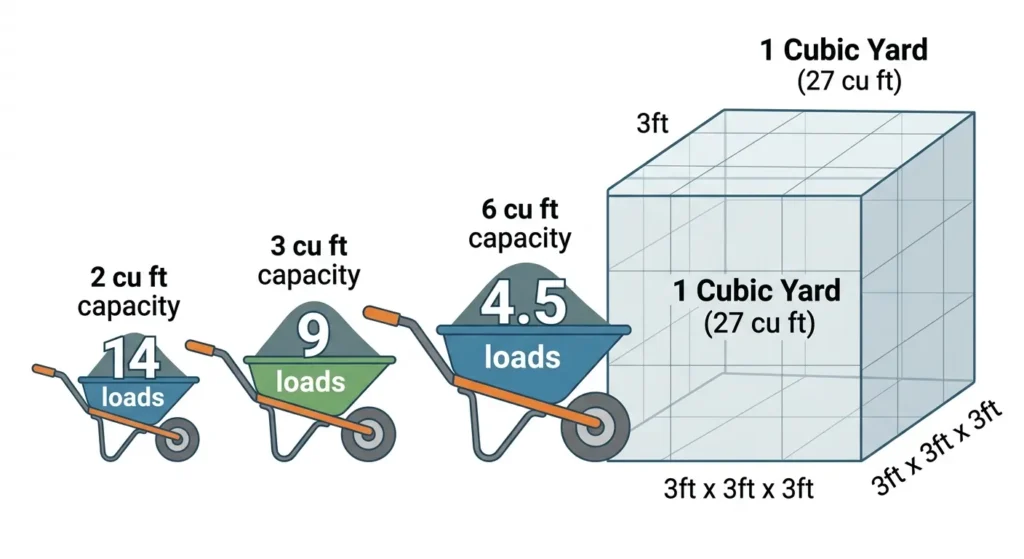
One cubic yard equals 27 cubic feet, so you can calculate the number of wheelbarrow loads by dividing 27 by your wheelbarrow’s usable capacity in cubic feet. If you’re hauling excavated soil, remember that digging can increase its volume, while wet or dense dirt can make each load significantly heavier.
Wheelbarrow Loads per Cubic Yard of Dirt
The following table shows how many loads you need to move one cubic yard of loose dirt using different wheelbarrow sizes.
| Wheelbarrow capacity | Loads per cubic yard |
|---|---|
| 2 cubic feet | 14 loads |
| 3 cubic feet | 9 loads |
| 4 cubic feet | 7 loads |
| 5 cubic feet | 6 loads |
| 6 cubic feet | 5 loads |
| 8 cubic feet | 4 loads |
These figures are rounded up to whole trips. For example, a 6-cubic-foot wheelbarrow holds 4.5 loads per cubic yard mathematically, meaning you need four full loads and one partial load to move the entire yard.
A 3-cubic-foot wheelbarrow is a practical option for many homeowners, while a larger contractor wheelbarrow can reduce the number of trips on construction sites. However, the best choice also depends on the weight of the dirt and the operator’s ability to move it safely.
How to Calculate Wheelbarrow Loads for One Cubic Yard?
Calculating wheelbarrow loads is straightforward when you know the capacity of your equipment.
Formula:
Number of loads = 27 ÷ wheelbarrow capacity in cubic feet
For example, if you have a 3-cubic-foot wheelbarrow:
27 ÷ 3 = 9 loads
You need nine full-capacity loads to move one cubic yard of loose dirt.
For a 6-cubic-foot wheelbarrow:
27 ÷ 6 = 4.5 loads
You need five trips, with the final trip carrying approximately half a load.
This calculation assumes that the wheelbarrow is filled to its stated capacity. If you leave space at the top to prevent spillage or reduce the weight, you may need additional trips.
What Size Wheelbarrow Do You Need for Dirt?
Wheelbarrows come in different sizes, and the capacity listed by a manufacturer may differ from the amount of dirt you can comfortably transport in one trip.
2- to 3-Cubic-Foot Garden Wheelbarrow
Small garden wheelbarrows are commonly used for landscaping, gardening, and residential construction tasks. They are suitable for moving topsoil, filling raised beds, spreading soil around plants, and handling smaller excavation jobs.
A 2-cubic-foot wheelbarrow requires approximately 14 loads per cubic yard. A 3-cubic-foot model requires nine loads.
Smaller wheelbarrows can be easier to maneuver through narrow garden paths, although the actual handling depends on the design, wheel configuration, and load weight.
4- to 6-Cubic-Foot Contractor Wheelbarrow
Contractor wheelbarrows generally have larger trays designed for demanding material-handling work. Depending on the model, they may feature steel or polyethylene trays and one or more wheels.
A 4-cubic-foot wheelbarrow requires about seven loads per cubic yard, while a 6-cubic-foot model requires approximately five trips.
These larger models can reduce the amount of manual hauling required on construction sites. However, filling the entire tray with heavy soil may make the wheelbarrow difficult or unsafe to lift and push.
8-Cubic-Foot and Larger Wheelbarrows
Some large-capacity wheelbarrows can hold 8 cubic feet or more. Theoretically, an 8-cubic-foot model needs four trips to move one cubic yard of dirt.
However, a larger tray does not automatically mean better performance. Soil can be heavy, and the wheelbarrow’s rated load, balance, terrain, and operator strength all affect how much material can be transported safely.
Why the Number of Wheelbarrow Loads Can Change?
The conversion table provides a useful starting point, but actual hauling conditions can change the number of trips needed.
1. Excavated Dirt Expands in Volume
Soil that is dug out of the ground often occupies more space than it did in its compacted state. This increase is commonly called soil swell or the fluff factor.
Depending on soil type, moisture, and excavation conditions, disturbed soil may expand by approximately 20% to 30%, although the actual amount can be lower or higher.
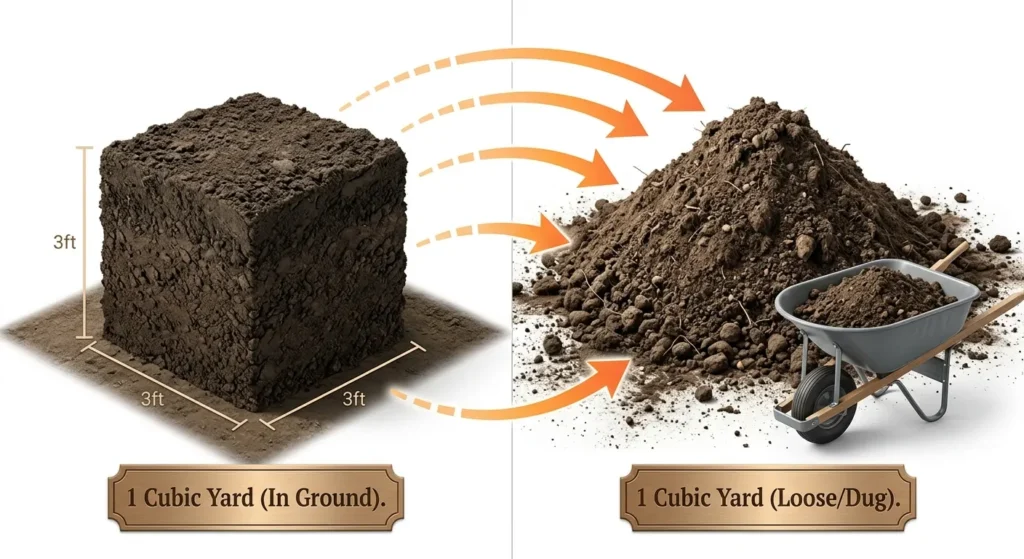
For example, one cubic yard of soil measured in the ground could occupy approximately 1.2 to 1.3 cubic yards after excavation if it expands by 20% to 30%.
If you need to remove excavated soil from a construction site, you may therefore make more wheelbarrow trips than the original in-ground volume suggests.
The expansion factor is not a universal conversion rate. Clay, sandy soil, and rocky material behave differently, so use project-specific estimates when planning excavation and spoil removal.
2. Wet Dirt Is Heavier
Moisture affects the weight of dirt and can make each wheelbarrow load harder to handle.
Dry soil may be relatively easy to transport, while wet clay or saturated soil can become substantially heavier. The wheelbarrow might have enough physical space for a full load but still exceed a safe working load.
For this reason, do not use tray volume alone to decide how much dirt to carry. Follow the manufacturer’s load rating and reduce the load when the material is too heavy to control comfortably.
3. Loose Soil and Compacted Soil Are Different
One cubic yard of loose topsoil is not necessarily equivalent to one cubic yard of compacted soil in terms of the amount of material being excavated.
Loose soil contains more air spaces and may occupy a greater volume. Compacted soil has less space between particles.
When calculating wheelbarrow trips, distinguish between the volume of soil before excavation and the volume of the loose material you actually need to transport.
4. The Wheelbarrow May Not Be Filled Completely
The number of trips also depends on how much dirt you place in the tray.
A wheelbarrow filled to the rim may spill on uneven ground, while a smaller load may be easier to control on slopes or narrow paths.
If you routinely carry less than the wheelbarrow’s stated capacity, calculate the loads using your actual load volume rather than the maximum tray size.
How Many Wheelbarrow Loads Do You Need for Your Project?
You can estimate the total number of loads by calculating the soil volume first.
Step 1: Measure the Area
Measure the length, width, and depth of the area in feet. Convert inches to feet before calculating.
For example, a garden bed measuring 10 feet long, 10 feet wide, and 6 inches deep has a depth of 0.5 feet.
Step 2: Calculate Cubic Feet
Multiply length by width by depth:
10 × 10 × 0.5 = 50 cubic feet
Step 3: Convert Cubic Feet to Cubic Yards
Divide the result by 27:
50 ÷ 27 = 1.85 cubic yards
The garden bed requires approximately 1.85 cubic yards of soil before accounting for settling, overfilling, or other project-specific adjustments.
Step 4: Calculate the Number of Wheelbarrow Loads
If you use a 3-cubic-foot wheelbarrow, each cubic yard requires nine full-capacity loads.
1.85 × 9 = 16.65 loads
You therefore need approximately 17 trips to transport the calculated volume, assuming loose soil, a full usable capacity of 3 cubic feet, and no additional volume from excavation.
If the dirt is dug out of the ground and expands, the number of trips may increase.
Tips for Moving Dirt Efficiently on a Construction Site
Moving a cubic yard of dirt by hand can be manageable, but larger quantities require careful planning.
- Avoid overfilling the tray. Keep the load stable and manageable, especially when moving wet soil or traveling over uneven ground.
- Prepare the hauling route. A firm, reasonably level path reduces the effort needed to push a loaded wheelbarrow.
- Use a suitable wheelbarrow. Choose a model with a load rating appropriate for the soil and the conditions on site.
- Estimate the total volume before starting. Measuring the area helps you plan labor and avoid underestimating the number of trips.
- Consider mechanical hauling for larger jobs. For several cubic yards of dirt, a powered wheelbarrow, compact loader, or suitable delivery service may be more efficient than repeated manual trips.
For excavation projects, remember that removing the soil is only part of the calculation. You may also need to account for loading, hauling distance, disposal requirements, and the space required to store or stockpile excavated material.
Frequently Asked Questions
How many wheelbarrows of dirt make one cubic yard?
One cubic yard of loose dirt requires approximately 14 loads in a 2-cubic-foot wheelbarrow, nine loads in a 3-cubic-foot wheelbarrow, or five trips in a 6-cubic-foot contractor wheelbarrow.
How many 3-cubic-foot wheelbarrows are in a cubic yard?
One cubic yard equals 27 cubic feet. Dividing 27 by 3 gives nine full-capacity wheelbarrow loads.
How many 6-cubic-foot wheelbarrows are in a cubic yard?
A 6-cubic-foot wheelbarrow requires 4.5 loads mathematically, or five trips in practice, with the last trip partially filled.
How many wheelbarrows of dirt are in 5 cubic yards?
Using a 3-cubic-foot wheelbarrow, five cubic yards require 45 full-capacity loads. A 6-cubic-foot wheelbarrow requires 22.5 loads mathematically, or 23 trips in practice.
Does wet dirt require more wheelbarrow trips?
Not necessarily because of volume alone. Wet dirt is generally heavier, so you may need to carry smaller loads for safe handling. If the wet soil also occupies a larger volume or expands during excavation, the total number of trips may increase.
How many wheelbarrows of dirt can you move in an hour?
The number depends on the wheelbarrow size, load weight, travel distance, ground conditions, and time required to load and unload each trip. There is no reliable universal number for every construction or landscaping job.
Conclusion
The number of wheelbarrow loads in a cubic yard of dirt depends primarily on the wheelbarrow’s usable capacity. A 2-cubic-foot model requires approximately 14 loads, a 3-cubic-foot model requires nine, and a 6-cubic-foot contractor wheelbarrow requires five trips.
Before starting a landscaping or excavation project, confirm your wheelbarrow’s capacity and consider the soil’s weight and whether excavation will increase its volume. These factors help you estimate the labor, time, and equipment needed to move dirt safely and efficiently.

Ahmed Ijaz runs this construction rental directory with over 5 years of experience in SEO, content, and web optimization. Every page is built using real research, hands-on expertise, and carefully reviewed information to meet strong EEAT standards.