Fiber optic trenching is the foundation of every reliable underground fiber network. Whether you’re deploying broadband infrastructure, connecting commercial facilities, or expanding telecommunications networks, proper trenching ensures long-term cable protection, network performance, and reduced maintenance costs.
Poor installation practices often lead to cable damage, service interruptions, and expensive repairs. Industry studies refer to accidental cable damage caused by excavation as “backhoe fade,” one of the leading causes of fiber network outages. By following proper engineering standards and installation techniques, contractors can significantly extend the service life of underground fiber infrastructure—often exceeding 20–25 years.
What Is Fiber Optic Trenching?
Fiber optic trenching is the process of excavating a trench to install underground fiber optic cables either directly in the soil or inside protective conduits. It provides physical protection while allowing easy maintenance and future network expansion.
A typical trenching project includes:
- Route planning
- Utility locating
- Soil assessment
- Excavation
- Conduit installation
- Cable pulling
- Backfilling
- Testing and documentation
Proper trenching minimizes environmental impact while protecting cables from moisture, mechanical damage, rodents, and future excavation.
Why Proper Fiber Optic Trenching Matters?
Correct installation provides several long-term benefits:
| Benefit | Impact |
|---|---|
| Reduced network outages | Lower maintenance costs |
| Better cable protection | Longer service life |
| Easier repairs | Reduced downtime |
| Regulatory compliance | Avoids legal penalties |
| Improved ROI | Lower lifetime ownership cost |
Although deeper trenches increase initial construction costs, they dramatically reduce expensive emergency repairs over the network’s lifespan.
Fiber Optic Installation Methods
Traditional Open-Cut Trenching
Open-cut trenching remains the most widely used installation method.
Advantages include:
- Cost-effective for long distances
- Easy inspection during installation
- Suitable for rural deployments
- Supports multiple conduits
Disadvantages include:
- Traffic disruption
- Longer restoration time
- Greater environmental impact
Microtrenching
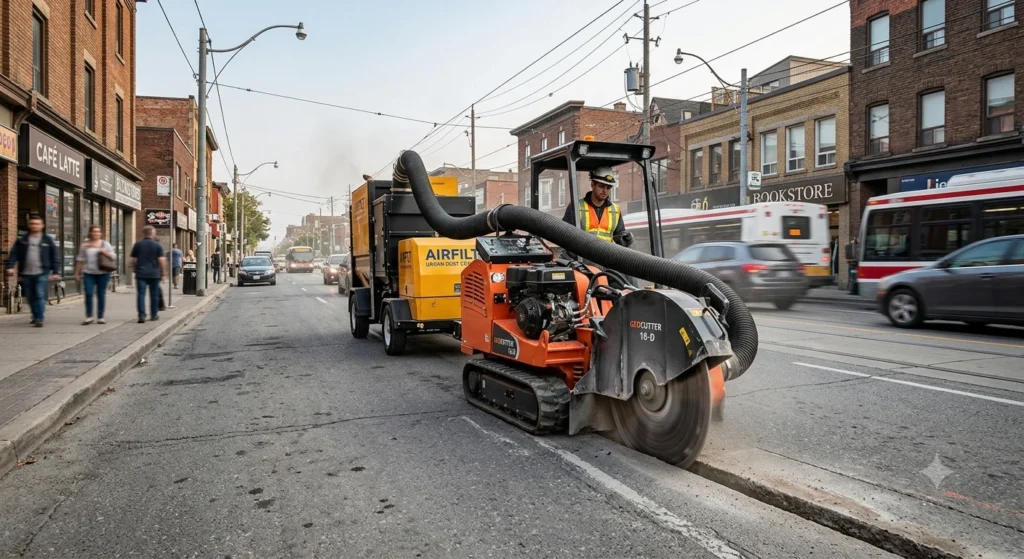
Microtrenching uses narrow saw cuts in roads or sidewalks.
Typical specifications include:
- Width: 1–2 inches
- Depth: 4–16 inches
Benefits include:
- Faster deployment
- Lower restoration costs
- Minimal traffic disruption
- Ideal for dense urban areas
Horizontal Directional Drilling (HDD)
Horizontal Directional Drilling is a trenchless method used beneath:
- Highways
- Railways
- Rivers
- Buildings
- Protected landscapes
Advantages include:
- Minimal surface disturbance
- Faster permitting
- Reduced environmental impact
- Excellent for congested utility corridors
Pre-Construction Planning
Successful fiber installation begins before excavation.
Route Planning
Engineers use Geographic Information Systems (GIS) to design the most efficient cable route while avoiding:
- Existing utilities
- Buildings
- Trees
- Drainage systems
- Future construction zones
Proper planning reduces project costs and installation risks.
Utility Location
Before digging, contractors should contact local utility locating services to identify underground infrastructure such as:
- Gas pipelines
- Water lines
- Sewer systems
- Electrical cables
- Existing telecommunications cables
Accurate utility mapping helps prevent accidental damage and costly delays.
Soil Assessment
Different soil types require different trenching techniques.
| Soil Type | Installation Consideration |
|---|---|
| Clay | Stable but difficult to excavate |
| Sand | Requires additional bedding |
| Rock | May need rock saws or concrete protection |
| Cobble | Requires wider trench preparation |
Engineers should also evaluate:
- Frost depth
- Water table
- Drainage conditions
- Ground stability
Choosing the Right Cable
Several cable types are commonly used.
Loose Tube Cable
Best for:
- Long-distance outdoor networks
- Moisture resistance
- Backbone installations
Armored Fiber Cable
Provides additional protection against:
- Rodents
- Construction equipment
- Heavy loads
Ribbon Fiber Cable
Ideal for:
- High-density data centers
- Large telecommunications networks
- Fast mass fusion splicing
Conduit vs Direct Burial
Direct Burial
The cable is placed directly into the trench.
Advantages:
- Lower installation cost
- Faster deployment
- Fewer materials
Disadvantages:
- More difficult repairs
- Limited upgrade flexibility
Conduit Installation
Fiber cables are installed inside HDPE or PVC conduits.
Advantages:
- Easy cable replacement
- Better physical protection
- Future expansion capability
- Lower maintenance costs
Although conduit installation has a higher upfront cost, it generally provides better long-term value.
Fiber Optic Trenching Best Practices
Proper trench construction includes:
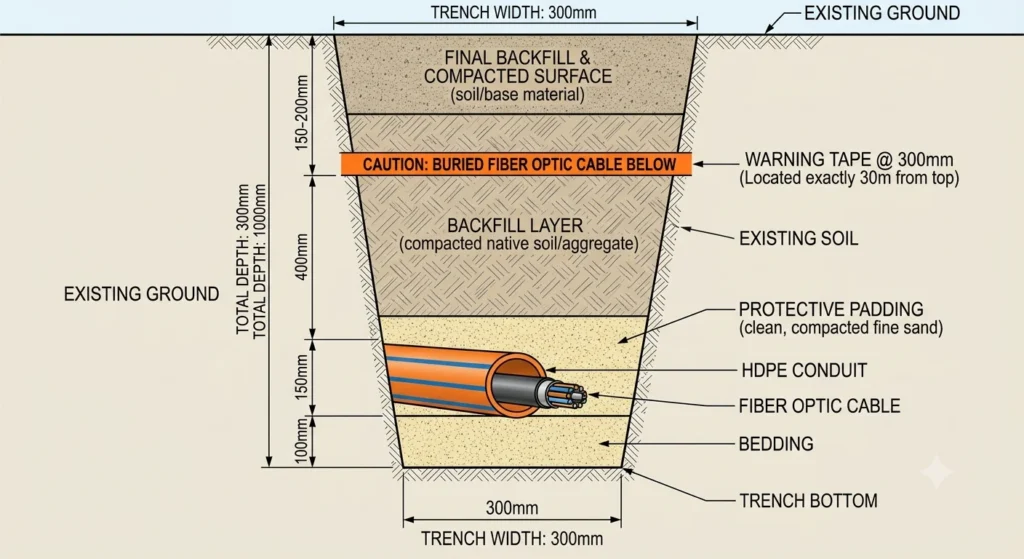
- Level trench bottom
- Remove sharp rocks
- Install granular bedding
- Maintain consistent trench depth
- Avoid excessive bends
- Protect cables during backfill
These practices significantly reduce cable stress and future failures.
Recommended Fiber Optic Burial Depth
Burial depth depends on installation type and local regulations.
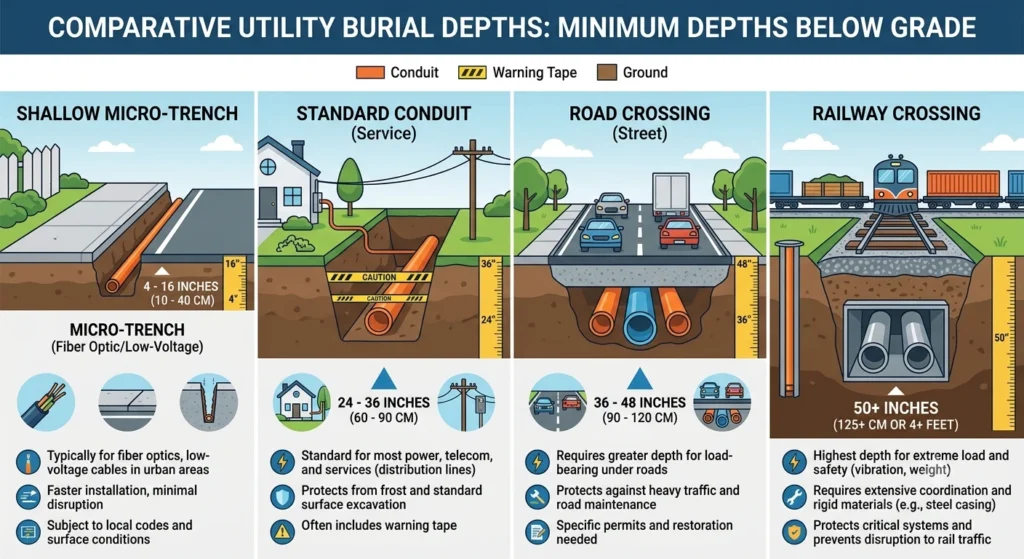
| Installation | Recommended Depth |
|---|---|
| Direct burial | 24–36 inches (60–90 cm) |
| Standard trench | 1.2–1.65 meters |
| Road crossings | 0.8–1.5 meters |
| Agricultural land | 24–48 inches |
Rocky terrain often requires additional protection such as concrete slabs or armored conduit.
Cable Protection Methods
Reliable underground installations use several protective measures.
Granular Bedding
Fine sand or screened soil cushions the cable against sharp rocks.
Warning Tape
Detectable warning tape is typically installed about 300 mm below the surface to alert future excavators.
Concrete Encasement
Concrete is commonly used where burial depth cannot meet minimum standards or where heavy traffic creates additional risk.
Armored Cable
Steel-armored fiber provides enhanced protection against mechanical damage and rodents.
Cable Pulling Best Practices
Proper cable installation prevents hidden damage.
Recommended guidelines include:
- Use cable payoff stands
- Monitor pulling tension
- Control bend radius
- Use pulling lubricant
- Install swivels to prevent twisting
- Maintain steady pulling speed
Ignoring manufacturer specifications can permanently damage optical fibers before the network becomes operational.
Testing After Installation
Every fiber installation should be tested before acceptance.
Common testing methods include:
- OTDR testing
- Optical power meter testing
- Light source testing
- End-to-end attenuation measurement
These tests verify splice quality, connector performance, and overall cable integrity.
Worker Safety
Fiber optic trenching involves significant construction hazards.
Safety measures include:
- Proper trench shoring
- Traffic control barriers
- Personal protective equipment (PPE)
- Dust suppression
- Equipment inspections
- Safe lifting procedures
Workers should never enter unsupported trenches deeper than regulatory limits.
Environmental Considerations
Responsible contractors minimize environmental impact by:
- Controlling erosion
- Managing water runoff
- Restoring disturbed surfaces
- Recycling excavation materials where possible
- Protecting nearby vegetation
Proper site restoration improves community acceptance and regulatory compliance.
Future Trends in Fiber Optic Trenching
The telecommunications industry continues to adopt faster and more efficient installation technologies.
Emerging trends include:
- AI-assisted route planning
- Smart GIS mapping
- Robotic trenching systems
- Increased microtrenching adoption
- Expanded trenchless drilling
- High-capacity ribbon fiber deployment
These innovations reduce construction costs while accelerating broadband expansion.
Frequently Asked Questions
How deep should fiber optic cable be buried?
Most direct burial installations require 24–36 inches (60–90 cm) of cover, although local regulations and environmental conditions may require greater depths.
Is conduit better than direct burial?
Yes. Conduit offers better protection, simplifies future cable replacement, and reduces long-term maintenance costs.
What is microtrenching?
Microtrenching is a narrow, shallow cutting technique used primarily in urban environments to install fiber with minimal disruption.
Why is OTDR testing important?
An Optical Time Domain Reflectometer (OTDR) identifies splice losses, connector issues, and cable faults before the network enters service.
Conclusion
Fiber optic trenching is far more than simply digging a trench—it is a carefully engineered process that determines the reliability, longevity, and performance of underground communication networks. From route planning and soil analysis to selecting the correct installation method, maintaining proper burial depths, protecting cables, and conducting comprehensive post-installation testing, every step contributes to a resilient fiber infrastructure.
Whether you choose traditional open-cut trenching, microtrenching, or horizontal directional drilling, following industry best practices helps minimize downtime, reduce maintenance costs, and extend network life for decades. As broadband demand continues to grow worldwide, investing in quality trenching and installation practices remains one of the most effective ways to build scalable, future-ready fiber optic networks.

Ahmed Ijaz runs this construction rental directory with over 5 years of experience in SEO, content, and web optimization. Every page is built using real research, hands-on expertise, and carefully reviewed information to meet strong EEAT standards.