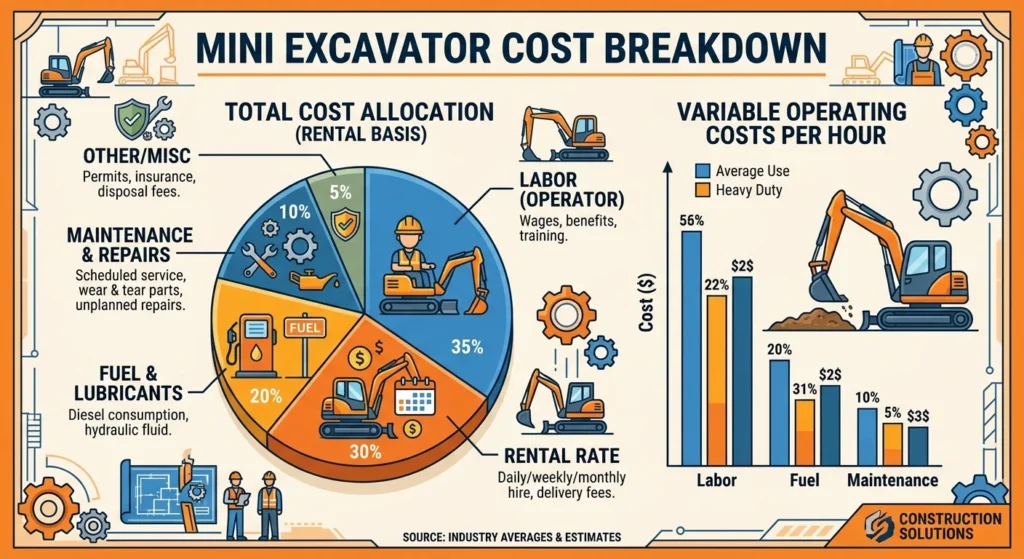
A mini excavator typically costs $30–$110+ per hour, depending on the machine size, rental arrangement, location, operator, attachments, and whether you rent or own the equipment.
A mini excavator typically costs $30–$60 per hour to rent, while a machine with an operator may cost $70–$110+ per hour. Your actual cost can be higher after adding fuel, delivery, attachments, insurance, and other fees.
Fuel, delivery, pickup, maintenance, insurance, attachments, operator labor, depreciation, and resale value can all change your actual cost per productive hour.
Mini Excavator Cost Per Hour : Quick Breakdown
| Cost factor | Indicative cost |
|---|---|
| Mini excavator rental | $30–$60/hour |
| Mini excavator with operator | $70–$110+/hour |
| Daily rental | $197–$416/day |
| Micro 0.8-ton fuel use | 1–2 L/hour |
| 3-ton fuel use | 4–5 L/hour |
| Fuel budget | $50–$150/day |
| Annual servicing | $2,000–$4,500 |
| Track replacement | $3,000–$8,000 |
Important: These figures are planning ranges based on the supplied outline. Actual prices vary significantly by market, machine, rental company, project conditions, fuel prices, and equipment availability.
What Determines the Cost of a Mini Excavator?
The total cost of a mini excavator depends on the rental rate, machine size, operator labor, fuel, attachments, transportation, maintenance, insurance, and—if you own the equipment—depreciation and financing.
A useful way to think about the total cost is:
True hourly cost = equipment cost + fuel + labor + maintenance + attachments + transportation + insurance + other applicable expenses
This calculation is more useful for project budgeting than looking at the rental company’s advertised hourly rate alone.
Mini Excavator Rental Cost Per Hour
Mini excavator rental rates typically range from $30–$60 per hour.
A machine supplied with an operator can cost approximately $70–$110+ per hour.
Rental companies may not always quote an hourly price. Instead, they may use daily, weekly, or monthly rates.
Typical Mini Excavator Rental Rates
| Rental arrangement | Indicative cost |
|---|---|
| Hourly machine rental | $30–$60/hour |
| Machine with operator | $70–$110+/hour |
| Daily rental | $197–$416/day |
The wide weekly range demonstrates why you should compare like-for-like equipment. A micro excavator and a larger 5-ton mini excavator are not directly comparable.
Rental pricing can also depend on:
- Machine operating weight
- Digging depth
- Engine type
- Brand and model
- Local demand
- Rental duration
- Attachments
- Delivery distance
- Insurance requirements
- Seasonal availability
How Much Does a Mini Excavator Cost With an Operator?
Hiring a mini excavator with an operator can cost approximately $70–$110+ per hour.
Although this is more expensive than renting the machine alone, an experienced operator can improve productivity and reduce the risk of damage.
An experienced operator can improve productivity, reduce idle time, use attachments efficiently, and lower the risk of equipment or property damage.
For a project with a tight deadline, paying for an experienced operator may actually reduce the total project cost, even if the hourly rate is higher.
Mini Excavator Ownership Costs
Buying a mini excavator changes the calculation completely.
Instead of paying only a rental rate, an owner must account for the machine’s entire lifecycle.
Ownership costs include:
- Purchase price
- Financing
- Interest
- Depreciation
- Insurance
- Warranty
- Fuel
- Maintenance
- Repairs
- Storage
- Transportation
- Attachments
- Resale value
The purchase price alone does not tell you whether owning is economical.
Depreciation and Resale Value
Depreciation is one of the most important ownership costs.
A machine purchased for $60,000 does not necessarily cost $60,000 to own if it can later be sold for $30,000.
A simplified capital-cost calculation is:
Purchase price − resale value = net depreciation
For example:
$60,000 − $30,000 = $30,000
If the excavator produces 1,000 productive hours during its ownership period:
$30,000 ÷ 1,000 = $30 per productive hour
This is only the depreciation component. Fuel, maintenance, insurance, financing, and other costs still need to be added.
Mini Excavator Fuel Cost Per Hour
Fuel consumption varies considerably according to machine size and workload.
A micro excavator around 0.8 tons may consume approximately 1–2 liters per hour.
A 3-ton machine may use approximately 4–5 liters per hour.
Actual consumption depends on:
- Engine size
- Excavation depth
- Soil conditions
- Hydraulic load
- Operator technique
- Idle time
- Attachment
- Digging versus grading
- Machine maintenance
How to Calculate Fuel Cost?
Use this formula:
Hourly fuel cost = fuel consumption per hour × fuel price per liter
For example, if a machine consumes 4 liters per hour and diesel costs $1.75 per liter:
4 × $1.75 = $7/hour
Over an eight-hour workday:
$7 × 8 = $56/day
The supplied planning range of $50–$150 per day illustrates how fuel expenses can vary depending on machine size, fuel prices, and workload.
Mini Excavator Maintenance Costs
Routine maintenance includes oil and filter changes, hydraulic-system checks, greasing, track inspection, and other manufacturer-recommended services. A general planning figure is $2,000–$4,500 per year, although actual costs vary by machine, usage, age, and repairs.
Track Replacement Costs
Tracks are wear components and can become a significant long-term expense.
The supplied planning range for track replacement is approximately $3,000–$8,000.
Track life depends on:
- Ground conditions
- Operating technique
- Machine weight
- Track quality
- Tension
- Turning practices
- Frequency of use
Operating continuously on abrasive surfaces can accelerate undercarriage wear.
Preventive maintenance can help extend track and undercarriage life and reduce unexpected downtime.
Mini Excavator Cost by Machine Size
Machine size has a direct impact on both rental price and operating cost.
| Size | Typical Applications |
|---|---|
| 0.8 ton | Backyard work, landscaping, narrow access |
| 1–2 tons | Residential excavation, drainage, utility trenches |
| 3–6 tons | Construction, deeper excavation, site preparation |
The cheapest machine is not always the most economical. If a machine is too small, additional operating hours can outweigh its lower rental rate.
Mini excavators are especially popular for residential backyard work, such as managing pool excavation costs in tight, confined spaces.
Mini Excavator Attachment Costs
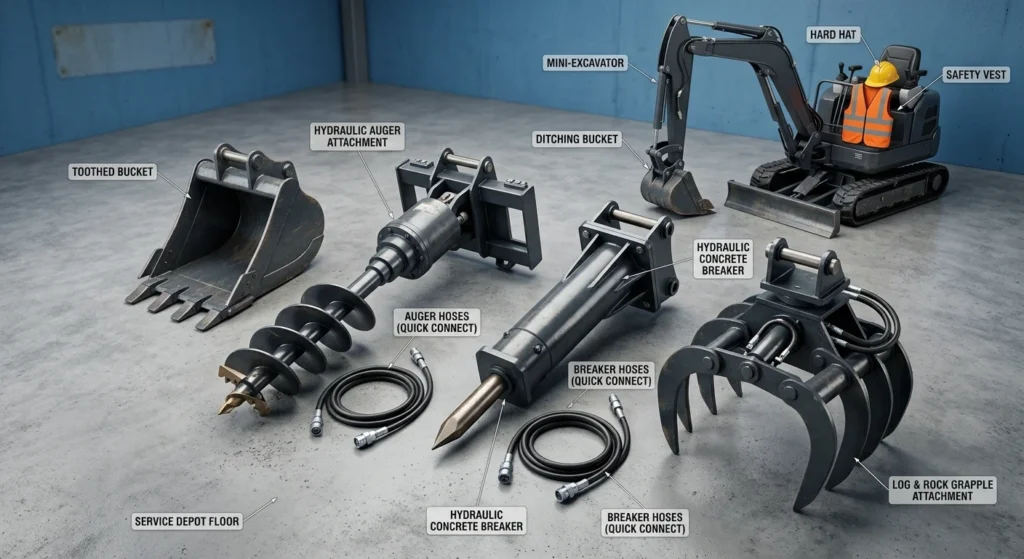
Attachments can significantly affect the final project price.
Common attachments include buckets, hydraulic breakers, augers, grapples, tilt buckets, and compaction wheels. Standard buckets may be included, while specialized attachments often cost extra.
“Which attachments are included in the quoted rate?”
Rent or Buy a Mini Excavator?
| Rent | Buy |
|---|---|
| One-time projects | Frequent excavation |
| Few days of use | Regular use |
| No storage required | Storage available |
| No depreciation risk | Resale value |
| Lower upfront cost | Higher upfront investment |
Total Cost of Ownership Formula
A basic mini excavator total-cost-of-ownership calculation is:
TCO = purchase price + financing + insurance + maintenance + repairs + fuel + storage + transportation − resale value
To determine the hourly ownership cost:
Hourly ownership cost = TCO ÷ productive operating hours
A more detailed calculation can separate fixed and variable expenses:
Hourly cost = fixed ownership costs ÷ productive hours + variable operating costs per hour
This approach gives you a much more realistic comparison against rental rates.
Cost-Saving Strategies for Mini Excavator Owners and Renters
1. Choose the Correct Machine
Do not pay for a 5-ton excavator when a 1.5-ton machine can efficiently complete the job.
Conversely, avoid choosing an undersized machine that takes twice as long.
2. Plan the Site Before Excavation
Identify:
- Access points
- Utility locations
- Spoil areas
- Digging zones
- Material storage
- Machine parking
- Attachment requirements
Good planning reduces idle time and unnecessary movement.
3. Minimize Idling
An excavator that runs without performing productive work still consumes fuel and accumulates engine hours.
4. Compare All-In Rental Prices
Ask rental companies to provide:
- Equipment cost
- Delivery
- Pickup
- Fuel requirements
- Insurance
- Attachments
- Overtime charges
- Damage terms
Compare the complete quote rather than the advertised base rate.
Frequently Asked Questions
How much does it cost to rent a mini excavator for a day?
A general planning range is approximately $197–$416 per day. Actual prices depend on machine size, location, rental duration, attachments, demand, and rental-company policies.
Is it cheaper to rent or buy a mini excavator?
For occasional projects, renting is usually simpler and can be more economical because you avoid depreciation, storage, maintenance, insurance, and financing. Buying can make financial sense for contractors with frequent and predictable equipment use.
How much fuel does a mini excavator use per hour?
A micro excavator around 0.8 tons may consume approximately 1–2 liters per hour, while a 3-ton excavator may consume approximately 4–5 liters per hour. Actual consumption varies according to workload, machine condition, engine, operator, and site conditions.
Do I need a license to operate a mini excavator?
Requirements vary by jurisdiction, employer, project, and worksite. Some applications require specific training or certification, while requirements differ for private and commercial work. Check the regulations applicable to your location before operating the machine.
What size mini excavator do I need for my project?
Consider access width, digging depth, soil conditions, lifting requirements, operating weight, attachment requirements, and project size. Micro excavators work well in tight residential spaces, while 3–6-ton machines provide greater capacity for demanding excavation and site-preparation work.
What is the cheapest way to rent a mini excavator?
Compare the total rental package, not just the hourly rate. Ask multiple rental companies about daily or weekly pricing, delivery, pickup, fuel, insurance, attachments, and minimum rental periods.
Final Answer: Mini Excavator Cost Per Hour
A mini excavator typically costs $30–$60 per hour to rent, while a machine with an operator may cost $70–$110+ per hour.
Your actual cost can increase with fuel, delivery, attachments, insurance, and other rental fees. For occasional projects, renting is usually the practical choice. Contractors with frequent excavation work may save money by owning a machine when they can generate enough productive hours to spread ownership costs.ductive hours are generated to spread fixed ownership costs.

Ahmed Ijaz runs this construction rental directory with over 5 years of experience in SEO, content, and web optimization. Every page is built using real research, hands-on expertise, and carefully reviewed information to meet strong EEAT standards.