Selecting the right trencher can make or break your excavation project.
Whether you’re installing utility lines, laying pipelines, building irrigation systems, or preparing fiber optic cable routes, choosing between a chain trencher and a wheel trencher directly impacts productivity, operating costs, and project completion time.
Many contractors make the mistake of selecting equipment based solely on price without considering soil conditions, trench dimensions and terrain. The result is slower excavation, excessive wear on the machine, higher maintenance costs, and unnecessary downtime.
What is a Chain Trencher?
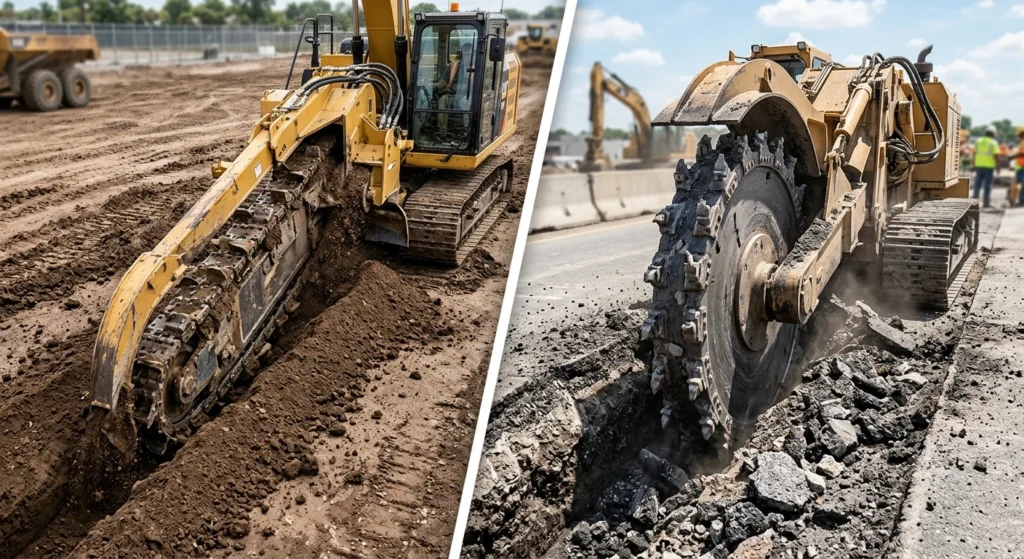
A chain trencher is a trenching machine equipped with a continuous digging chain mounted around a long boom. It operates similarly to an oversized chainsaw, with hardened digging teeth cutting through the soil as the machine slowly advances.
Chain trenchers are widely used across construction, agriculture, utility installation, landscaping, and infrastructure development because they create clean, narrow, and deep trenches efficiently.
How Does a Chain Trencher Work?
The operator lowers the boom to the required trench depth before moving the machine forward. As the digging chain rotates around the boom, its teeth continuously remove soil and transport it away from the trench.
Unlike bucket excavators, chain trenchers create consistent trench widths while maintaining accurate depths throughout the excavation.
Key Features
- Creates deep and narrow trenches
- Adjustable trench depth
- Available with different chain configurations
- Efficient soil removal
- High accuracy during trenching
Typical Specifications
| Feature | Chain Trencher |
|---|---|
| Trench Depth | 24–48 inches (or deeper on larger models) |
| Trench Width | 4–12 inches |
| Best Soil Type | Clay, sand, loam, compact soil |
| Speed | High in soft ground |
Best Applications
Chain trenchers are ideal for:
- Water pipeline installation
- Gas pipeline construction
- Sewer line excavation
- Electrical cable installation
- Telecommunications infrastructure
- Irrigation systems
- Drainage projects
- Agricultural trenching
Because they excel in soft and medium-density soils, chain trenchers remain the preferred choice for most utility contractors.
What is a Wheel Trencher?
A wheel trencher, often called a rockwheel trencher, uses a large circular metal wheel fitted with carbide or hardened steel teeth. Instead of scraping soil like a chain, the rotating wheel grinds and cuts through the ground much like an industrial circular saw.
Wheel trenchers are engineered for demanding environments where chain trenchers struggle, especially in rocky terrain, asphalt, pavement, and concrete.
How Does a Wheel Trencher Work?
The rotating cutting wheel penetrates the ground while the machine advances. The teeth break apart hard materials, removing spoil from the trench as the wheel continues rotating.
Its design allows consistent cutting even in mixed ground conditions containing rock and compact materials.
Key Features
- Powerful rock-cutting capability
- Faster excavation in hard ground
- Lower wear in rocky terrain
- Replaceable carbide teeth
- Excellent cutting precision
Typical Specifications
| Feature | Wheel Trencher |
|---|---|
| Trench Depth | 12–36 inches |
| Trench Width | Adjustable |
| Best Soil Type | Rock, asphalt, pavement, concrete |
| Speed | High in hard ground |
Best Applications
Wheel trenchers are commonly used for:
- Road maintenance
- Utility repair beneath pavement
- Fiber optic installations
- Municipal infrastructure
- Oil and gas pipelines
- Rocky construction sites
- Highway utility work
Chain Trencher vs Wheel Trencher
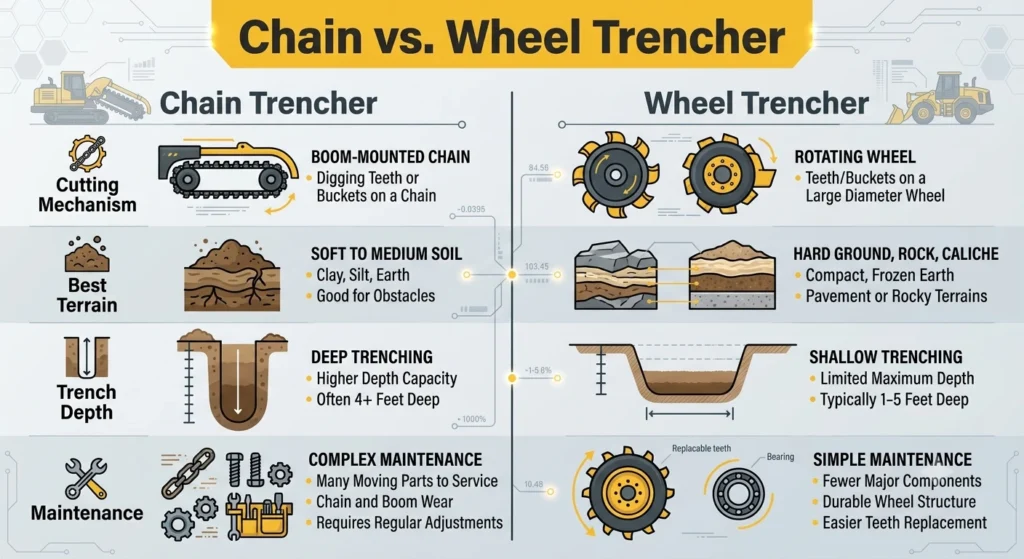
Although both machines perform trench excavation, their designs make them suitable for very different working environments.
1. Cutting Mechanism
Chain Trencher
Uses a rotating digging chain wrapped around a boom. The chain continuously scrapes and removes soil.
Best for:
- Soft soils
- Clay
- Sand
- Loam
Wheel Trencher
Uses a rotating steel wheel with carbide teeth that grinds through the ground.
Best for:
- Rock
- Asphalt
- Concrete
- Mixed terrain
Winner: Depends on soil conditions.
2. Soil Compatibility
This is the biggest deciding factor.
Chain Trencher Performs Best In
- Sandy soil
- Clay
- Loam
- Agricultural land
- Moderately compacted earth
Wheel Trencher Excels In
- Rocky terrain
- Frozen ground
- Asphalt roads
- Concrete surfaces
- Gravel
Winner: Wheel trencher for hard ground.
3. Trench Depth
Chain trenchers are specifically designed to dig deeper trenches.
Chain Trencher
- 24–48 inches
- Larger industrial models exceed 60 inches
Wheel Trencher
- Usually 12–36 inches
- Better suited for shallow excavation
Winner: Chain trencher
4. Trench Width
Chain trenchers typically produce narrower trenches, reducing backfill requirements.
Wheel trenchers can create wider trenches by changing wheel configurations.
Winner: Depends on project requirements.
5. Excavation Speed
Performance changes depending on ground conditions.
In Soft Soil
Chain trenchers work faster because the digging chain easily cuts through loose material.
In Rock
Wheel trenchers outperform chain trenchers significantly.
Winner:
- Soft soil → Chain trencher
- Hard ground → Wheel trencher
6. Productivity
For long-distance utility installations across farmland or open terrain, chain trenchers maintain excellent productivity.
For municipal roadwork and pavement cutting, wheel trenchers complete jobs more efficiently.
7. Operating Costs
Operating expenses include:
- Fuel
- Teeth replacement
- Wear parts
- Maintenance
- Downtime
Chain Trencher Costs
Higher wear occurs in rocky conditions, increasing replacement costs for chains, sprockets, and drive components.
Wheel Trencher Costs
Replaceable carbide teeth generally reduce maintenance complexity and extend service life in hard materials.
Winner: Wheel trencher in rocky terrain.
8. Maintenance
Chain Trencher Maintenance
Requires regular inspection of:
- Chain tension
- Sprockets
- Boom
- Bearings
- Drive system
Wheel Trencher Maintenance
Maintenance focuses on:
- Cutting teeth
- Wheel bearings
- Hydraulic systems
Teeth replacement is typically faster and simpler.
Winner: Wheel trencher
9. Terrain Adaptability
Chain trenchers allow operators to continuously adjust boom depth during excavation.
Wheel trenchers maintain a consistent cutting angle, making them effective on uneven or rocky ground.
Chain Trencher vs Wheel Trencher Comparison Table
| Feature | Chain Trencher | Wheel Trencher |
|---|---|---|
| Cutting Mechanism | Rotating chain | Rotating steel wheel |
| Best Soil | Soft soil | Hard ground |
| Rock Performance | Moderate | Excellent |
| Trench Depth | Deep | Moderate |
| Trench Width | Narrow | Adjustable |
| Speed in Soft Soil | Excellent | Good |
| Speed in Rock | Poor | Excellent |
| Maintenance | Higher | Lower |
| Operating Cost | Moderate to High | Lower in hard terrain |
| Best Applications | Utilities, irrigation, drainage | Roads, pavement, rocky excavation |
Applications of Chain and Wheel Trenchers
Utility Installation
Chain trenchers are widely used for:
- Water lines
- Gas pipelines
- Sewer systems
- Electrical conduits
Pipeline Projects
Large pipeline installations often use:
- Chain trenchers for farmland
- Wheel trenchers for mountainous terrain
Irrigation Systems
Agricultural irrigation projects typically favor chain trenchers because they create long, narrow trenches efficiently.
Drainage Construction
Drainage contractors rely on chain trenchers for installing drainage pipes across fields and landscapes.
Road Construction
Wheel trenchers dominate road maintenance because they cut through asphalt and concrete with ease.
Fiber Optic Installation
Urban fiber optic projects frequently use micro trenchers, a specialized type of wheel trencher, to cut narrow channels in pavement with minimal disruption.
How to Choose the Right Trencher?
Selecting the right equipment depends on project conditions rather than upfront purchase price.
Choose a Chain Trencher If:
- You are working in soft or medium soil.
- Deep trenches are required.
- Utility lines need long, continuous excavation.
- Irrigation or drainage systems are being installed.
- Agricultural trenching is the primary application.
Choose a Wheel Trencher If:
- The ground contains rock or gravel.
- Asphalt or concrete must be cut.
- Road maintenance is involved.
- High-speed trenching is required in hard materials.
- You need lower wear in demanding terrain.
Consider a Micro Trencher If:
- Installing fiber optic cables in urban areas.
- Working on city streets.
- Minimizing traffic disruption is important.
- Narrow pavement cuts are required.
Market Trends
Chain trenchers continue to hold a significant share of the trenching equipment market due to their versatility across construction, agriculture, utility installation, and infrastructure projects.
However, increasing investments in telecommunications, renewable energy, highway expansion, and underground utility upgrades have boosted demand for wheel trenchers and micro trenchers, particularly for urban and rocky environments.
Modern manufacturers are also introducing GPS guidance, automated depth control, telematics, and more durable carbide cutting systems to improve efficiency and reduce operating costs.
Final Verdict: Which Trencher Should You Choose?
There is no universal winner in the chain trencher vs wheel trencher debate. The best choice depends entirely on your project’s soil conditions, required trench depth, and application.
If your work primarily involves soft soil, deep utility trenches, irrigation systems, or agricultural projects, a chain trencher delivers superior depth, precision, and efficiency.
If you’re excavating through rock, asphalt, concrete, or mixed terrain, a wheel trencher offers faster cutting speeds, lower wear, and better long-term operating costs.
Before making a purchase or rental decision, evaluate:
- Soil composition
- Trench depth
- Trench width
- Terrain conditions
- Project duration
- Maintenance budget
- Equipment operating costs
Choosing the right trencher based on these factors will maximize productivity, reduce downtime, and help keep your project on schedule and within budget.
Frequently Asked Questions
Which is cheaper: a wheel trencher or a chain trencher?
Chain trenchers often have a lower initial purchase price, but wheel trenchers can be more cost-effective over time in rocky conditions because they generally experience less wear and have simpler tooth replacement.
Can a chain trencher cut through rock?
A chain trencher can handle moderately compacted ground and some rock with specialized chains, but it is not the best option for extensive rock excavation. A wheel trencher is specifically designed for cutting through rock, asphalt, and concrete.
What type of trencher is best for fiber optic cable installation?
For urban fiber optic projects, a micro trencher (a specialized wheel trencher) is typically the best choice because it creates narrow, precise cuts in pavement with minimal disruption. For rural installations in soft soil, a chain trencher is often more suitable.
Which trencher is faster?
It depends on the ground conditions. Chain trenchers are generally faster in soft soil, while wheel trenchers outperform them in hard ground, rocky terrain, and pavement.
Is a chain trencher better for deep trenches?
Yes. Chain trenchers are designed to excavate deeper, narrow trenches, making them the preferred option for utility lines, pipelines, drainage systems, and irrigation projects.
Can a wheel trencher be used on soft soil?
Yes, but it is not always the most efficient choice. Wheel trenchers can work in soft soil, though chain trenchers usually provide better productivity and lower operating costs in these conditions.

Ahmed Ijaz runs this construction rental directory with over 5 years of experience in SEO, content, and web optimization. Every page is built using real research, hands-on expertise, and carefully reviewed information to meet strong EEAT standards.