
What size generator do I need? It’s one of the most common questions homeowners, RV owners, contractors, and business operators ask when preparing for power outages or remote power needs.
Choosing the right generator size is critical. An undersized generator can overload, trip breakers, damage equipment, and fail when you need it most. An oversized generator can cost significantly more upfront, waste fuel, and operate inefficiently.
This comprehensive guide explains exactly how to determine the correct generator capacity for your situation. We’ll cover generator sizing methodology, wattage calculation, running watts vs. starting watts, fuel considerations, appliance power requirements, and recommended generator sizes for homes, RVs, job sites, and commercial facilities.
Whether you’re planning for emergency preparedness, home backup power, RV camping, or construction work, this guide draws on industry best practices used by leading manufacturers, electricians, and major home improvement experts.
Understanding the Basics: Electrical Terms You Need to Know
Before calculating generator capacity, it’s important to understand the electrical terms involved in generator sizing.
What Is Wattage?
A watt (W) measures electrical power. Every appliance, tool, or device requires a specific number of watts to operate.
A simple analogy:
- Watts = Water Flow
- Volts = Water Pressure
- Amps = Pipe Size
The higher the wattage requirement, the larger the generator you’ll need.
Generator Size Explained
When people ask, “What size generator do I need?” they’re really asking:
How many watts of electrical power must my generator produce?
Generator size is measured by its wattage output or power capacity.
Running Watts vs. Starting Watts
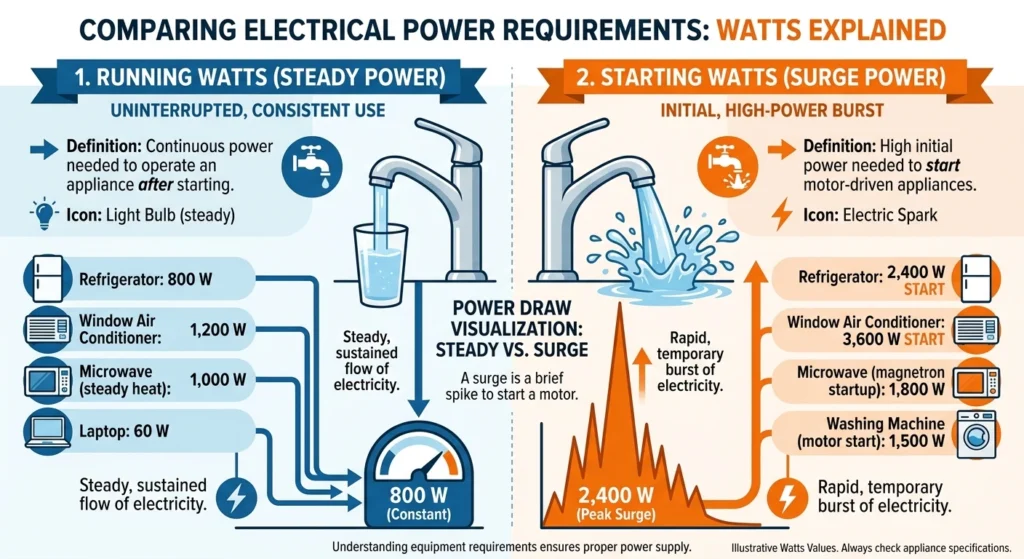
Understanding this distinction is the most important part of generator sizing.
Running Watts (Rated Watts)
Running watts represent the continuous power required to keep an appliance operating.
Examples:
- Refrigerator running: 150-400W
- TV: 120-400W
- Laptop: 50-250W
Starting Watts (Surge Watts)
Many appliances with electric motors require an extra burst of power during startup.
Starting watts can be:
- 2x running watts
- 3x running watts
- 5x running watts
- Up to 7x running watts
Examples:
| Appliance | Running Watts | Starting Watts |
|---|---|---|
| Refrigerator | 150-400W | 800-1,200W |
| Window AC | 900-1,500W | 1,800-3,600W |
| Well Pump | 900W | 2,700W |
Ignoring startup surges is one of the most common generator sizing mistakes.
Volts, Amps, and Watts
The basic electrical formula:
Volts × Amps = Watts
Example:
120V appliance drawing 10 amps:
120 × 10 = 1,200 watts
Common Household Voltages
120V Appliances
- TVs
- Microwaves
- Refrigerators
- Computers
- Lighting
240V Appliances
- Electric dryers
- Well pumps
- Central HVAC systems
- Electric water heaters
If you need to power 240V equipment, your generator must provide 240V output.
kW vs. kVA
Commercial generators are often rated in kVA.
Formula
kVA × Power Factor = kW
Typical commercial power factor:
0.8
Example:
100 kVA generator:
100 × 0.8 = 80 kW
Convert kW to kVA
kVA = kW ÷ Power Factor
Example:
80 kW load:
80 ÷ 0.8 = 100 kVA
Residential users typically focus on watts and kilowatts, while commercial facilities often use kVA ratings.
Step-by-Step: How to Calculate the Right Generator Size
Follow this process to accurately answer:
“What size generator do I need?”
Step 1: List Everything You Want to Power
Create a complete inventory of devices that may run simultaneously.
Home Backup Examples
- Refrigerator
- Freezer
- Furnace fan
- Sump pump
- Well pump
- Wi-Fi router
- Television
- Lights
- Microwave
- Medical devices
RV Examples
- Air conditioner
- Refrigerator
- Coffee maker
- Microwave
- Device chargers
- Interior lights
Job Site Examples
- Circular saw
- Air compressor
- Welder
- Battery chargers
- Work lights
Missing even one major appliance can result in an undersized generator.
Step 2: Find the Wattage of Each Item
Method 1: Check the Appliance Label
Most equipment includes:
- Wattage
- Voltage
- Amperage
Method 2: Use the Formula
If only volts and amps are listed:
Volts × Amps = Watts
Example:
120V × 8A = 960W
Method 3: Use a Watt Meter
Plug-in electricity monitors provide accurate real-world measurements.
Method 4: Use Reference Charts
The appliance wattage charts later in this guide provide reliable estimates.
Step 3: Record Running and Starting Watts
Create a worksheet:
| Appliance | Running Watts | Starting Watts |
|---|---|---|
| Refrigerator | 400W | 1,200W |
| Furnace Fan | 800W | 2,000W |
| Lights | 150W | N/A |
Motor-driven equipment requires startup wattage calculations.
Common examples:
- Refrigerators
- Freezers
- Air conditioners
- Pumps
- Compressors
- Furnace blowers
Step 4: Calculate Total Power Requirements
Golden Generator Sizing Formula
Total Running Watts + Highest Starting Wattage = Peak Power Requirement
Example
Running loads:
- Refrigerator = 400W
- Furnace = 800W
- Lights = 300W
- TV = 200W
- Sump Pump = 800W
Total Running Watts:
2,500W
Highest Startup Surge:
1,800W
Peak Requirement:
2,500 + 1,800 = 4,300W
Minimum Generator Needed:
4,300W
Step 5: Add a Safety Margin
Never size a generator at exactly your calculated requirement.
Recommended Buffer
Add:
20% extra capacity
Formula:
Calculated Wattage × 1.20
Example:
4,300W × 1.20 = 5,160W
Recommended generator:
5,500W
Fuel Adjustments
| Fuel Type | Additional Capacity |
|---|---|
| Gasoline | None |
| Propane | Add 10% |
| Natural Gas | Add 10-15% |
Generator Size Recommendations by Use Case
What Size Generator Do I Need for a House?
Home Backup Generator Sizing
| Scenario | Recommended Size | Appliances Covered |
|---|---|---|
| Basic Essentials | 3,000-5,000W | Refrigerator, lights, TV, chargers |
| Medium Backup | 5,000-7,500W | Essentials plus furnace and pumps |
| Large Backup | 7,500-12,500W | Central AC and major appliances |
| Whole House | 10,000-26,000W+ | Entire home |
What Size Generator for a 2000 Sq Ft House?
Most 2,000-square-foot homes require:
- 5,000-7,500W for essentials
- 10,000W+ for central air conditioning
- 15,000-22,000W for whole-house standby coverage
Refrigerator Only
A refrigerator typically requires:
- Running: 150-400W
- Starting: 800-1,200W
A 1,500-2,000W generator is generally sufficient.
What Size Generator for an RV?
RV Generator Sizing Chart
| RV Type | Recommended Size |
|---|---|
| Pop-Up Camper | 2,000-2,400W |
| 30-Amp Camper | 3,500-4,500W |
| Class B Campervan | 2,000-3,600W |
| Class C RV | 2,800-4,000W |
| Class A RV (1 AC) | 5,500-7,000W |
| Class A RV (2+ AC) | 7,000-12,500W |
| 50-Amp RV | 6,000-8,000W+ |
Can a 2000-Watt Generator Run an RV Air Conditioner?
Usually no.
Most rooftop RV air conditioners require:
- Running: 1,300-1,800W
- Starting: 2,800-3,200W+
A 2,000W generator often lacks sufficient startup capacity.
What Size Generator for a 30-Amp Camper?
Formula:
30A × 120V = 3,600W
Recommended:
3,500-4,500W generator
Job Site and Construction Generator Sizing
| Application | Recommended Size |
|---|---|
| Small Job Site | 3,000-6,000W |
| Medium Site | 6,000-10,000W |
| Large Site | 10,000-22,000W+ |
Common Tool Requirements
Circular Saw
- Running: 1,200-1,800W
- Starting: 2,400-3,600W
Air Compressor (2 HP)
- Running: 2,500W
- Starting: 7,500W
Welder
- Running: 2,000W
- Starting: 2,500W
Commercial and Industrial Generator Sizing
| Application | Typical Range |
|---|---|
| Small Retail Store | 30-60kVA |
| Office Building | 100-250kVA |
| Construction Site | 200-500kVA |
| Manufacturing Facility | 500-2000kVA+ |
Three-Phase Formula
kVA = (Voltage × Current × 1.73) ÷ 1000
Always include a 25% growth and safety margin for commercial installations.
Types of Generators and Their Sizing Considerations
Portable Generators
Output Range
1,000-22,000W+
Best For
- Emergency backup
- Job sites
- Camping
Sizing Rule
Calculate load requirements and add 20%.
Inverter Generators
Output Range
1,000-11,000W+
Best For
- Electronics
- RV camping
- Tailgating
Advantages
- Quiet operation
- Fuel efficiency
- Clean sine wave output
Home Standby Generators
Output Range
8,500-26,000W+
Best For
Permanent home backup.
Advantages
- Automatic startup
- Natural gas or propane fuel
- Whole-home integration
Professional load analysis is strongly recommended.
Fuel Type Impact on Generator Size
| Fuel Type | Power Output | Adjustment |
|---|---|---|
| Gasoline | 100% | None |
| Propane | ~90% | Add 10% |
| Natural Gas | 85-90% | Add 10-15% |
Always verify ratings for your intended fuel source.
Generator Wattage Reference Charts
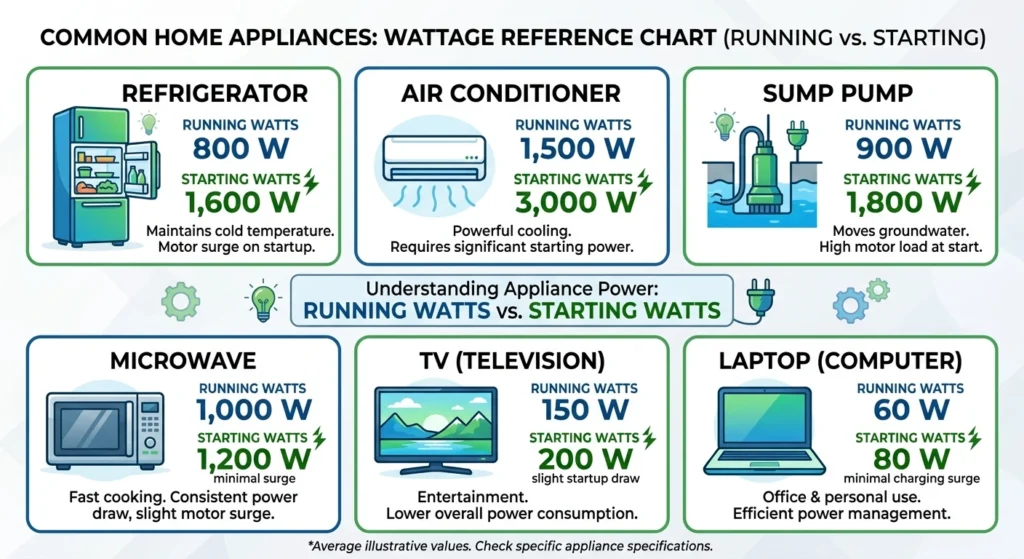
Home Appliances
| Appliance | Running Watts | Starting Watts |
|---|---|---|
| Refrigerator (Energy Star) | 150-400W | 800-1,200W |
| Refrigerator (Standard) | 350-800W | 1,050-2,400W |
| Freezer | 100-500W | 500-1,000W |
| Window AC (10,000 BTU) | 900-1,500W | 1,800-3,600W |
| Central AC (3 Ton) | 3,000-3,500W | 5,000-6,000W |
| Furnace Fan (1/2 HP) | 300-875W | 800-2,350W |
| Sump Pump (1/3 HP) | 800-1,050W | 1,300-2,900W |
| Well Pump (1/2 HP) | 900W | 2,700W |
| Microwave | 600-1,500W | No Surge |
| Electric Water Heater | 4,000-4,500W | No Surge |
| Electric Dryer | 5,400W | 6,750W |
| Television | 120-400W | No Surge |
| LED Bulb | 8-15W | No Surge |
| Laptop | 50-250W | No Surge |
| Wi-Fi Router | 10-30W | No Surge |
RV Appliances
| Appliance | Running Watts | Starting Watts |
|---|---|---|
| 13,500 BTU RV AC | 1,300-1,500W | 2,800-3,200W |
| 15,000 BTU RV AC | 1,500-1,800W | 3,000W+ |
| RV Refrigerator | 150-600W | 400-1,000W |
| Microwave | 1,000-1,500W | Same |
| Coffee Maker | 650-1,750W | Same |
| Hair Dryer | 1,200-1,875W | Same |
Power Tools
| Tool | Running Watts | Starting Watts |
|---|---|---|
| Circular Saw | 1,200-1,800W | 2,400-3,600W |
| Reciprocating Saw | 960W | 960W |
| Drill (3/8″) | 440W | 600W |
| Drill (1/2″) | 600W | 900W |
| Air Compressor (1 HP) | 1,600W | 4,500W |
| Air Compressor (2 HP) | 2,500W | 7,500W |
| Belt Sander | 1,200W | 2,400W |
| Welder | 2,000W | 2,500W |
| Miter Saw | 1,800W | 1,800W |
Critical Safety and Installation Requirements
Carbon Monoxide Safety
Never operate a generator:
- Inside a house
- Inside a garage
- Inside a basement
- Inside a shed
- Under enclosed patios
Place generators at least:
20 feet away from your home
Operate only in well-ventilated areas.
Electrical Safety
Never Backfeed
Do not plug a generator into a wall outlet.
Backfeeding can:
- Electrocute utility workers
- Damage equipment
- Violate electrical codes
Transfer Switches
A transfer switch should be installed by a licensed electrician when connecting a generator to a home’s electrical system.
240V Loads
Large appliances require:
- 240V-capable generator
- Appropriate outlet
- Professional installation
Safe Generator Operation
- Never overload the generator
- Refuel only after cooling
- Avoid overfilling fuel tanks
- Start large motors first
- Monitor voltage and frequency
Special Considerations and Advanced Sizing
Whole-House Energy Monitoring
The most accurate sizing method involves monitoring actual electrical usage.
Methods include:
- Smart energy monitoring systems
- Utility bill analysis
- Clamp-on ammeter measurements
Special Loads
Heat Pumps
- Running: 4,700W
- Starting: 4,500W
Garage Door Opener
- Running: 720W
- Starting: 1,420W
Welding Equipment
Can require 2-4 times running load during startup.
Power Factor and Three-Phase Systems
Formula
kVA Required = kW ÷ Power Factor
Example:
100kW load at 0.8 PF:
100 ÷ 0.8 = 125kVA
Prime vs. Standby Power
Prime Power
Continuous operation as the primary power source.
Standby Power
Emergency backup only.
Standby generators may produce higher output but should not operate continuously at full load.
Environmental Factors
Generator performance can decrease due to:
- High altitude
- Extreme temperatures
- Poor ventilation
Always verify derating specifications for your location.
Frequently Asked Questions
Will a 3500-Watt Generator Run a Refrigerator?
Yes.
Most refrigerators require:
- 150-400W running
- 800-1,200W starting
A 3,500W generator provides ample capacity.
What Size Generator Do I Need for a 2000 Sq Ft House?
Typically:
- 5,000-7,500W for essentials
- 10,000W+ for central air
- 15,000W+ for whole-house backup
What’s the Difference Between Starting Watts and Running Watts?
Running watts power equipment continuously.
Starting watts provide the temporary surge needed to start motors and compressors.
Always size for the highest startup surge.
Do I Need a Transfer Switch for a Portable Generator?
Yes, if connecting it to your home’s electrical system.
Transfer switches prevent dangerous backfeeding and provide safe power routing.
Does Propane or Natural Gas Reduce Generator Output?
Yes.
- Propane: roughly 10% less power
- Natural Gas: roughly 10-15% less power
Increase generator size accordingly.
Will a 2000-Watt Generator Run a Camper Air Conditioner?
Usually no.
Most RV air conditioners need:
- 2,800-3,200W startup power
A larger generator is typically required.
What Size Generator Do I Need for a 30-Amp Camper?
At minimum:
30A × 120V = 3,600W
Recommended:
3,500-4,500W
Final Recommendations
If you’re asking “What size generator do I need?”, the answer starts with a proper load calculation—not guesswork.
Follow this proven generator sizing framework:
- List every device you want to power.
- Find each appliance’s running watts.
- Identify starting watts for motor-driven equipment.
- Add all running watts together.
- Add the highest startup surge.
- Include a 20% safety margin.
- Adjust for propane or natural gas operation.
- Choose a generator that exceeds your final calculated requirement.
Final Generator Sizing Checklist
✅ Created a complete appliance inventory
✅ Found running wattage for each device
✅ Identified starting wattage requirements
✅ Calculated total running watts
✅ Added highest starting surge
✅ Included a 20% safety margin
✅ Adjusted for fuel type
✅ Confirmed generator output capacity
✅ Reviewed transfer switch requirements
✅ Verified safety practices
For whole-home backup systems, healthcare facilities, manufacturing operations, and other critical applications, consult a licensed electrician or generator professional for a detailed load analysis before making a final purchase decision.
If you’re working on a construction site, choosing the right power setup is just as important as selecting equipment like those covered in boom lift rental cost guides. Many machines and tools depend on reliable electricity, so knowing what size generator you need helps prevent overloads, downtime, and wasted fuel. Proper generator sizing ensures your equipment runs smoothly and efficiently throughout the project.

Ahmed Ijaz runs this construction rental directory with over 5 years of experience in SEO, content, and web optimization. Every page is built using real research, hands-on expertise, and carefully reviewed information to meet strong EEAT standards.