If you spend enough time around construction sites, heavy equipment forums, or social media videos, you’ll eventually hear a strange claim: an excavator can “unscrew itself” if it keeps spinning in the same direction. Some people even insist there’s a limit often “16 rotations”before the upper structure supposedly detaches from the tracks below.
It sounds believable at first. After all, excavators rotate continuously, and the top half appears to sit on a giant circular joint. But is there any truth to the myth?
The short answer is No, an excavator cannot unscrew itself through normal rotation. The idea misunderstands how excavators are engineered, how slew bearings work, and how rotational forces are transmitted through the machine. Modern excavators are specifically designed to rotate continuously without loosening or disconnecting the upper structure from the undercarriage.
This article explains where the myth came from, how excavator rotation systems actually function, and why the machine cannot “unscrew” itself no matter how many times it spins.
Structure of an Excavator
To understand why the myth is false, you first need to know how an excavator is built.
An excavator consists of two major sections:
- The undercarriage
- Tracks or wheels
- Travel motors
- Final drives
- Frame and support structure
- The upper structure (house)
- Cab
- Engine
- Hydraulic pumps
- Boom, arm, and bucket
- Counterweight
The upper structure rotates independently of the undercarriage. This rotation allows operators to dig, load, and dump material efficiently without repositioning the tracks every few seconds.
The rotating connection between these two sections is not a threaded connection like a screw or bolt cap. Instead, excavators use a specialized component called a slew bearing or swing bearing.
What Is a Slew Bearing?
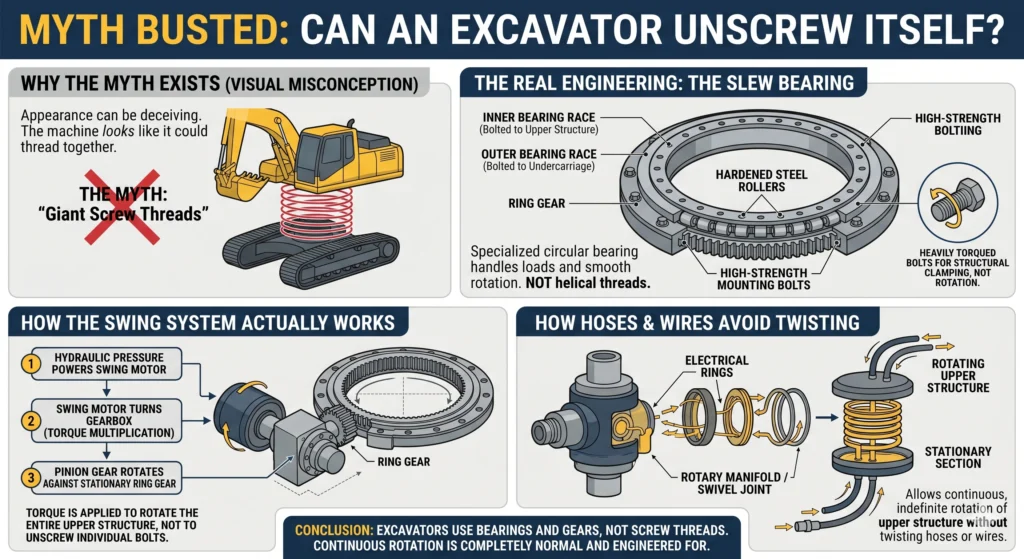
A slew bearing is a massive circular bearing designed to handle enormous loads while allowing smooth rotation.
It typically contains:
- Inner and outer bearing races
- Hardened steel balls or rollers
- A ring gear
- High-strength mounting bolts
One side of the bearing is bolted to the undercarriage, while the other is bolted to the upper structure. The excavator’s swing motor drives a pinion gear that meshes with the ring gear attached to the bearing assembly.
This design creates rotational movement, but there are no giant screw threads involved.
That distinction matters.
A screw converts rotational motion into linear movement because it contains helical threads. Excavators do not use helical threads between the upper and lower structure. They use bearings and gears. Since there are no threaded surfaces to “walk upward” during rotation, there is nothing to unscrew.
How the Swing System Actually Works
The excavator’s rotation comes from the swing drive system.
Here’s the basic process:
- Hydraulic pressure powers the swing motor.
- The swing motor turns a gearbox.
- The gearbox multiplies torque through planetary gears.
- A pinion gear rotates against the stationary ring gear.
- The upper structure rotates around the slew bearing.
The key point is that the swing motor creates torque between the upper structure and the ring gear—not on the mounting bolts themselves.
The bolts holding the slew bearing are heavily torqued and designed to resist vibration, shear forces, and massive operational loads. Their purpose is structural clamping, not rotational movement.
In other words:
- The excavator rotates on bearings.
- The bolts stay fixed.
- The rotational energy never acts like a wrench turning those bolts loose.
That’s why continuous rotation cannot cause the machine to separate from itself.
Where the Myth Came From
The “excavator unscrewing itself” story likely originated from a mix of misunderstandings, operator jokes, and internet exaggeration.
Heavy equipment operators often tell newcomers fictional rules or myths as harmless pranks. Similar myths exist in many industries. One common version claims excavators must rotate in both directions evenly or they’ll “unthread” from the base.
Social media amplified the joke, and eventually many people began treating it as real mechanical advice. Reddit discussions and online forums show that the myth has circulated for years, especially among people unfamiliar with excavator engineering.
The myth became even more convincing because excavators visually resemble giant threaded assemblies. From a distance, the rotating upper body can appear to sit on a large circular screw mechanism.
But appearance and engineering are two very different things.
Why Continuous Rotation Is Completely Normal
Excavators are specifically designed for unrestricted rotational movement.
Operators routinely spin the machine continuously during:
- Trenching
- Loading trucks
- Demolition
- Material handling
- Forestry work
- Dredging operations
If excavators truly unscrewed themselves after repeated rotation, they would be unusable in real-world construction environments.
Instead, manufacturers engineer the swing system to withstand constant rotation under extreme conditions.
Modern excavators include:
- High-strength slew bearings
- Precision-machined ring gears
- Heavy-duty hydraulic swing motors
- Hardened gear teeth
- Specialized lubrication systems
- Locking bolt systems
These components are intended for years of repetitive rotational movement.
What About Hydraulic Lines and Electrical Wiring?
One reason the myth persists is that people wonder how hoses and wires avoid twisting when the excavator spins continuously.
The answer is a clever component called a rotary manifold or swivel joint.
This device allows hydraulic fluid to pass between rotating and stationary sections without tangling hoses. Electrical systems use slip rings or similar rotating connections.
Because of these systems:
- Hydraulic lines do not wrap around themselves
- Electrical connections remain intact
- The machine can rotate indefinitely
This engineering solution eliminates the need for any rotational limit.
Can an Excavator Ever Separate From the Undercarriage?
While excavators cannot unscrew themselves, the upper structure can technically separate from the undercarriage under extreme circumstances but not because of spinning.
Possible causes include:
- Catastrophic slew bearing failure
- Severely loosened mounting bolts
- Structural cracking
- Major collision damage
- Improper maintenance
- Corrosion or fatigue failure
These are mechanical failures, not rotational “unscrewing.”
For example, if slew bearing bolts are improperly torqued or neglected for long periods, they may loosen over time due to vibration and stress. But this is a maintenance issue, not evidence that the excavator rotated itself apart.
The Role of Bolt Preload
Another reason the myth fails mechanically involves bolt preload.
Excavator slew bearings are mounted using extremely high-tension bolts torqued to precise specifications. These bolts clamp the bearing assembly tightly against the machine structure.
When bolts are properly preloaded:
- Friction between surfaces increases dramatically
- Relative movement is minimized
- Vibration resistance improves
- Rotational loosening becomes extremely unlikely
The forces generated during normal excavator operation are distributed across the bearing and frame—not concentrated into a bolt-turning force.
This is basic mechanical engineering.
A rotating excavator body does not act like a wrench on the bolts because the motion occurs within the bearing system itself.
Why the “16 Rotations” Claim Makes No Sense
One popular version of the myth claims an excavator will detach after 16 full rotations in the same direction.
There is no engineering basis for this number.
Excavators are used in applications where operators may rotate hundreds of times daily in one direction. If a fixed rotation limit existed:
- Manufacturers would warn operators clearly
- Machines would include rotation counters
- Construction sites would experience constant failures
None of these things happen.
The “16 rotations” number is simply internet folklore repeated often enough that people assume it must be true.
What Actually Damages the Swing System?
Although excavators cannot unscrew themselves, their swing systems can still experience wear and failure over time.
Common causes include:
Poor lubrication
Insufficient grease can damage the slew bearing and gear teeth.
Shock loading
Aggressive operation or sudden impacts stress the swing drive.
Overloading
Lifting loads beyond capacity increases bearing stress.
Contamination
Dirt and debris accelerate wear.
Improper bolt torque
Loose or uneven bolt tension can damage the bearing assembly.
Hydraulic issues
Low pressure or contaminated fluid can damage the swing motor.
These are genuine maintenance concerns that operators and mechanics monitor carefully.
Why the Myth Refuses to Die
The excavator myth survives because it combines three things people love:
- A machine that looks mysterious
- A mechanical explanation that sounds plausible
- A story that spreads easily online
Once a myth reaches social media, repetition often replaces technical understanding. Many people hear the claim from confident sources and never investigate further.
In reality, excavator engineering is far more sophisticated than the myth suggests.
These machines are designed by teams of mechanical, hydraulic, and structural engineers who account for rotational loads, vibration, torque transfer, and long-term durability. The idea that the entire machine could accidentally “unscrew” through ordinary operation would represent a catastrophic design flaw that manufacturers could never allow.
Final Verdict
No, an excavator cannot unscrew itself.
The machine rotates on a slew bearing system using gears, bearings, and hydraulic motors—not giant screw threads. Continuous rotation does not apply loosening torque to the structural bolts connecting the upper and lower sections. Modern excavators are intentionally engineered for unrestricted rotational movement and routinely spin continuously during normal operation.
The myth survives mostly because it sounds mechanically believable to people unfamiliar with how excavators actually work. But from an engineering standpoint, the idea is impossible under normal operating conditions.
What can happen is wear, poor maintenance, or component failure—but that’s entirely different from “unscrewing.”
So the next time someone warns that an excavator will detach itself after too many spins in one direction, you’ll know the truth: it’s construction folklore, not mechanical reality.

Ahmed Ijaz runs this construction rental directory with over 5 years of experience in SEO, content, and web optimization. Every page is built using real research, hands-on expertise, and carefully reviewed information to meet strong EEAT standards.