Choosing the right skid steer isn’t just about horsepower or brand, it’s about lifting capacity. Whether you’re in construction, farming, or landscaping, understanding how much a skid steer can safely lift is critical for productivity, safety, and cost efficiency.
This guide provides a complete skid steer lifting capacity chart, along with detailed explanations, brand comparisons, and real-world applications so you can confidently select the right machine.
What Is Skid Steer Lifting Capacity?
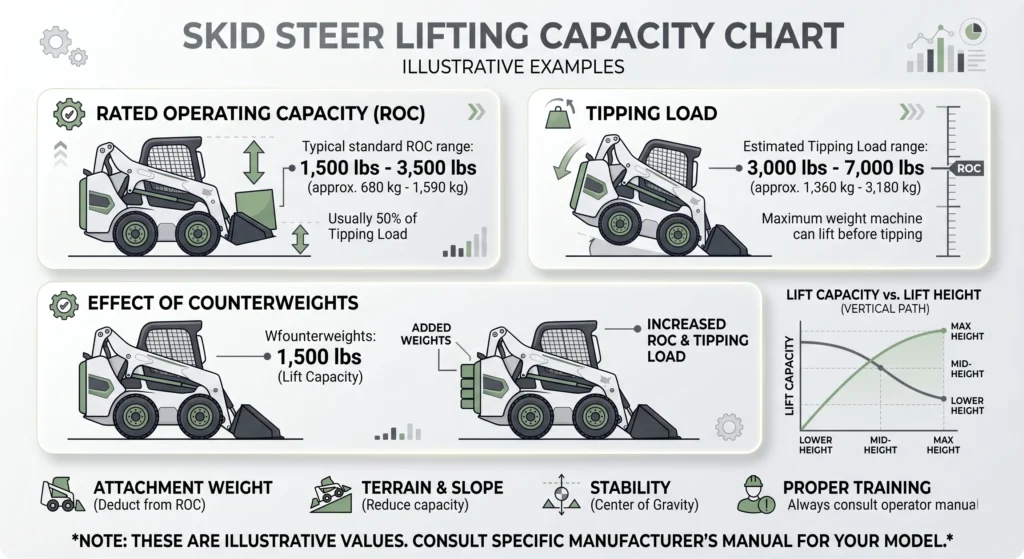
Skid steer lifting capacity refers to the maximum weight a machine can safely lift, carry, and maneuver without tipping or losing stability.
The most important metric used across the industry is:
Rated Operating Capacity (ROC)
- Defined as 50% of the tipping load
- Represents the maximum safe lifting limit
- Standardized across manufacturers
Safety organizations like OSHA recommend always operating within ROC limits to prevent tip-over accidents.
Tipping Load vs ROC
Many beginners confuse these two terms—but the difference is critical:
| Metric | Definition | Importance |
|---|---|---|
| Tipping Load | The weight at which the machine begins to tip forward | Indicates maximum limit |
| Rated Operating Capacity (ROC) | 50% of tipping load | Safe working capacity |
👉 Example:
- Tipping Load = 4,000 lbs
- ROC = 2,000 lbs
This built-in safety margin ensures stability even when operating on uneven terrain.
Skid Steer Lifting Capacity Chart (By Size)
Below is a comprehensive chart based on machine size categories:
| Size Category | ROC (lbs) | Tipping Load (lbs) | Horsepower | Typical Use |
|---|---|---|---|---|
| Small Frame | 1,200 – 1,750 | 2,400 – 3,500 | < 50 HP | Landscaping, residential jobs |
| Medium Frame | 1,750 – 2,200 | 3,500 – 4,400 | 50–75 HP | Agriculture, grading |
| Large Frame | 2,200 – 4,000+ | 4,400 – 8,000+ | 75–100+ HP | Heavy construction |
Industry platforms like BigRentz and DOZR confirm that most skid steers fall within these ranges.
Skid Steer Lifting Capacity Chart (By Brand & Model)
Different manufacturers engineer machines with varying lifting capabilities. Here’s a comparison of popular models:
| Brand | Model | ROC (lbs) | Tipping Load | Lift Type |
|---|---|---|---|---|
| Bobcat Company | S650 | ~2,690 | ~5,380 | Vertical |
| Caterpillar Inc. | 262D | ~2,700 | ~5,400 | Vertical |
| John Deere | 332G | ~3,600 | ~7,200 | Vertical |
| Kubota | SSV75 | ~2,690 | ~5,380 | Vertical |
| CASE Construction Equipment | SR210 | ~2,100 | ~4,200 | Radial |
👉 Key takeaway:
- Larger machines = higher ROC
- Vertical lift models dominate high-capacity lifting
Radial vs Vertical Lift: Which Is Better?
Lift arm design plays a major role in lifting performance.
Vertical Lift
- Maximum height reach
- Best for loading trucks and stacking
- Higher stability at full extension
Radial Lift
- Strong mid-range lifting
- Better for digging and grading
- Lower cost and simpler design
Manufacturers like Caterpillar Inc. design vertical lift machines specifically for heavy lifting applications.
Factors That Affect Skid Steer Lifting Capacity
1. Machine Weight
Heavier machines provide better counterbalance and stability, allowing higher lifting capacity.
2. Hydraulic System Performance
- Determines lifting force
- High-flow hydraulics improve efficiency
- Impacts attachment performance
3. Center of Gravity
Improper load placement can drastically reduce lifting capacity and increase tipping risk.
4. Wheelbase and Footprint
A wider base improves stability and load distribution.
5. Lift Height
The higher the load is lifted, the more stability decreases.
6. Attachments
Attachments can significantly reduce effective lifting capacity.
Skid Steer Lifting Capacity with Attachments
Attachments change how weight is distributed and handled.
| Attachment | Effect on Capacity |
|---|---|
| Standard Bucket | Baseline |
| Pallet Forks | -10% to -20% |
| Grapple Bucket | -20% to -30% |
| Auger | Moderate reduction |
👉 Example:
Using pallet forks instead of a bucket may reduce capacity by 15% on average.
Real-World Applications of Lifting Capacity
1. Landscaping Projects
- Small skid steers (ROC ~1,500 lbs)
- Tasks: mulch, soil, debris removal
- Advantage: maneuverability in tight spaces
2. Agriculture & Farming
- Medium skid steers (ROC ~2,000 lbs)
- Tasks: hay bales, feed, fencing materials
Brands like John Deere dominate this segment.
3. Construction & Heavy Duty Work
- Large skid steers (ROC 3,000–4,000+ lbs)
- Tasks: concrete, steel, palletized materials
Machines from Caterpillar Inc. excel in this category.
How to Calculate Skid Steer Lifting Capacity
The standard formula:
ROC = Tipping Load × 0.5
Example:
- Tipping Load = 6,000 lbs
- ROC = 3,000 lbs
⚠️ Always follow manufacturer specifications and safety guidelines from Occupational Safety and Health Administration.
Skid Steer vs Compact Track Loader Capacity
| Feature | Skid Steer | Compact Track Loader |
|---|---|---|
| Lift Capacity | Moderate–High | Higher stability |
| Terrain | Hard surfaces | Soft, muddy terrain |
| Cost | Lower | Higher |
Tracked machines distribute weight more evenly, improving stability and lifting performance.
Safety Guidelines for Skid Steer Lifting
Safety is critical when operating heavy equipment.
Follow these best practices:
- Never exceed ROC
- Keep loads low during movement
- Avoid sudden turns or stops
- Distribute loads evenly
- Ensure proper operator training
Following standards set by Occupational Safety and Health Administration reduces accident risk significantly.
How to Choose the Right Skid Steer Capacity
Selecting the right machine depends on your workload.
Step-by-Step Decision Framework
- Determine maximum load weight
- Add a 20–30% safety margin
- Consider attachment weight
- Evaluate terrain conditions
- Choose lift type (radial vs vertical)
Quick Decision Table
| Job Requirement | Recommended Machine |
|---|---|
| Tight spaces | Small frame |
| Mixed tasks | Medium frame |
| Heavy lifting | Large frame |
Common Mistakes to Avoid
- Using tipping load instead of ROC
- Ignoring attachment weight
- Overloading the machine
- Choosing the wrong lift type
- Not accounting for terrain
Advanced Insights: What Most Contractors Miss?
This is where you outperform competitors.
1. Dynamic Load Behavior
Loads shift during movement, reducing effective capacity.
2. Hydraulic Limitations
Even if weight is within ROC, weak hydraulics can reduce performance.
3. Terrain Impact
Soft or uneven ground lowers real lifting capacity.
4. Operator Skill
Experienced operators can maximize efficiency while maintaining safety.
Frequently Asked Questions
What is the average skid steer lifting capacity?
The average skid steer lifting capacity typically ranges between 1,250 and 4,000 pounds, depending on the machine’s size, design, and manufacturer. Small-frame skid steers are usually on the lower end of this range and are ideal for light-duty tasks like landscaping and residential work. Medium-frame machines offer a balanced capacity for farming and general construction, while large-frame skid steers can handle heavier materials such as concrete, steel, and palletized loads. It’s important to note that lifting capacity is measured using Rated Operating Capacity (ROC), which represents a safe working limit rather than the machine’s maximum tipping point.
Can a skid steer lift 3,000 lbs?
Yes, many skid steers can safely lift 3,000 pounds, but this capability is typically found in large-frame or high-capacity models. Machines from manufacturers like John Deere and Caterpillar Inc. are well-known for producing models in this range. These machines are designed with more powerful hydraulic systems, greater operating weight, and improved stability, allowing them to handle heavy loads efficiently. However, operators must still ensure proper load distribution and stay within the manufacturer’s rated operating capacity to maintain safety.
What skid steer can lift 5,000 lbs?
Skid steers that can lift 5,000 pounds are considered specialized, high-capacity machines and are not part of the standard skid steer range. While most traditional skid steers max out around 4,000 lbs of ROC, certain heavy-duty models—often larger or closer to compact track loaders—can approach or exceed this level under specific conditions. These machines typically feature reinforced frames, advanced hydraulics, and vertical lift designs to maintain stability at higher loads. For jobs requiring consistent lifting at this level, contractors may also consider alternative equipment such as wheel loaders or telehandlers for improved safety and efficiency.
Can a skid steer lift 2,000 lbs?
Yes, lifting 2,000 pounds is well within the capability of most medium-sized skid steers, making it one of the most common lifting thresholds in the industry. These machines are widely used in agriculture, construction, and material handling because they provide a strong balance between power and maneuverability. A skid steer with a 2,000 lb rated operating capacity can handle tasks like moving hay bales, loading trucks, or transporting heavy materials around a jobsite. As always, operators should factor in attachment weight and terrain conditions, as these can slightly reduce the effective lifting capacity in real-world scenarios.
Final Thoughts
A skid steer’s lifting capacity is influenced by multiple factors not just size. Understanding these variables helps you:
- Improve efficiency
- Reduce downtime
- Enhance safety
- Maximize ROI

Ahmed Ijaz runs this construction rental directory with over 5 years of experience in SEO, content, and web optimization. Every page is built using real research, hands-on expertise, and carefully reviewed information to meet strong EEAT standards.